Nigeria's green finance market moved from experimentation to consolidation in 2025, driven by record sovereign bond issuances, subnational climate financing, and growing private-sector participation.
Investor confidence strengthened as regulatory clarity improved and climate-aligned capital flows accelerated.
With new carbon-market initiatives, blended-finance structures, and ESG disclosure reforms on the horizon, 2026 is shaping up as a defining year for Nigeria's climate-finance ambitions.
Green Capital Shapes Nigeria's Climate Future
Nigeria's push for a low-carbon, climate-resilient economy gained fresh momentum in 2025 as green finance moved from policy aspiration to practical implementation.
Faced with rising greenhouse gas emissions, rapid population growth, and mounting climate risks, the country has increasingly turned to sustainable finance as a strategic tool for aligning national development with environmental goals.
Green finance is now central to Nigeria's Energy Transition Plan and its commitment to achieve Net-Zero emissions by 2060.
Progress in 2025, driven by regulatory reforms, sovereign and subnational green bond issuances, and rising participation from domestic and international investors, underscores the increased understanding of the opportunities.
At the same time, macroeconomic pressures and evolving compliance obligations continue to shape the pace and scale of the market.
A review by UDO UDOMA & BELO-OSAGIE (UUBO) examines how Nigeria's green-finance ecosystem matured in 2025 and what trends are likely to define climate investment in 2026.
Green Finance Enters Nigeria's Mainstream
The green finance architecture in Nigeria has expanded steadily over the past decade, through collaboration among government institutions, financial regulators, and private-sector actors.
A major milestone was Africa's first sovereign green bond, issued in 2017, followed by a N15 billion issuance in 2019 that financed 23 climate-aligned projects across Nigeria's Nationally Determined Contribution (NDC) sectors.
In 2025, the Federal Government issued a third sovereign green bond worth N50 billion, targeting renewable energy, clean transportation, water management, and climate adaptation. This confirmed green finance as a permanent fixture in Nigeria's development strategy rather than a niche instrument.
Regulatory foundations supporting this shift include:
- SEC Green Bond Rules (2018), guiding project eligibility, verification, and impact reporting.
- Federal Ministry of Environment Green Bond Framework (2018), aligning bonds with Nigeria's climate priorities.
- Climate Change Act (2021), mandating climate integration into national planning and requiring robust reporting and compliance for climate-related projects.
Together, these frameworks have strengthened investor confidence while shaping how climate-aligned projects are financed and monitored.
2025 Bond Issuances Break New Ground
- Federal Government: Oversubscribed Sovereign Green Bond – Nigeria's Series III Sovereign Green Bond, issued in June 2025, attracted N91.42 billion in subscriptions; 183% above its N50 billion target.
Ultimately, N47.36 billion was allotted at an 18.95% coupon for a five-year tenor, underlining strong investor appetite for climate-aligned debt.
- Lagos State: First Subnational Green Bond – Lagos State advanced subnational climate finance with a N214.8 billion bond programme, including a N14.815 billion green bond, Nigeria's first environmental sustainability bond issued by a state government.
The November 2025 issuance was 97.7% oversubscribed, supporting urban infrastructure, climate-resilient transport, and environmental management projects.
- Private Sector: Growing Corporate Participation – Private-sector issuers increasingly adopted green and sustainability-linked instruments. North South Power continued its N50 billion green bond programme for hydropower expansion, while Access Holdings prepared additional sustainability-linked issuances.
Infrastructure firms such as InfraCredit and CEESOLAR explored green debt to finance distributed renewable energy and water infrastructure projects.
These developments signal a shift from government-led green finance to a more diversified, market-driven ecosystem.
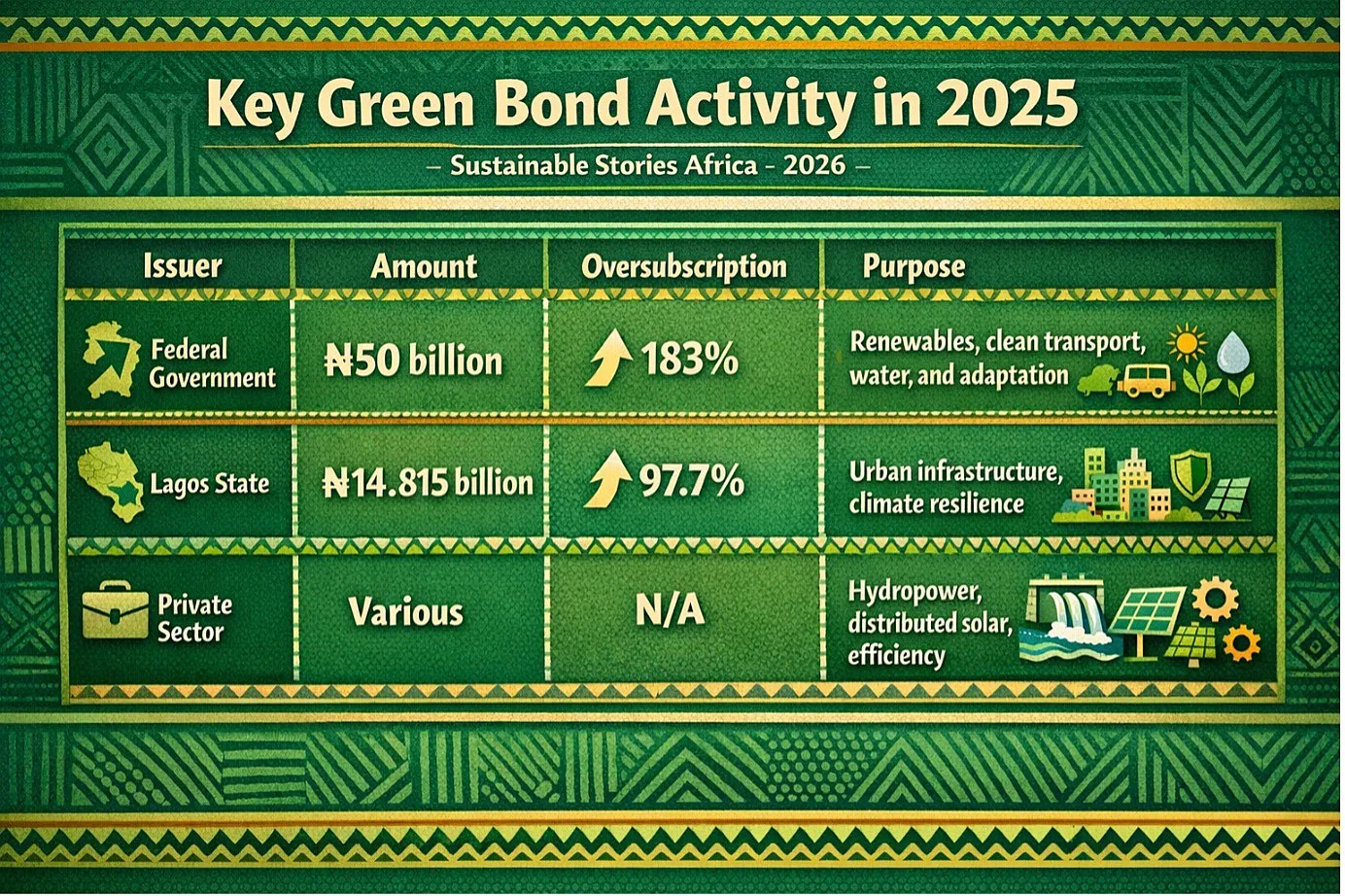
Key Green Bond Activity in 2025
| Issuer | Amount | Oversubscription | Purpose |
|---|---|---|---|
| Federal Government | N50 billion | 183% | Renewables, clean transport, water, and adaptation |
| Lagos State | N14.815 billion | 97.7% | Urban infrastructure, climate resilience |
| Private sector | Various | N/A | Hydropower, distributed solar, efficiency |
Guarantees, Carbon Markets, and Blended Finance
Beyond bonds, Nigeria expanded climate finance tools in 2025 through guarantees, carbon markets, and development finance partnerships.
- Green Guarantee Company (GGC) – Launched with $100 million in capital, GGC aims to unlock up to $1 billion in guarantees for green bonds and loans across emerging markets, with backing from NSIA, FCDO, the Green Climate Fund, USAID, and Norfund.
- Bank of Industry–FSD Africa Partnership – In January 2025, the Bank of Industry partnered with FSD Africa to strengthen climate finance capabilities, develop decarbonisation pathways, and expand adaptation finance programmes.
- Orteva Carbon Project – The Federal Government launched the $100 million Orteva Carbon Project, with projected carbon-credit revenues of between $350 million and $2.8 billion, positioning Nigeria as a hub for African carbon markets.
- Climate Change Fund Activation – Steps were taken to operationalise the National Climate Change Fund (NCCF), expected to unlock blended-finance structures, sustainability-linked loans, and carbon-credit-backed investments.
- International Capital Mobilisation – A $500 million Distributed Renewable Energy Fund, backed by NSIA, SEforALL, Africa50, and the International Solar Alliance, targeted mini-grids, industrial solar, home systems, and energy storage. Meanwhile, the Afrigreen Debt Impact Fund and IFC-backed facilities supported off-grid solar and commercial renewables nationwide.
Blended-finance structures, such as IFC's $80 million naira-denominated facility for Sun King Nigeria, signal the growing collaboration between DFIs and local banks to reduce foreign-exchange risk and expand long-term financing for renewables.
2026 Brings Investors, States, and ESG Reforms
- Deepening Investor Appetite – Institutional investors—including pension funds, insurers, and asset managers—are embedding ESG into mandates. Pension Fund Administrators increased participation in sovereign green bonds, supported by the National Pension Commission, signalling stronger demand for sustainable debt in 2026.
- State-Level Climate Financing – Following Lagos State's success, more states are expected to issue green or sustainability bonds. Gombe State announced plans for a N30 billion green bond to fund infrastructure and climate-smart agriculture, signalling a broader subnational shift in financing.
- ESG Disclosures and Regulatory Convergence – Nigeria is moving toward alignment with global ISSB (IFRS S1/S2) sustainability reporting standards. The SEC's 2025 plans to adopt these frameworks aim to improve ESG transparency, comparability, and investor confidence. Clean-energy reforms under the Electricity Act 2023 may also introduce project-level ESG reporting requirements.
- Financing the Net-Zero Transition – New instruments, including transition bonds, sustainability-linked sukuk, carbon-credit-backed notes, and blended-finance structures, are expected to gain traction. Nature-based solutions such as reforestation and regenerative agriculture could attract increased financing. Nigeria's National Carbon Market Framework and Climate Change Fund are projected to mobilise up to $3 billion annually for climate projects.
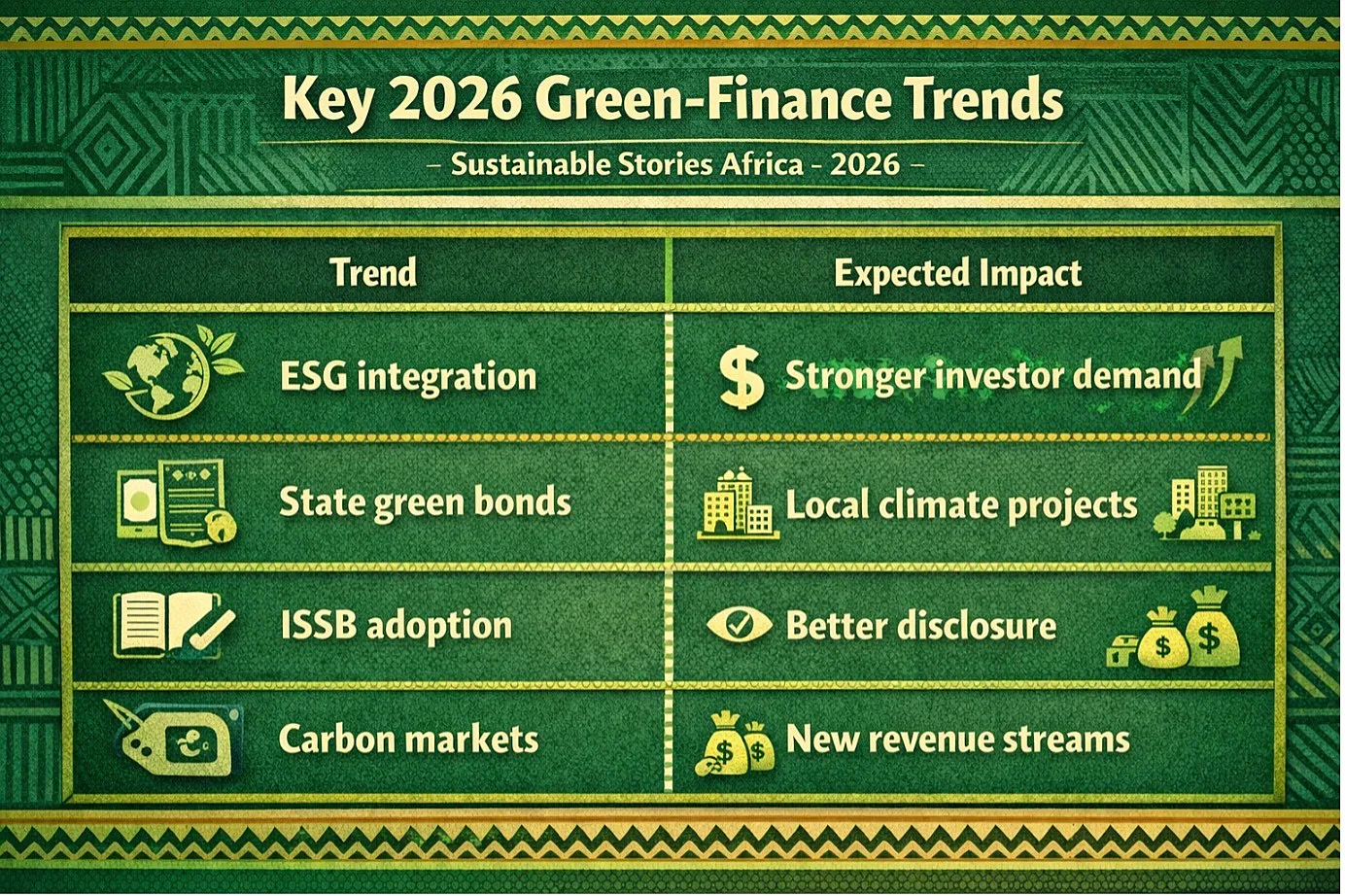
Key 2026 Green-Finance Trends
| Trend | Expected Impact |
|---|---|
| ESG integration | Stronger investor demand |
| State green bonds | Local climate projects |
| ISSB adoption | Better disclosure |
| Carbon markets | New revenue streams |
Path Forward: Scaling Climate Capital
Nigeria's green-finance ecosystem has matured into a structured, diversified market anchored by sovereign bonds, subnational issuances, and private-sector participation.
Guarantees, carbon markets, and blended finance now complement traditional debt instruments.
For Nigeria, 2026 is less about announcing new ambitions and more about doing the hard work: building bankable pipelines, deepening institutional capacity, and lifting the quality of ESG disclosure.
With stronger regulation and active investor engagements, green finance will enable the growth engine of the country's sustainable growth story over the next decade.
Other Potential Opportunities
In December, SSA reported the strategic alliance by FMDQ Group, FSD Africa, FC4SL, Chapel Hill Denham, Kaltani and Abia State Government, which would add to the list provided by UUBO.