South Africa is evaluating its carbon market strategy as global attention returns to Article 6 of the Paris Agreement.
New UN standards could allow the country to expand its Climate Offset Administration System (COAS) beyond removal credits.
If adopted, avoidance credits and nature-based solutions could unlock climate finance, reduce carbon tax burdens, and strengthen South Africa's international climate positioning.
Carbon Markets at a Crossroads
As global leaders' attention returned to Article 6 of the Paris Agreement, the framework governing international carbon markets and climate cooperation. Article 6 enables countries to collaborate on emissions reductions through market and non-market mechanisms, creating new pathways to meet climate commitments.
For South Africa, the stakes are high. While the country already operates a carbon tax system supported by the Climate Offset Administration System (COAS), its current rules restrict companies to removal credits such as reforestation and renewable energy projects.
Avoidance credits
Avoidance credits, which prevent emissions from occurring, remain excluded.
KPMG's thought-leadership report argues that recent international developments under Article 6 could allow South Africa to expand COAS, opening the door to broader climate investment, nature-based solutions, and stronger alignment with global carbon markets.
Global Rules Reshape Local Carbon Markets
Article 6 is divided into three cooperation mechanisms:
- Article 6.2 – Bilateral trading of Internationally Transferred Mitigation Outcomes (ITMOs).
- Article 6.4 – An UN-supervised carbon credit market (Sustainable Development Mechanism).
- Article 6.8 – Non-market cooperation, such as technology transfer and capacity building.
These mechanisms enable countries to trade verified emissions reductions or cooperate on climate projects without direct financial transactions.
For South Africa, this could mean selling emissions reductions to other countries or developing internationally certified projects.
Why COAS Limits Business Participation
South Africa's carbon tax, introduced in 2019, allows companies to offset tax liabilities by investing in approved climate projects through COAS.
However, only removal projects, such as reforestation, are currently eligible. Avoidance credits, which prevent emissions through conservation or efficiency, are excluded.
This restriction limits South Africa's ability to leverage its natural assets:
- Land conservation
- Soil health improvement
- Wetland preservation
These projects prevent emissions and generate high-quality carbon credits; however, they remain ineligible for domestic tax offsets. As a result, companies miss both financial and climate-impact opportunities.
Article 6 Unlocks New Climate Value
In October 2024, the Article 6.4 Supervisory Body finalised international standards for both avoidance and removal credits, emphasising environmental integrity and rigorous verification.
If South Africa aligns COAS with these standards, businesses could invest in:
Where South African Businesses can invest by aligning with COAS
| Project Type | Climate Benefit | Economic Opportunity |
|---|---|---|
| Land conservation | Prevents deforestation | Carbon credit revenue |
| Methane capture | Cuts potent emissions | Waste-to-value projects |
| Energy efficiency | Avoids industrial emissions | Operational cost savings |
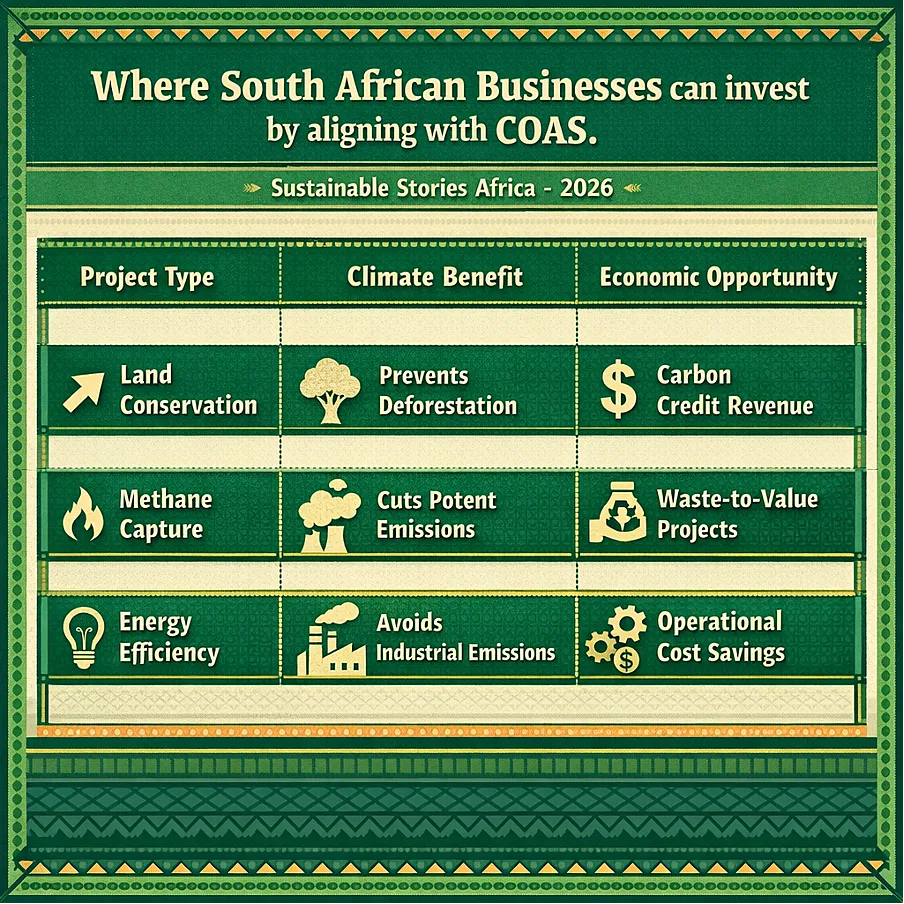
This would enable companies to claim carbon tax relief and trade credits internationally, expanding South Africa's role in global carbon markets.
Nature-Based Solutions Drive Dual Impact
South Africa's diverse ecosystems make nature-based solutions (NBS) particularly valuable for both avoidance and removal credits:
Value of Nature-Based Solutions
| NBS Category | Avoidance Impact | Removal Impact | Co-Benefits |
|---|---|---|---|
| Forest conservation | Prevents carbon loss | Reforestation captures CO₂ | Biodiversity, tourism |
| Sustainable agriculture | Reduces soil emissions | Builds soil carbon | Food security |
| Wetland restoration | Prevents degradation | Enhances carbon sinks | Water quality |
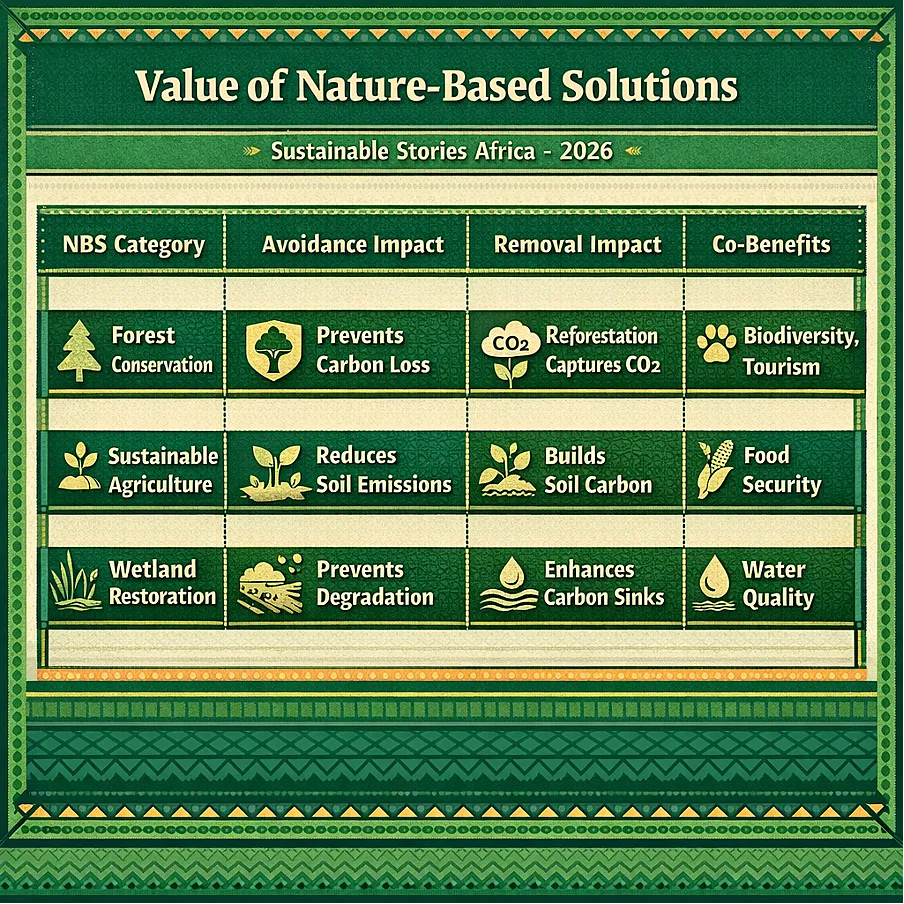
KPMG argues that investing in NBS enables businesses to generate revenue, strengthen ecosystems, and support community development, while aligning with both national and international climate goals.
PATH FORWARD – Aligning Markets with Climate Integrity
South Africa's carbon market is at a strategic turning point. By aligning COAS with Article 6 standards, the country can unlock avoidance credits, attract climate finance, and expand the use of nature-based solutions.
With the right policy adjustments, businesses can reduce carbon tax exposure, generate verified credits, and contribute to long-term climate resilience.