Limiting warming to 1.5°C could require allocating up to 13% of global high-biodiversity areas to land-intensive carbon removal.
A new multi-model study warns that large-scale forestation and bioenergy with carbon capture may collide with conservation goals.
For low- and middle-income countries, the overlap is sharper, raising urgent questions about equity, land governance and climate strategy design.
Land, Carbon and Biodiversity at a Crossroads
Deep climate mitigation pathways increasingly depend on land.
But whose land and at what ecological cost?
A new study in Nature Climate Change assesses the biodiversity implications of land-intensive carbon dioxide removal (CDR), including forestation and bioenergy with carbon capture and storage (BECCS). Across five integrated assessment models, researchers find that pathways aligned with 1.5°C could allocate up to 13% of global areas of high biodiversity importance to land-intensive CDR.
The findings highlight a structural tension at the heart of climate policy: carbon removal may reduce warming-related biodiversity loss; however, its land footprint could simultaneously threaten the very ecosystems climate action seeks to protect.
Climate Mitigation Meets Biodiversity Limits
Modelled 1.5°C pathways increasingly deploy gigatonnes of carbon removal via forest expansion and bioenergy crops.
However, the study shows that in ambitious mitigation scenarios, up to 11% of remaining climate refugia may overlap with forestation and around 4% with BECCS.
While avoiding warming could conserve up to roughly 25% of refugia loss under certain assumptions, this benefit depends heavily on whether ecosystems recover after temperature overshoot.
The implication is that CDR is not automatically positive for biodiversity.
Global Models, Uneven Impacts
The study integrates five major models, AIM, GLOBIOM, IMAGE, GCAM and REMIND-MAgPIE, to map overlaps between CDR land use and biodiversity hotspots.
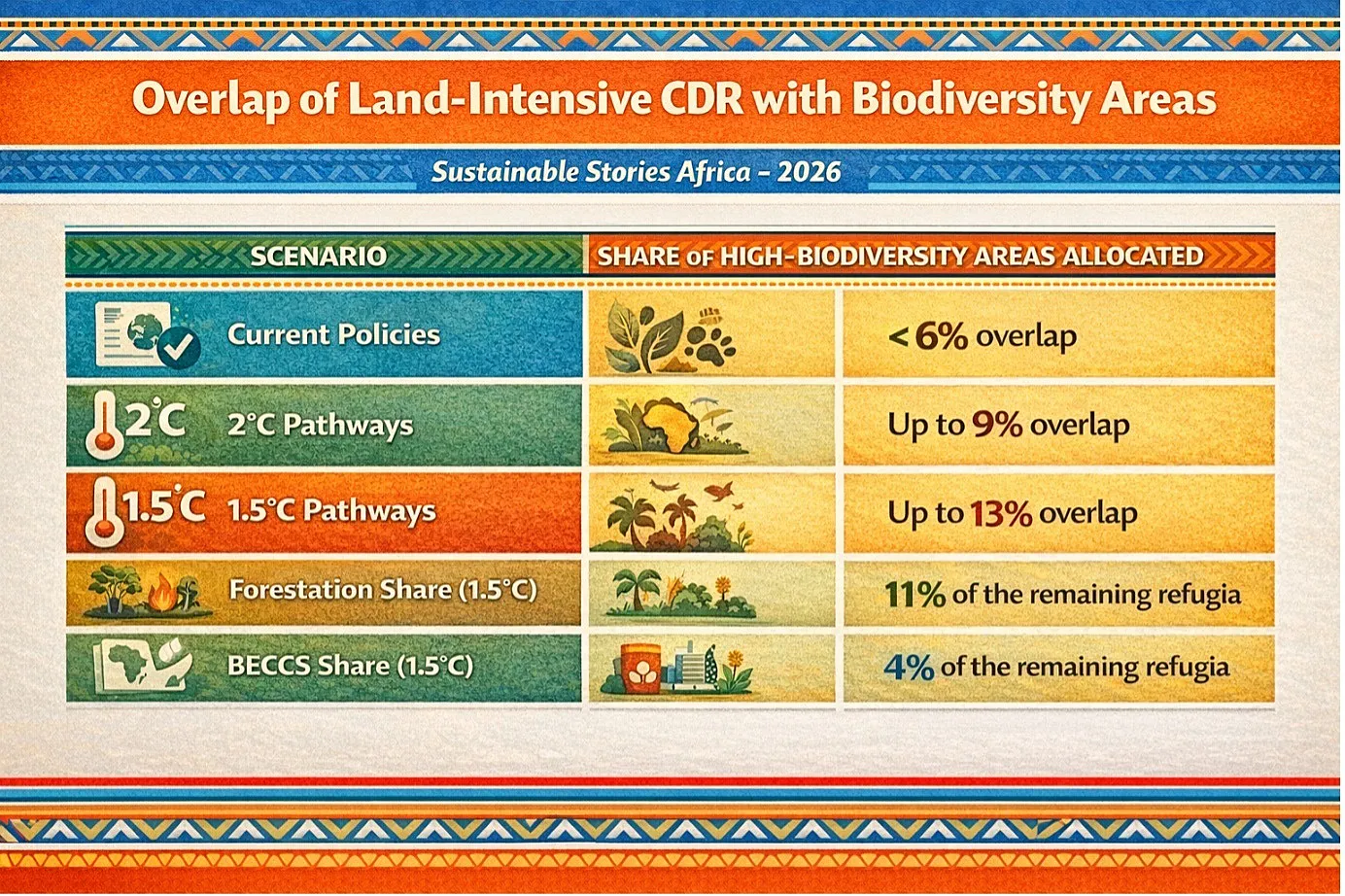
Overlap of Land-Intensive CDR with Biodiversity Areas
Scenario | Share of High-Biodiversity Areas Allocated |
|---|---|
Current Policies | <6% overlap |
2°C Pathways | Up to 9% overlap |
1.5°C Pathways | Up to 13% overlap |
Forestation Share (1.5°C) | 11% of the remaining refugia |
BECCS Share (1.5°C) | 4% of the remaining refugia |
Notably, non-Annexe I countries, largely low- and middle-income economies, face higher relative allocations of climate refugia for forestation (up to 15%) compared to Annexe I nations (around 7%).
This reflects a dual inequity: countries least responsible for emissions may shoulder disproportionate biodiversity trade-offs.
Spatial consensus mapping reveals recurring CDR, such as biodiversity overlap zones in Eastern China, parts of the US, West Africa (for BECCS) and Indo-Pacific states.
Designing Synergies, Avoiding Trade-Offs
The study stresses that CDR is not inherently harmful. Restoring degraded ecosystems with diverse native species could deliver carbon sequestration and biodiversity gains simultaneously.
However, poorly designed forestation, especially monoculture plantations or conversion of natural grasslands, can reduce ecosystem resilience and species richness.
Biodiversity-Constrained CDR Availability (SSP2-26)
Exclusion Criterion | Reduction in CDR Land Availability |
|---|---|
Excluding current biodiversity hotspots | >50% unavailable by 2050 |
Excluding 1.8°C-resilient refugia | Significant constraint |
Excluding resilient biodiversity hotspots | Substantial constraint |
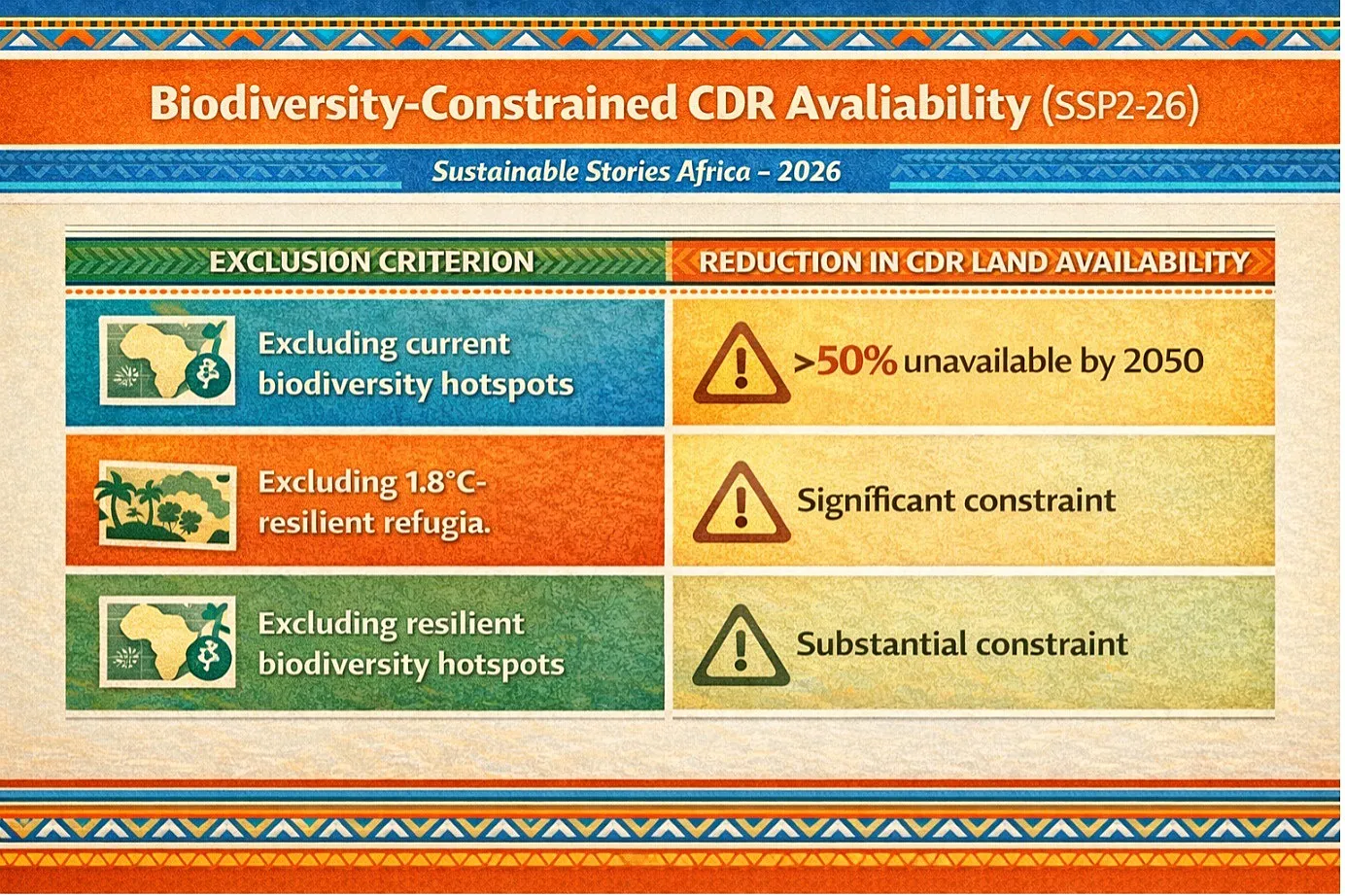
Strictly enforcing biodiversity conservation goals could render over half of planned forestation and BECCS land unavailable by mid-century.
However, alternative pathways exist, diversified CDR portfolios, greater emphasis on ecosystem restoration, and accelerated near-term emissions reductions to limit dependence on land-intensive removal.
Rethinking Carbon Removal Portfolios
The research suggests three strategic shifts:
- Prioritise restoration over expansion, focusing on degraded lands rather than intact ecosystems.
- Diversify CDR technologies, reducing reliance on land-intensive options.
- Increase biodiversity finance flows, particularly toward non-Annexe I countries facing disproportionate land pressure.
Without such recalibration, climate mitigation could trigger “environmental problem shifting,” solving one crisis while intensifying another.
Path Forward – Aligning Carbon and Conservation Goals
Future mitigation pathways must embed biodiversity constraints directly into modelling frameworks. Protecting high-integrity ecosystems while targeting degraded lands for restoration can reduce conflict.
Ultimately, limiting overshoot and cutting gross emissions rapidly will reduce dependence on land-intensive CDR, easing pressure on biodiversity while preserving carbon sinks for long-term resilience.