Each one-percentage-point rise in the share of people over 65 reduces national water use by 2.17%.
That is the headline finding from a global study covering 168 countries. For Africa, the world’s youngest continent, the numbers raise a more complex question: what happens to water demand in a region that is not ageing, but expanding?
Demography Is Rewriting Water Economics
Population ageing is usually discussed in terms of pensions, healthcare costs, and labour shortages. Rarely is it framed as a water story.
However, a global analysis spanning 1987–2018 reveals a consistent, statistically robust pattern: countries with rising elderly populations tend to withdraw less water overall.
Across 168 nations, ageing independently explains a meaningful share of the decline in total water withdrawal (TWW), even after controlling for GDP, total population, and youth share.
Globally, this suggests a structural demographic dividend for water security. But Africa’s demographic profile, youthful, urbanising, and expanding, positions the continent on a different trajectory. The real question is not whether ageing reduces water demand. It is whether Africa can achieve water efficiency without waiting to age.
Demography Is Reshaping Water Demand
The central finding is clear.
A 1%-point increase in the population aged 65 and over reduce 2.17% the total water withdrawal. Projections indicate that by 2050, global ageing could reduce water use by between 15% and 31% under various SSP scenarios.
The statistical robustness is notable. Across 15 regression specifications, placebo reshuffling tests, Monte Carlo simulations, and instrumentally variable checks, the ageing effect remains consistently negative and significant.
The world may be entering an era where demographic transition quietly offsets water stress.
But that is not Africa’s immediate story.
Why Ageing Lowers Water Withdrawal
The research disaggregates impacts across sectors.
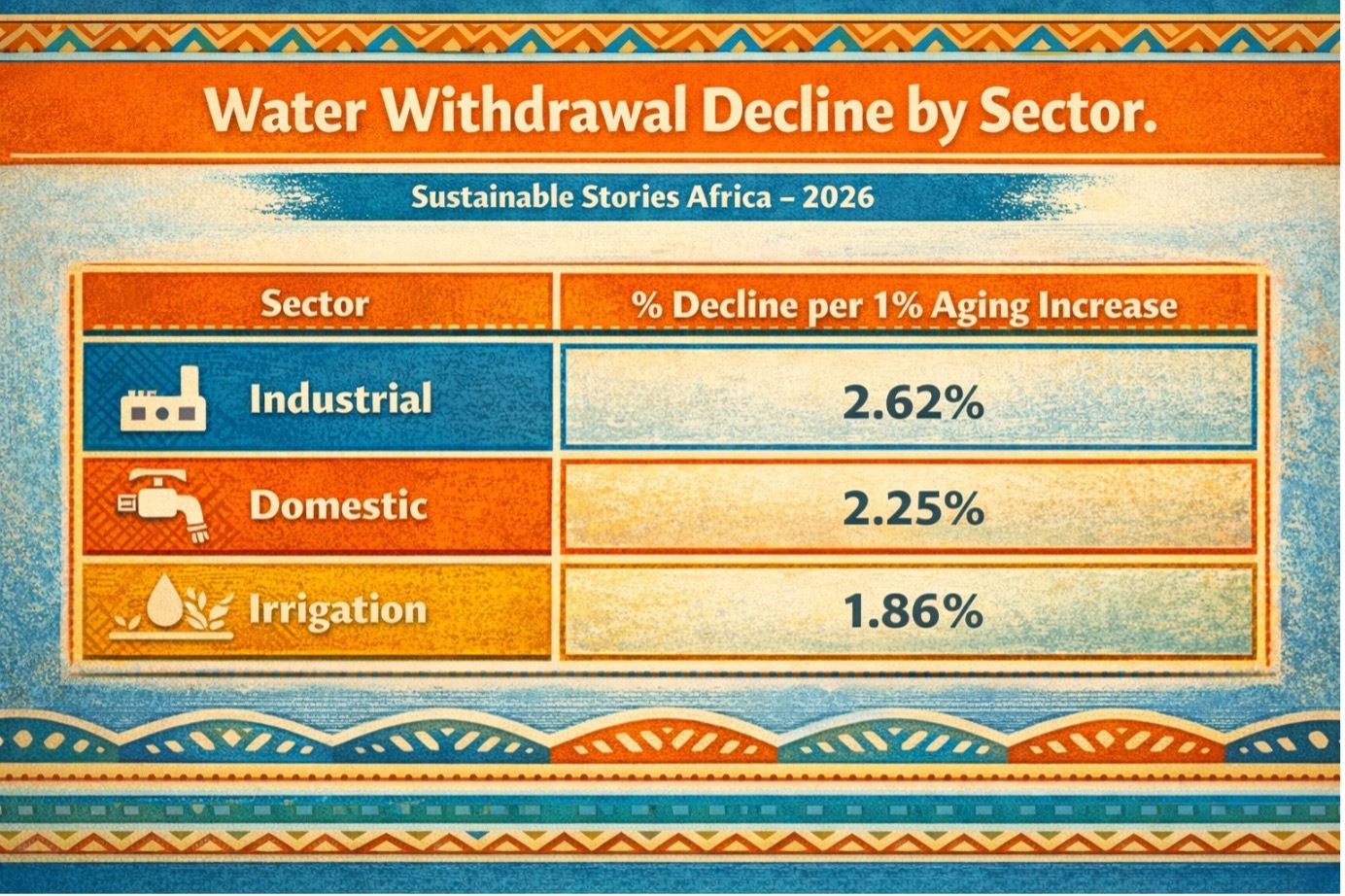
Water Withdrawal Decline by Sector
Sector | % Decline per 1% Aging Increase |
|---|---|
Industrial | 2.62% |
Domestic | 2.25% |
Irrigation | 1.86% |
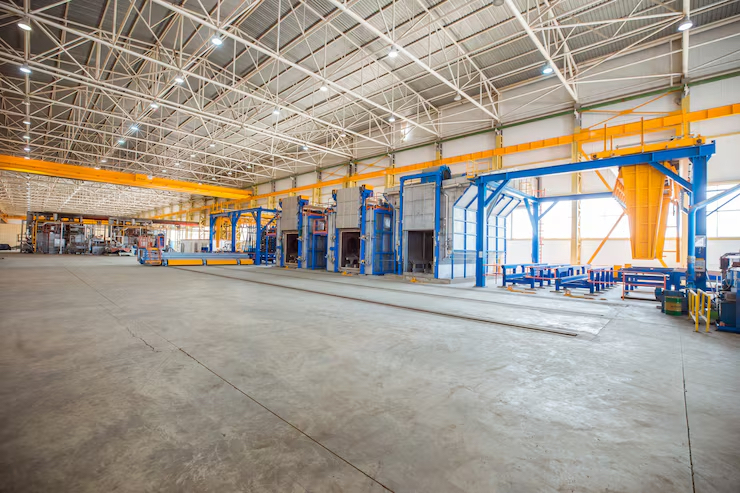
Industrial water demand falls most sharply. Ageing societies tend to:
- Experience labour force contraction
- Shift toward service-based economies
- Adopt automation and water-efficient technologies
Manufacturing intensity declines, and water use falls with it.
Domestic demand drops more modestly. Basic water needs remain relatively stable. Irrigation responds least, driven more by climate and crop patterns than age structure.
The mechanism is structural, not behavioural alone.
Africa’s Divergent Demographic Path
Africa’s population remains overwhelmingly young. Many countries have below 5% of elderly people. Urbanisation, industrialisation, and rising incomes are expanding water demand, not contracting it.
The continent faces:
- Expanding municipal demand
- Industrial catch-up ambitions
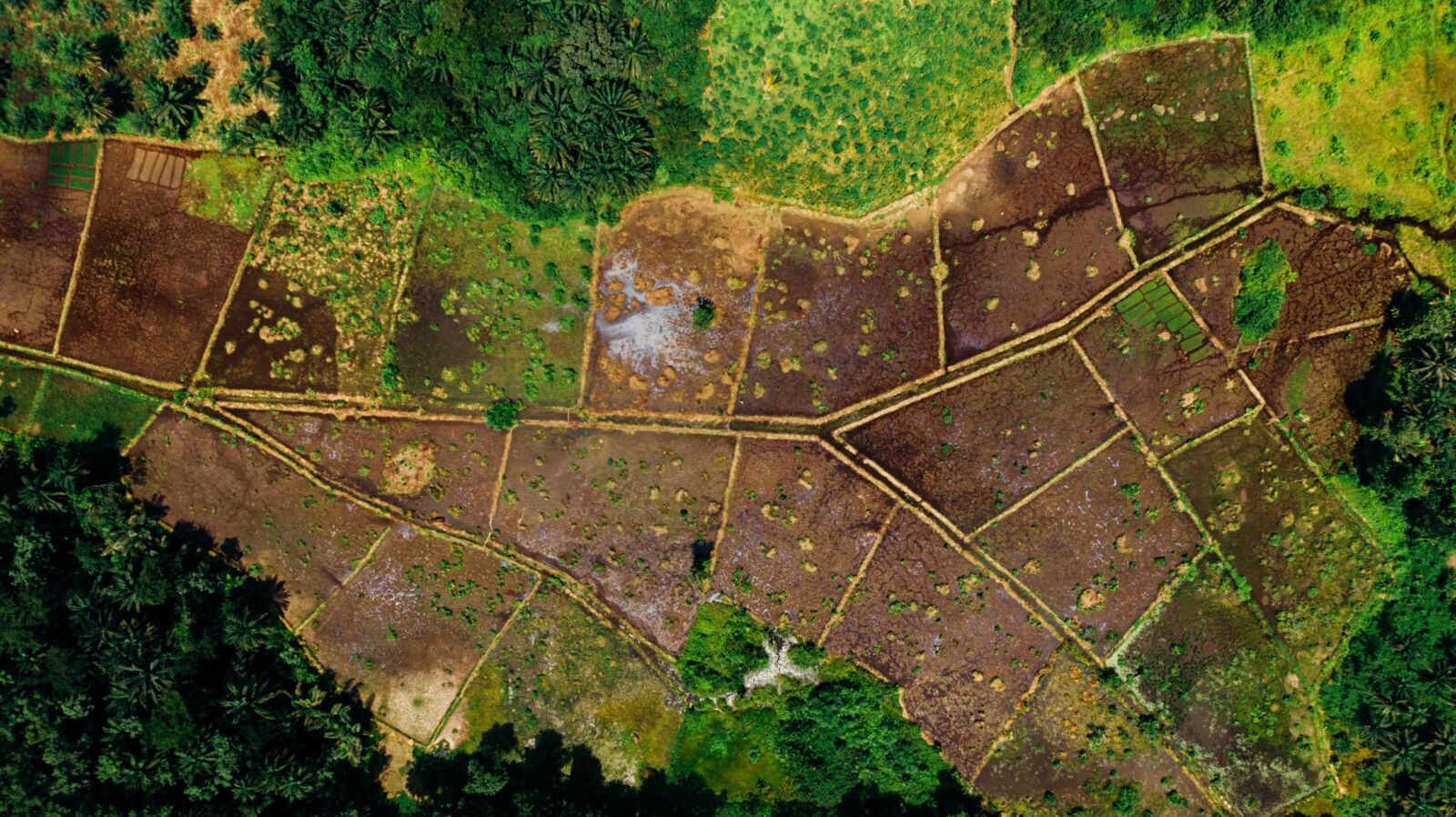
- Agricultural intensification
- Climate variability pressures
Where ageing economies may see structural water decline, Africa’s demographic momentum implies structural growth.
Socioeconomic Moderators Matter
The study also finds that the magnitude of aging’s water effect varies by context .
In countries with higher:
- Education levels
- Sanitation access
- Income per capita
- Freshwater availability
…the ageing effect weakens.
Efficiency and infrastructure matter as much as demography.
This is the key African insight: water outcomes are shaped by institutional quality and sectoral composition, not age alone.
Efficiency Without Waiting to Age
The positive takeaway is structural.
Water use declines when economies:
- Move toward services
- Increase technological intensity
- Improve infrastructure efficiency
- Embed conservation norms
Africa does not need to age to benefit from this pattern.
Consider the possibilities:
- Smart irrigation systems reducing withdrawal intensity
- Water-efficient manufacturing standards
- Urban design limiting leakage
- Digital monitoring of industrial consumption
The water dividend seen in ageing economies can be engineered through policy.
Build Water Efficiency Into Growth
Africa’s water strategy should integrate demographic foresight.
- Design Industrial Policy Around Water Intensity – Industrial expansion must encourage efficiency from inception.
- Integrate Age Structure into Water Forecasts – Water planning should incorporate demographic composition, not just population totals.
- Accelerate Infrastructure Modernisation – Reducing leakage, upgrading sanitation, and improving irrigation systems can moderate demand growth.
Demographic Water Pathways
Region Type | Demographic Trend | Water Demand Outlook |
|---|---|---|
Aging Economies | The rising elderly share | Structural decline |
Youthful Economies | Population expansion | Structural increase |
Efficient Systems | High institutional capacity | Moderated demand |
Inefficient Systems | Infrastructure gaps | Escalating stress |
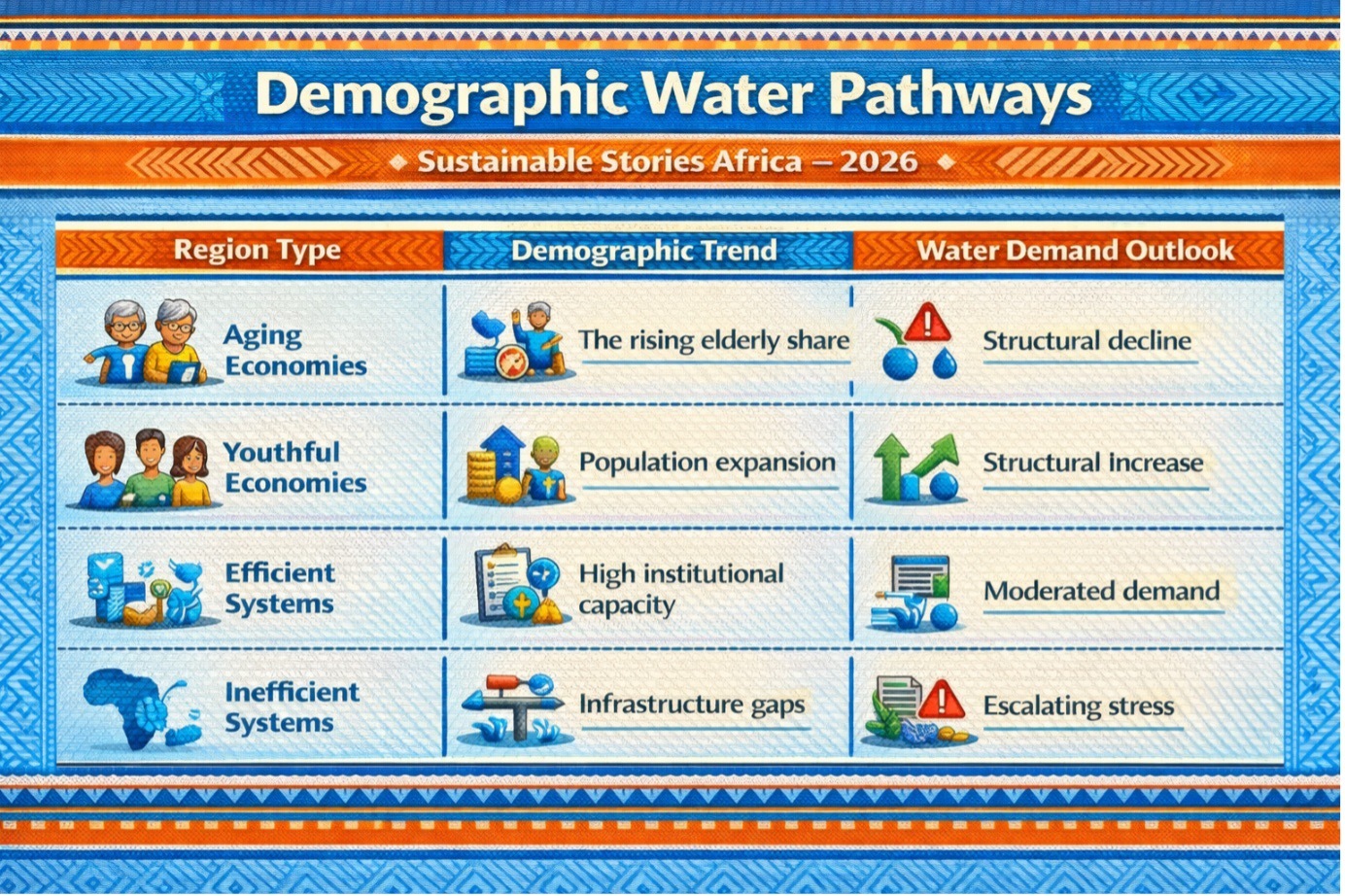
Africa’s trajectory will depend on which column dominates.
PATH FORWARD – Efficiency Before Demography Shifts
Global ageing may ease water pressure elsewhere. Africa’s demographic expansion will test water systems for decades to come.
The strategic response is clear: build efficiency now. If policy, infrastructure, and industrial design align early with water-intensity targets, Africa can grow without inheriting the water stress of past industrial models.