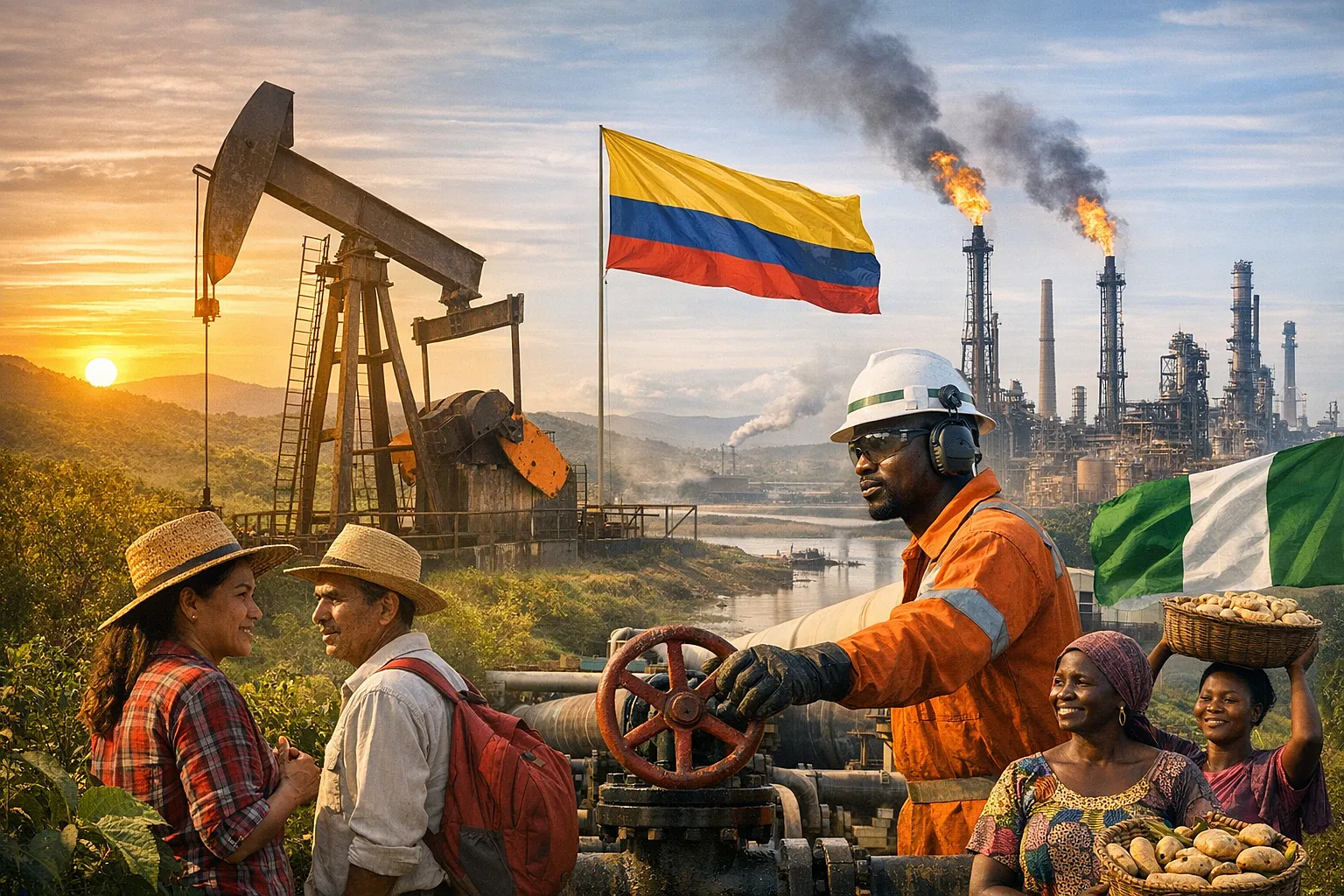
Despite pledging support for the Paris Agreement, Colombia and Nigeria continue to justify expanding oil and gas production through powerful national narratives.
These storylines, framed around development, energy security, and transition needs, risk locking both countries into high-carbon futures at a time when global climate targets demand rapid fossil-fuel phase-outs.
Narratives driving fossil fuel dependence
Colombia and Nigeria stand at a crossroads. Both countries publicly support the Paris Agreement and acknowledge the urgency of climate action. This is according to the Stockholm Environment Institute brief, in December 2024.
However, both continue to promote oil and gas expansion as central to their development strategies.
Behind these policy choices lie powerful national narratives, carefully constructed stories that frame fossil fuels as essential for prosperity, energy security, and even climate transitions.
These narratives shape how governments justify new exploration, infrastructure, and long-term reliance on hydrocarbons.
The problem is that many of these arguments are built on outdated assumptions, selective evidence, and oversimplified claims.
As global climate science makes clear, fossil fuel production must fall sharply by about 6% per year from 2020 to 2030 to keep warming below 1.5°C. Current government plans, however, still point toward expansion rather than phase-out.
Fossil fuel stories versus climate reality
Scientists warn that meeting global climate targets requires a steep decline in fossil fuel production. However, governments worldwide still plan to extract more than double the amount of fossil fuels in 2030 than is consistent with a 1.5°C pathway. Colombia and Nigeria are no exception.
Despite their climate pledges, both countries continue to defend oil and gas expansion using persuasive national narratives. These stories frame fossil fuels as indispensable for development, energy security, and even the energy transition itself.
Such narratives matter. They influence public opinion, shape policy priorities, and justify long-term investments that risk locking economies into high-carbon pathways for decades.
The three shared fossil fuel narratives
Between December 2015 and May 2022, the governments of Colombia and Nigeria used three main narratives to justify oil and gas expansion, despite their Paris Agreement commitments.
The Story Told
| Narrative | Core Claim | Policy Implication |
|---|---|---|
| Development | Oil and gas revenues drive national growth and social programmes | Continued exploration and fiscal dependence |
| Energy security | Fossil fuels ensure stable, affordable domestic energy | Prioritising hydrocarbons over renewables |
| Energy transition | Gas is a "bridge fuel" to a low-carbon future | New gas infrastructure investments |
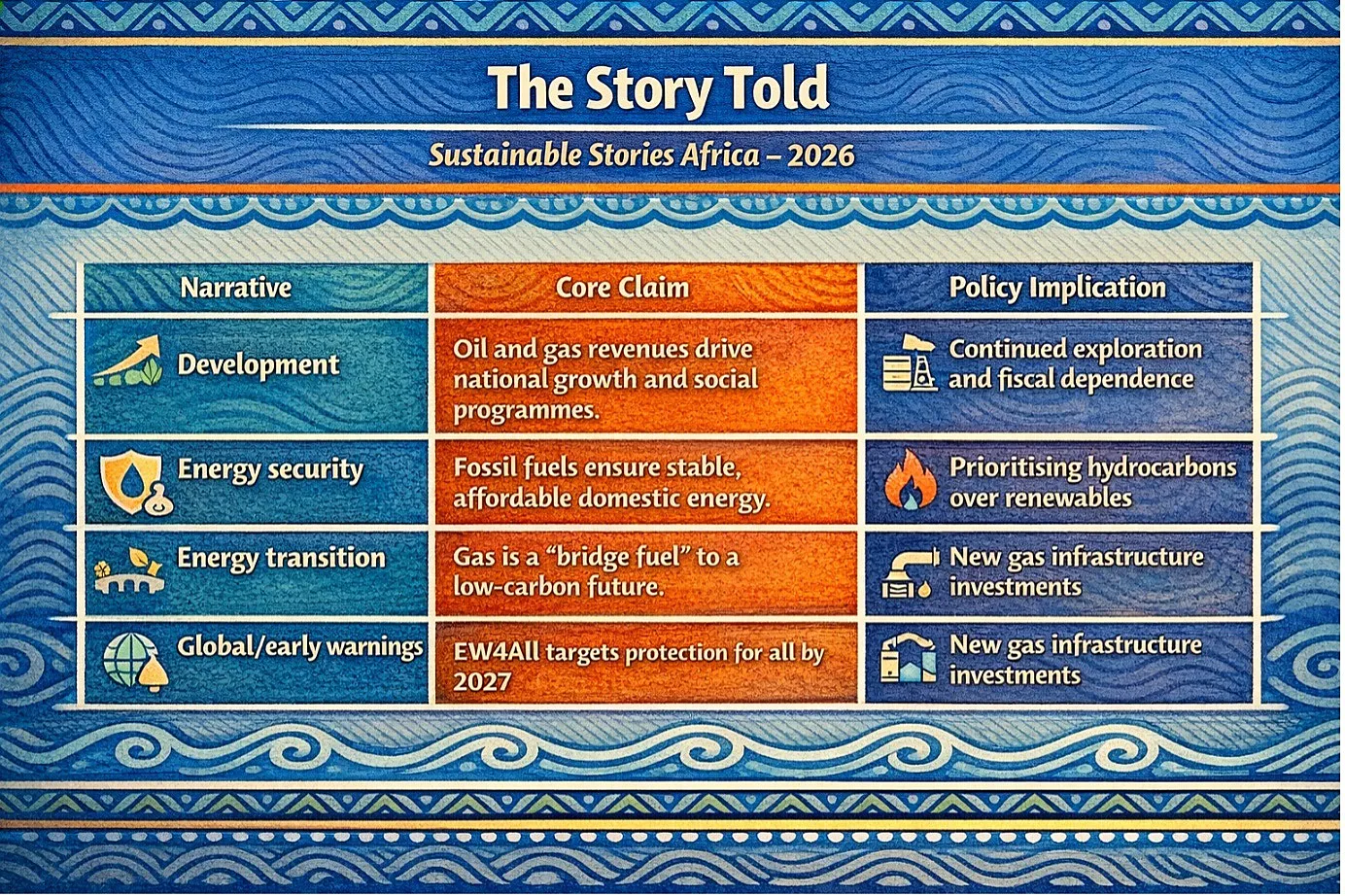
In Nigeria, a fourth narrative also plays a role: oil and gas production as a symbol of regional influence and international status.
- Development narrative – In Colombia, fossil fuel revenues were linked to funding the 2016 peace agreement, post-COVID recovery, and regional development. In Nigeria, gas production was framed as key to industrialisation and economic growth.
- Energy security narrative – Both governments argued that domestic oil and gas protect against energy shortages, reduce import dependence, and offer a more reliable supply than renewables.
- Transition narrative – Oil and gas were portrayed as compatible with climate goals through efficiency improvements, emissions reductions, carbon offsets, and carbon capture technologies. Gas was framed as a "bridge" to renewables.
Why these narratives could be misleading
The research shows that many of these narratives rely on one-sided, inaccurate, or outdated assumptions.
Myth 1: Fossil fuels guarantee inclusive development
While oil and gas can boost national revenues, historical evidence shows mixed results for inclusive growth. Resource wealth often leads to:
- Unequal revenue distribution
- Local environmental harm
- Economic volatility
- Weak local value creation
Communities near extraction sites frequently bear the costs without sharing the benefits.
Myth 2: Fossil fuels ensure energy security
Renewables also strengthen energy security by:
- Reducing import dependence
- Lowering electricity price volatility
- Enabling faster deployment
- Expanding access in remote areas
However, traditional energy-security metrics often ignore these advantages, reinforcing fossil-fuel bias.
Myth 3: "Low-carbon" oil and gas are compatible with 1.5°C
Even with reduced flaring and methane leaks, most emissions occur when fossil fuels are burned. Research shows that meeting climate targets requires by 2050:
- 99% reduction in coal
- 70% reduction in oil
- 84% reduction in gas
No realistic carbon-capture scenario allows continued large-scale fossil fuel use.
Myth 4: Gas is a safe transition bridge
The "bridge fuel" narrative often avoids key questions:
- Where does the bridge end?
- When does the phase-out begin?
Instead, it encourages new pipelines, LNG terminals, and gas plants that prolong fossil dependence and divert investment from renewables.
How narratives create carbon lock-in
By legitimising new fossil fuel infrastructure, these narratives contribute to carbon lock-in, a system where political, technical, and economic barriers entrench fossil fuel use.
Examples include:
- Nigeria's LNG and gas pipeline expansion
- Colombia's revised royalty system favours extractive regions
- Continued fiscal reliance on oil and gas revenues
Such policies increase the risk of stranded assets as global fossil fuel demand peaks and declines. They also risk creating "stranded communities", regions economically dependent on industries that may soon shrink.
PATH FORWARD
Challenging fossil fuel narratives
Civil society organisations and researchers play a critical role in countering these narratives. The SEI brief outlines four key strategies:
- Push high-income countries to lead – Wealthier nations with lower fossil dependence must phase out production faster and support developing countries financially.
- Challenge outdated assumptions – Researchers can expose flawed energy-security claims, overstated development benefits, and unrealistic decarbonisation scenarios.
- Demand transparency – Governments and companies should disclose emissions, spending, climate risks, and fossil-fuel subsidies.
- Promote alternative futures – Civil society can build compelling narratives around renewable energy, green jobs, and inclusive development beyond fossil fuels.
Rewriting the future energy story
Narratives shape reality. In Colombia and Nigeria, fossil fuel storylines have helped sustain political support for continued oil and gas expansion, even as climate science calls for rapid phase-outs.
These narratives may offer short-term reassurance, but they carry long-term risks: stranded assets, economic vulnerability, environmental harm, and missed opportunities for clean-energy leadership.
A just and credible energy transition requires more than new technologies. It requires new stories, ones grounded in evidence, equity, and the promise of sustainable prosperity beyond fossil fuels.