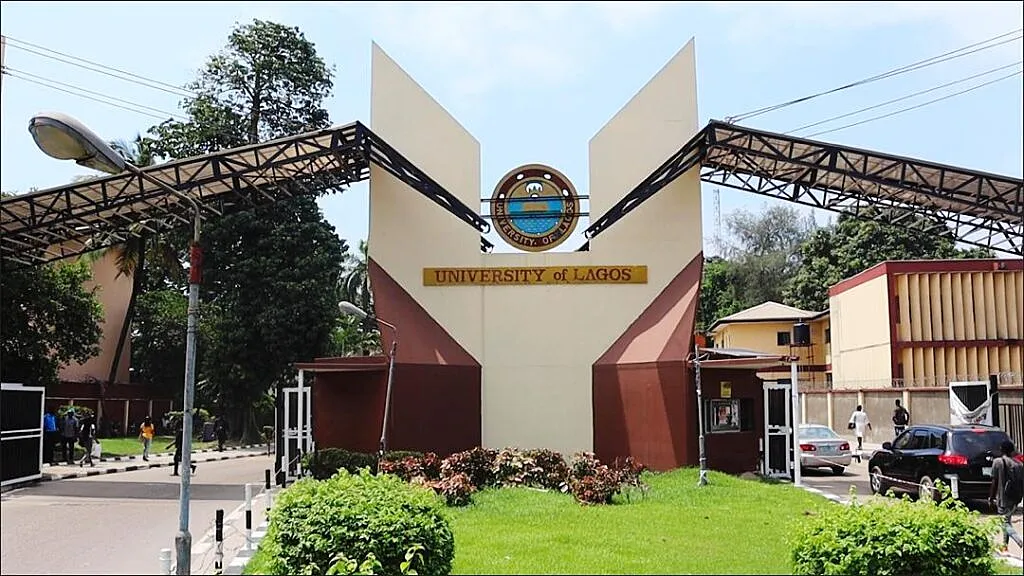
The University of Lagos (UNILAG) is positioning itself not just as a teaching institution, but as a sustainability engine for Nigeria's future.
Its 2024–2026 SDG Report outlines how research, operations and community engagement are being recalibrated around the United Nations' 2030 Agenda.
From solar-powered campus transport to gender equity research across Africa's creative sector, UNILAG's strategy signals a deeper shift: universities are no longer observers of development, they are active architects of it.
UNILAG's SDG Blueprint for National Transformation – A Campus Rewriting Nigeria's Future
Across Africa, universities are increasingly being judged by rankings and relevance. In Lagos, Nigeria's commercial capital, UNILAG is making a deliberate case that higher education must sit at the centre of sustainable development.
Its Sustainable Development Goals Report 2024–2026 sets out a structured alignment with the United Nations' 2030 Agenda, framing sustainability as an institutional responsibility, not a peripheral project.
With over 52,000 students and a reputation as one of Africa's leading public universities, UNILAG's SDG roadmap presents a microcosm of how Nigerian institutions can embed climate action, inclusion, innovation and economic growth into their core mandate.
Universities as Engines of Sustainable Change
When the United Nations adopted the 17 Sustainable Development Goals (SDGs) in 2015, governments were placed at the forefront of delivery. However, a decade later, it is increasingly clear that universities will determine whether those goals translate into lived reality.
UNILAG's report highlights that higher education institutions are "drivers of knowledge, innovation and leadership" and must integrate sustainability across teaching, research, operations and community engagement.
The message is simple but consequential: academia must move from commentary to implementation.
Translating Global Goals into Local Action
UNILAG's SDG strategy is structured around concrete interventions across poverty reduction, food security, health, gender equality, energy transition and industrial innovation.
- Ending Poverty Through Access and Entrepreneurship – With over 30,000 full-time students receiving financial aid support, the university has expanded scholarships and revitalised its work-study programme.
- Its Entrepreneurship and Skills Development Centre (ESDC) supports student-led ventures, positioning enterprise as a poverty alleviation tool.
- The model reflects SDG 1's mandate to "leave no one behind".
- Food Security and Agricultural Innovation – Through partnerships such as GAIN and its on-campus UNILAG Farm, the institution is addressing food quality and nutrition.
A Professor of Aquaculture Nutrition highlighted that over 821 million people globally face hunger, reinforcing the urgency of circular agricultural systems.
Food security, in this framing, becomes both a research agenda and a campus operations priority.
- Health Systems and Digital Care – UNILAG's Medical Centre has introduced telemedicine booths enabling virtual consultations. Equipped with essential medical devices and medications, the system reduces waiting times and expands access to healthcare.
In parallel, genomics research at the D.K. Olukoya Central Research Laboratories is advancing personalised healthcare solutions in West Africa.
- Energy Transition and Clean Mobility – Few developments illustrate operational alignment with SDG 7 more vividly than UNILAG's commissioning of 20 solar-powered electric vehicles in December 2024.
Complemented by research from the Energhx Research Group and a 1,000-tree afforestation drive, the campus is experimenting with real-time decarbonisation.
- Innovation, Infrastructure and Market Readiness – UNILAG's Innovation-to-Market (I2M) initiative has connected 362 innovators to markets in its first year.
Meanwhile, partnerships such as the MoU with Nord Motors embed industry collaboration into academic training.
This is the Triple Helix model, government, industry and academia, translated into practice.
- Gender Equity and Inclusive Growth – A multi-country research initiative on gender-based inequities in Africa's creative sector (2024–2026) positions UNILAG within continental policy conversations.
At an operational level, its Equal Opportunity Policy promotes inclusive recruitment and anti-discrimination safeguards.
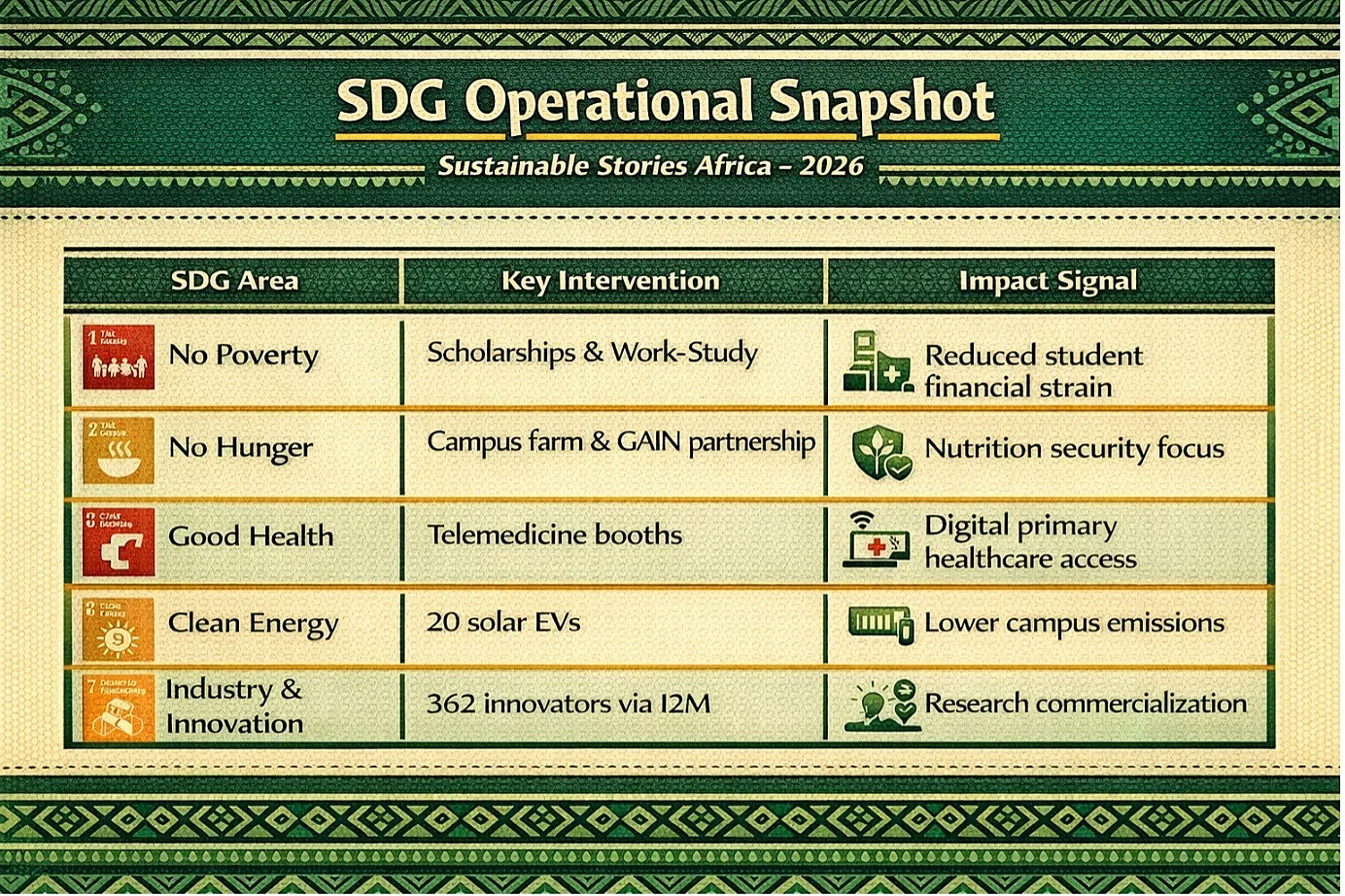
SDG Operational Snapshot
| SDG Area | Key Intervention | Impact Signal |
|---|---|---|
| No Poverty | Scholarships & Work-Study | Reduced student financial strain |
| No Hunger | Campus farm & GAIN partnership | Nutrition security focus |
| Good Health | Telemedicine booths | Digital primary healthcare access |
| Clean Energy | 20 solar EVs | Lower campus emissions |
| Industry & Innovation | 362 innovators via I2M | Research commercialization |
The Promise of a Sustainability-Centric University
The implications extend beyond campus boundaries.
A university that integrates renewable energy pilots, inclusive research labs, circular economy hubs and digital healthcare systems becomes a demonstration site for national policy. It models what SDG integration looks like in practice—measurable, interdisciplinary and locally anchored.
For Nigeria, where climate vulnerability, youth unemployment and urban pressure converge, this blueprint offers a template: align academic excellence with societal transformation.
Failure to act risks perpetuating graduate unemployment, research irrelevance and environmental degradation. Success, however, creates skilled leaders capable of navigating Africa's energy transition and inclusive growth agenda.
Institutionalising Accountability and Scale
UNILAG's report emphasises the importance of stakeholder engagement, including students, faculty, industry and policymakers, as critical to implementation.
The next phase must focus on:
- Establishing measurable SDG indicators.
- Publishing periodic impact dashboards.
- Strengthening industry-funded research translation.
- Embedding sustainability metrics into governance frameworks.
If scaled across Nigeria's federal universities, such integration could reshape national development architecture.
Path Forward – Embedding Sustainability into Institutional DNA
UNILAG's 2024 – 2026 SDG roadmap signals a structural shift, embedding sustainability across curriculum, research, operations and community outreach.
The priority now is measurable implementation: tracking emissions, expanding renewable pilots, commercialising innovation and scaling inclusive policies.
By institutionalising accountability and strengthening partnerships, the university positions itself as a regional sustainability laboratory, demonstrating that African universities can lead, not follow, in achieving the 2030 Agenda.