
Across industries, organisations are cutting costs, restructuring teams, and prioritising younger, cheaper labour. However, in doing so, many are quietly discarding one of their most valuable assets, experience.
From boardrooms to factory floors, the erosion of institutional knowledge is emerging as a hidden risk to productivity, governance and long-term economic growth, particularly in African and emerging-market economies.
The Cost Of Losing Institutional Memory
Across Africa and many emerging markets, a quiet workforce paradox is unfolding. Companies often complain about talent shortages and productivity gaps; however, many organisations are systematically shedding their most experienced employees.
The phenomenon is not confined to one industry. From financial services and manufacturing to government agencies and development institutions, seasoned professionals are frequently replaced during restructuring exercises, automation drives or cost-cutting programmes.
However, the consequences extend far beyond employment statistics. When experienced professionals leave organisations, they take with them institutional memory, technical expertise and leadership wisdom that cannot easily be replaced.
For economies already grappling with skills gaps, governance challenges and rapid technological transformation, the cost of “firing experience” may prove far greater than anticipated.
A Workforce Strategy With Hidden Costs
“We keep firing experience.”
The phrase, widely discussed in leadership circles and professional networks, captures a growing concern across global labour markets: organisations are losing their most seasoned talent in pursuit of efficiency, restructuring or technological transformation.
In Africa, where the World Bank estimates that between 10 and 12 million young people enter the labour market each year, the focus has understandably shifted toward youth employment and digital skills development.
However, this shift has created an unintended imbalance.
While companies invest heavily in recruiting younger talent, experienced professionals, often in their 40s, 50s or early retirement years, are being pushed out of the workforce through:
- restructuring programmes
- early retirement schemes
- age-biased recruitment practices
- automation and digital transitions
The result is a widening gap between technical expertise, institutional knowledge and workforce continuity.
In sectors such as banking, energy, infrastructure and public administration, the loss of experienced professionals is beginning to affect organisational performance and governance capacity.
The Knowledge Gap Inside Modern Organisations
Institutional knowledge, the accumulated understanding of processes, systems, relationships and history within an organisation, is often invisible until it disappears.
When experienced professionals leave, organisations frequently lose:
- long-term client relationships
- operational insights
- regulatory experience
- crisis management skills
- mentoring capacity
These losses can have real economic consequences.
Risks Of Losing Institutional Experience
Risk Area | Impact On Organisations |
|---|---|
Knowledge loss | Critical operational processes become fragmented |
Governance gaps | Reduced oversight and compliance capacity |
Productivity decline | Teams spend time rediscovering existing knowledge |
Weak mentorship | Younger workers lose access to experienced guidance |
Strategic misalignment | Long-term lessons from past projects disappear |
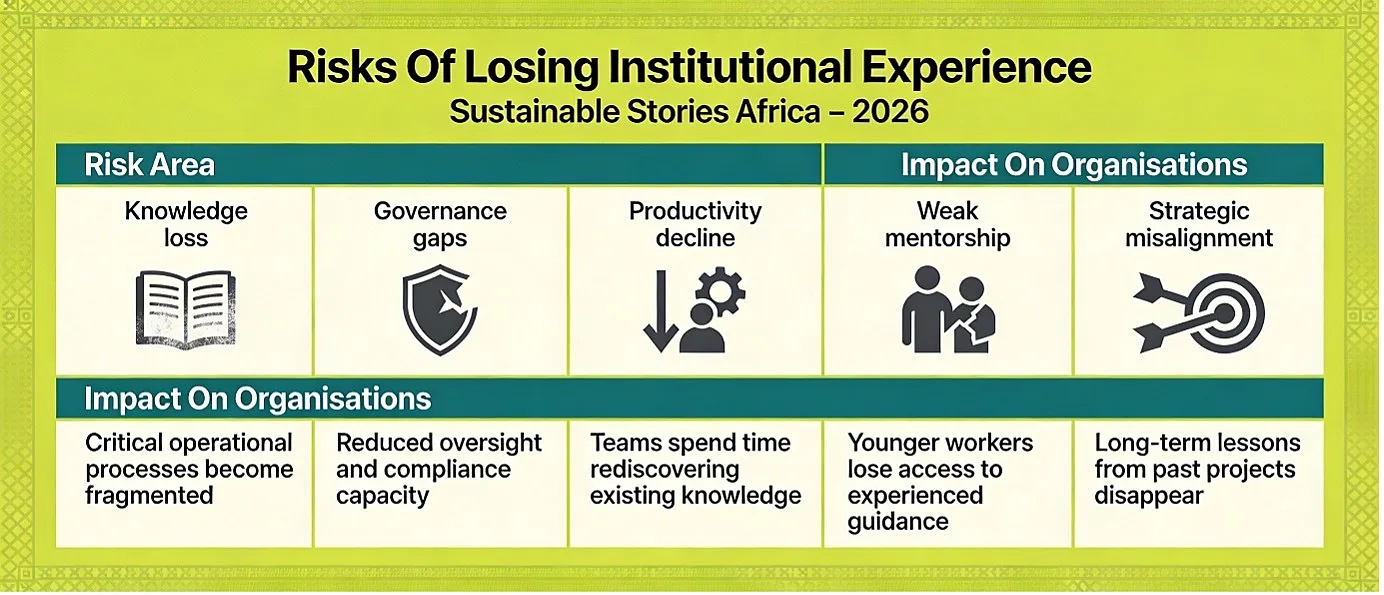
Across many African institutions, where documentation systems are often weak and knowledge-transfer processes are limited, experience remains embedded in people rather than systems.
When those individuals leave, the knowledge often leaves with them.
This dynamic is particularly visible in sectors undergoing rapid transformation, such as:
- energy transition projects
- financial-sector digitalisation
- infrastructure development
- climate finance and ESG reporting
In these complex fields, experience often determines whether projects succeed or fail.
Experience And Youth Should Not Compete
Africa’s demographic advantage, its young population, is frequently described as a powerful economic asset.
However, youth and experience should not be seen as competing forces.
The most productive organisations combine both.
Younger professionals bring:
- digital fluency
- creativity
- adaptability
Experienced professionals bring:
- strategic judgment
- industry relationships
- institutional continuity
Together, these attributes form what economists call “intergenerational productivity ecosystems.”
The Complementary Workforce Model
Workforce Segment | Key Strengths |
|---|---|
Young professionals | Digital skills, innovation, energy |
Mid-career professionals | Technical expertise, project execution |
Senior professionals | Strategic leadership, institutional memory |
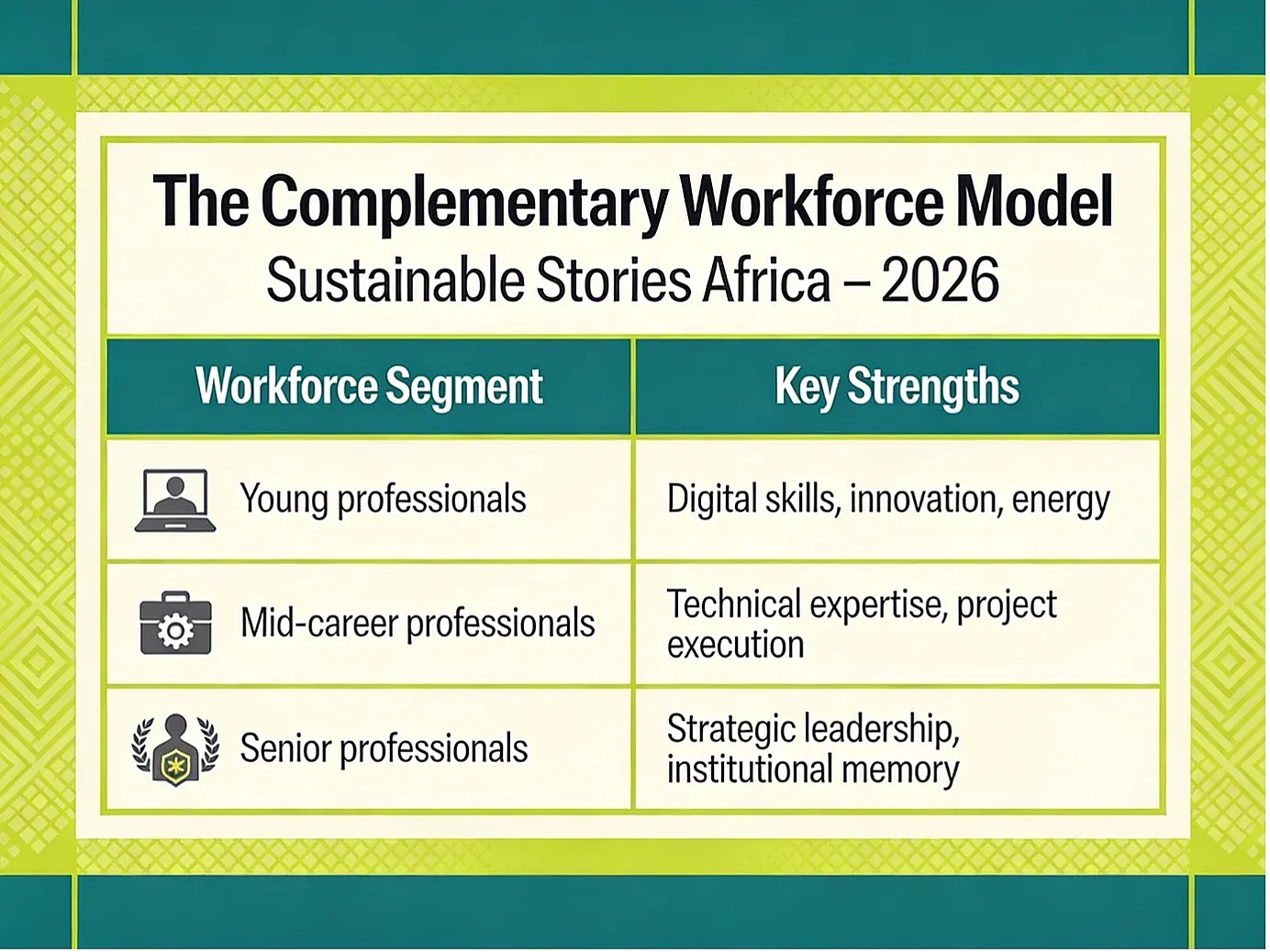
When organisations disproportionately remove experienced workers, they risk dismantling this balance.
Rebuilding The Value Of Experience
Reframing how organisations treat experience could unlock significant economic and institutional benefits.
Rather than viewing experienced professionals as a cost burden, forward-looking organisations are increasingly recognising them as strategic assets.
Companies that successfully integrate experience into workforce planning often benefit from:
- faster decision-making
- stronger governance structures
- more effective mentoring programmes
- improved project outcomes
In complex sectors such as climate finance, infrastructure development and sustainable investment, experienced professionals play a particularly vital role.
For example:
- Infrastructure financing requires decades of regulatory and project expertise
- ESG reporting demands deep governance and compliance knowledge
- Large-scale energy projects rely on institutional coordination across governments and investors
In these contexts, experience functions as economic infrastructure.
Rethinking Workforce Strategy
Addressing the experience gap requires coordinated action from organisations, governments and educational institutions.
- Build Structured Knowledge Transfer Systems – Organisations must establish formal mentorship and knowledge-sharing programmes that connect senior professionals with younger employees.
- Create Flexible Career Pathways – Rather than forcing early exits, companies can create flexible roles for experienced professionals, such as:
- advisory positions
- part-time leadership roles
- project-based engagements
- Reform Age-Biased Hiring Practices – Many recruitment systems unintentionally prioritise youth over experience. Balanced hiring frameworks can ensure organisations benefit from both.
- Digitise Institutional Knowledge – Investing in digital knowledge systems helps capture expertise before it disappears.
- Promote Intergenerational Workforces – Companies should design workforce strategies that intentionally integrate multiple generations rather than replacing one with another.
For African economies aiming to build globally competitive industries, preserving experience will be as important as developing new skills.
Path Forward – Experience As Strategic Economic Capital
Africa’s workforce future should not be framed as a choice between youth and experience. Sustainable growth requires the integration of both.
By valuing institutional knowledge, strengthening mentorship systems and redesigning workforce strategies, organisations can transform experience into a powerful driver of innovation, governance and long-term economic resilience.
Culled From: We Keep Firing Experience | LinkedIn