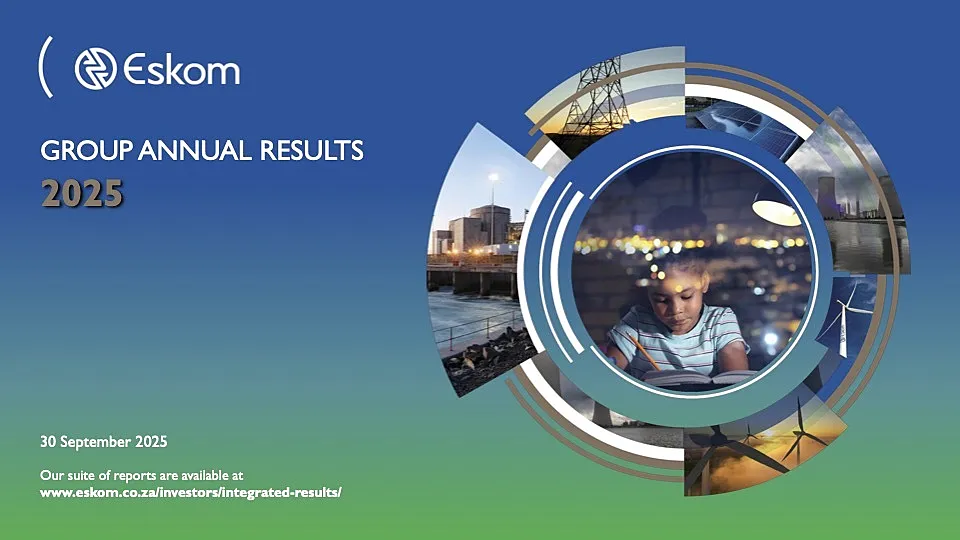
Eskom frames FY2025 (year ended 31 March 2025) as a "pivotal moment" marked by organisational reform, operational stabilisation efforts, and renewed sustainability governance.
Leadership emphasises that the utility's sustainability performance is tightly linked to plant reliability and the ability to maintain environmental compliance, noting that "maintaining full compliance i s linked to the state and reliability of plant" and remains challenging, even as the Generation Recovery Plan is reported to have supported progress on "the air quality improvement plan and the water implementation plan."
Governance signals include oversight by the Board's Social, Ethics and Sustainability (SES) Committee, with the SES Chair presenting the report and reiterating integration of sustainability principles in business strategy.
The CEO notes a revised strategic direction approved by the Board amid "legislative changes, market restructuring, and stakeholder engagement."
The report structures performance around "eleven material ESG matters", with oversight "through Exco and Board committees," and positions its ESG framework as a monitoring "canvas" to contribute to national priorities through 2030, while highlighting SDGs next to relevant performance parameters.
Operationally, the "Year in review" notes a decline in loadshedding: 352 days in FY2024 vs 83 days in FY2025 (a 76% reduction), alongside emphasis on debt relief support and unbundling progress (including the National Transmission Company South Africa (NTCSA)).
On transition, Eskom positions the Just Energy Transition (JET) as central, citing workstreams including a renewable pipeline (e.g., "2GW" referenced) and grid expansion needs, and notes international and domestic stakeholder engagement on JET and infrastructure investment.
SDG Alignment
How SDGs are used in the report
- Eskom states it highlights "the key SDGs" throughout the report next to relevant performance parameters and links its ESG monitoring to contributions toward the National Development Plan (NDP) to 2030.
- Eskom notes 2025 as the 10th anniversary of the SDGs, positioning its sustainability reporting within that global milestone.
Where SDG linkage is explicit
- In its resilience/disaster management discussion, Eskom links national disaster-management priorities to "the SDGs and the Paris Agreement," embedding these into the Enterprise Resilience Programme.
Geography of SDG impacts
- The report's SDG framing is primarily South Africa, anchored (NDP and national compliance framing), while stakeholder engagement includes international partners (UK, China, Netherlands, Germany, Zimbabwe, Zambia) on energy cooperation, JET and infrastructure investment.
SDG notes
- Disclosure method: SDGs are signposted next to performance items; the report does not, in the cited sections, provide a single consolidated SDG list.
ESG Management
Governance and oversight
- Eskom identifies 11 material ESG matters and states oversight of these matters and related initiatives is "through Exco and Board committees."
- The Board Social, Ethics and Sustainability (SES) Committee provides visible governance leadership via the SES Chair's statement.
Management approach
- The CEO states executive leadership stabilisation was prioritised and that all Exco roles are filled.
- The Board approved a revised strategic direction responding to sector reforms and legislative changes.
Frameworks and standards referenced
- The report references adoption/alignment with sustainability frameworks, including GRI and SDGs, and indicates intent to align with international standards such as TCFD and ISSB in the "2024-onward" phase description.
Initial Areas of Impact
Eskom's reported impact areas are presented as performance highlights and programmes tied to reliability, compliance, and transition:
- System reliability/electricity crisis response: "Achieving operational excellence to permanently end the electricity crisis" is listed among the 11 material ESG matters.
- Environmental compliance and stewardship: leadership links compliance performance to plant reliability and cites progress through the Generation Recovery Plan supporting air and water plans.
- Just Energy Transition and repurposing: the report highlights repurposing of coal assets (e.g., Komati referenced in the evolution timeline).
- Air Quality Offset Project (community-facing): cited as ongoing, including "Phase 2 in Gert Sibande Municipality."
- STEM/future skills pipeline: Eskom Expo for Young Scientists and International Science Fair cited with "over 300 finalists."
Metrics for Definition
Key reported metrics (FY2025 vs FY2024 where stated)
| Metric | FY2024 | FY2025 | Notes |
|---|---|---|---|
| Days with loadshedding | 352 | 83 | Reported as a 76% reduction |
| "EAF" (Energy Availability Factor) | 54.7% | 60.6% | Cited in year-in-review panel |
| Work-related fatalities | 0 | 0 | Stated in year-in-review panel |
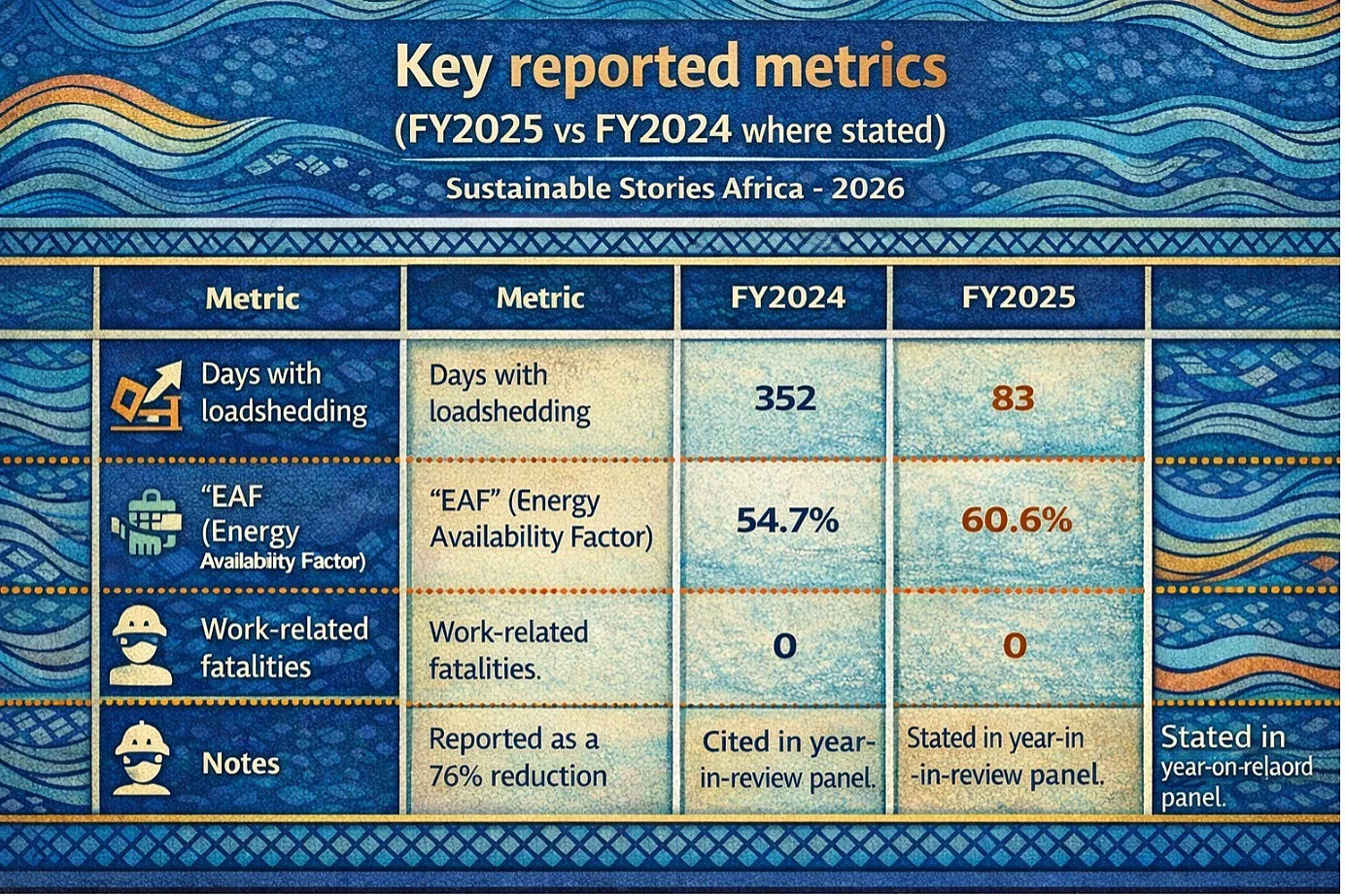
Examples of KPI categories that the report signals it tracks
- The report indicates that it marks parameters as positive/negative/neutral (green/red/amber) "where possible," implying a structured internal assessment approach alongside SDG signposting.
- It also references integration of "environmental and social KPIs" in the ESG evolution timeline.
Assurance/verification
- In the cited sections, Eskom references internal systems and certifications (e.g., ISO 9001:2015 recertification for Eskom Risk and Sustainability, and ongoing internal audits for QMS).
Areas of Focus
Forward priorities signalled
- "Creating the Eskom of the future and achieving a JET" is explicitly listed as a material ESG matter.
- The "2024-onward" phase describes priorities including benchmarking and gap assessment of the ESG framework, alignment with TCFD/ISSB, emphasis on circular economy and embedding sustainability into "the evolving Eskom."
- The CEO frames the revised strategic direction as a response to national energy reforms and sector restructuring.
Operational excellence (end electricity crisis)
JET delivery and "Eskom of the future"
Environmental stewardship + climate action
Governance, compliance, anti-crime/anti-corruption
Materiality Concepts
Material issues disclosed
- Eskom lists "eleven material ESG matters" grouped across ESG, Environment, Social, and Governance, covering operational excellence, JET, environmental stewardship, climate action, workforce/culture, national development, leadership, financial sustainability/tariffs, legal separation (unbundling), governance/compliance/ethics, and combatting crime/fraud/corruption.
Materiality process (what is shown)
- Eskom states oversight sits with Exco and Board committees, and that its ESG framework is used to monitor progress toward 2030-linked objectives (NDP/SDG framing).
Sustainability Risk Management Concepts
Risk framing and governance
- Eskom links resilience, disaster risk reduction, sustainable development and climate adaptation across multiple frameworks, and states it has integrated compliance requirements (Disaster Management Act and Climate Change Act) into climate adaptation planning.
- Disaster risk assessments are addressed "at National, Provincial, and Sites," and climate/resilience risk assessments are referenced for vulnerability assessments and adaptation plans.
Examples of risk categories implied in the Report
- Operational/environmental compliance risk tied to plant reliability and licence to operate.
- Climate adaptation and disaster risk managed via the Enterprise Resilience Programme.
- Crime/fraud/corruption explicitly treated as a material governance matter.
Sustainability Strategy Concepts and Management
How strategy is defined and applied
- Eskom positions its ESG approach as evolving from compliance to strategic integration and "sustainable development leadership," including repurposing coal plants, benchmarking/gap assessment of ESG framework, and alignment with international standards (TCFD/ISSB).
- The report states it uses "our ESG framework as a canvas" to monitor continual improvement and contribute to NDP/SDG goals through 2030.
Strategic pillars identified from the "11 material ESG matters"
- Operational excellence to end the electricity crisis
- Eskom of the future + Just Energy Transition
- Environmental stewardship
- Climate action
- Skilled workforce + ethical culture
- Governance, compliance, and anti-corruption
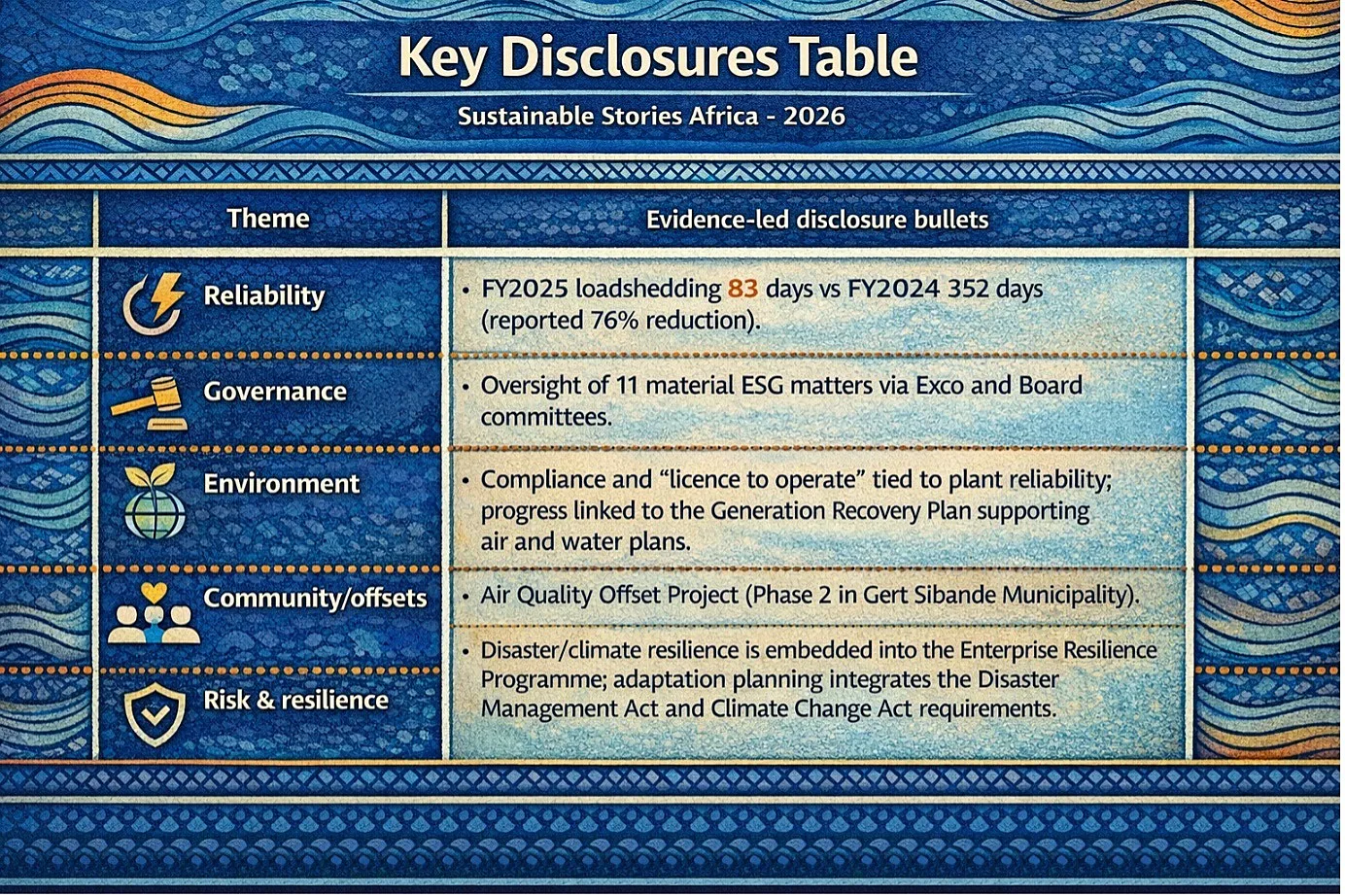
Key Disclosures Table
| Theme | Evidence-led disclosure bullets |
|---|---|
| Reliability | FY2025 loadshedding 83 days vs FY2024 352 days (reported 76% reduction) |
| Governance | Oversight of 11 material ESG matters via Exco and Board committees |
| Environment | Compliance and "licence to operate" tied to plant reliability; progress linked to the Generation Recovery Plan supporting air and water plans |
| Community/offsets | Air Quality Offset Project (Phase 2 in Gert Sibande Municipality) |
| Risk & resilience | Disaster/climate resilience is embedded into the Enterprise Resilience Programme; adaptation planning integrates the Disaster Management Act and Climate Change Act requirements |
Disclosure Improvements
To sharpen transparency and usability, Eskom's sustainability reporting would benefit from a more structured, decision-ready disclosure framework.
A single-page SDG mapping table linking priority goals to FY2025 outcomes, accountable executives, and data boundaries would clarify strategic alignment.
A consolidated ESG KPI catalogue, showing definitions, baselines, targets and methods, would improve comparability. Clear assurance statements would strengthen data credibility.
Compact environmental dashboards, with plant-level breakouts where material, would enhance accountability.
Standardised Just Transition metrics, covering project pipelines and workforce reskilling, would anchor social impact.
Publishing the materiality matrix would further connect stakeholder priorities to Board-level action.
Suggested improvements
- SDG mapping table: a single page listing the specific SDGs Eskom prioritises, with (i) targets, (ii) FY2025 outcomes, (iii) responsible executives, (iv) data boundaries.
- KPI catalogue: one consolidated table of all ESG KPIs tracked (definitions, units, baselines, FY2024–FY2025, targets, methodology).
- Assurance clarity: specify which ESG metrics are externally assured (if any), assurance scope/standard, and any limitations.
- Environmental totals: provide a compact, year-on-year dashboard for emissions, water withdrawal/consumption, waste, and compliance exceedances (with plant-level breakouts where material).
- Just Transition metrics: standardise JET reporting with a pipeline table (MW, stage, capex, expected COD, grid dependencies) and workforce transition indicators (reskilling numbers, locations, timelines).
- Materiality method transparency: if a materiality matrix exists, include it with stakeholder groups, scoring method, and how issues translate into Exco/Board agendas and incentives.
Kindly note that Sustainable Stories Africa (SSA) has conducted this review independently, without any financial, material or other inducements, to ensure objectivity, integrity and transparency in highlighting Eskom's sustainability disclosures.