The World Economic Forum’s 2026 Energy Transition Index shows near-stalled global progress, while sub-Saharan Africa records the greatest regional improvement.
Better readiness from a low base, however, is not the same as reliable power.
For Nigeria and its neighbours, the decisive test is whether resource and investment gains become dependable, affordable electricity.
A Better Score Is Not Enough
The World Economic Forum’s Energy Transition Index 2026, prepared with Accenture, evaluates 120 countries using 44 indicators.
- It weighs current system performance at 60% and transition readiness at 40%.
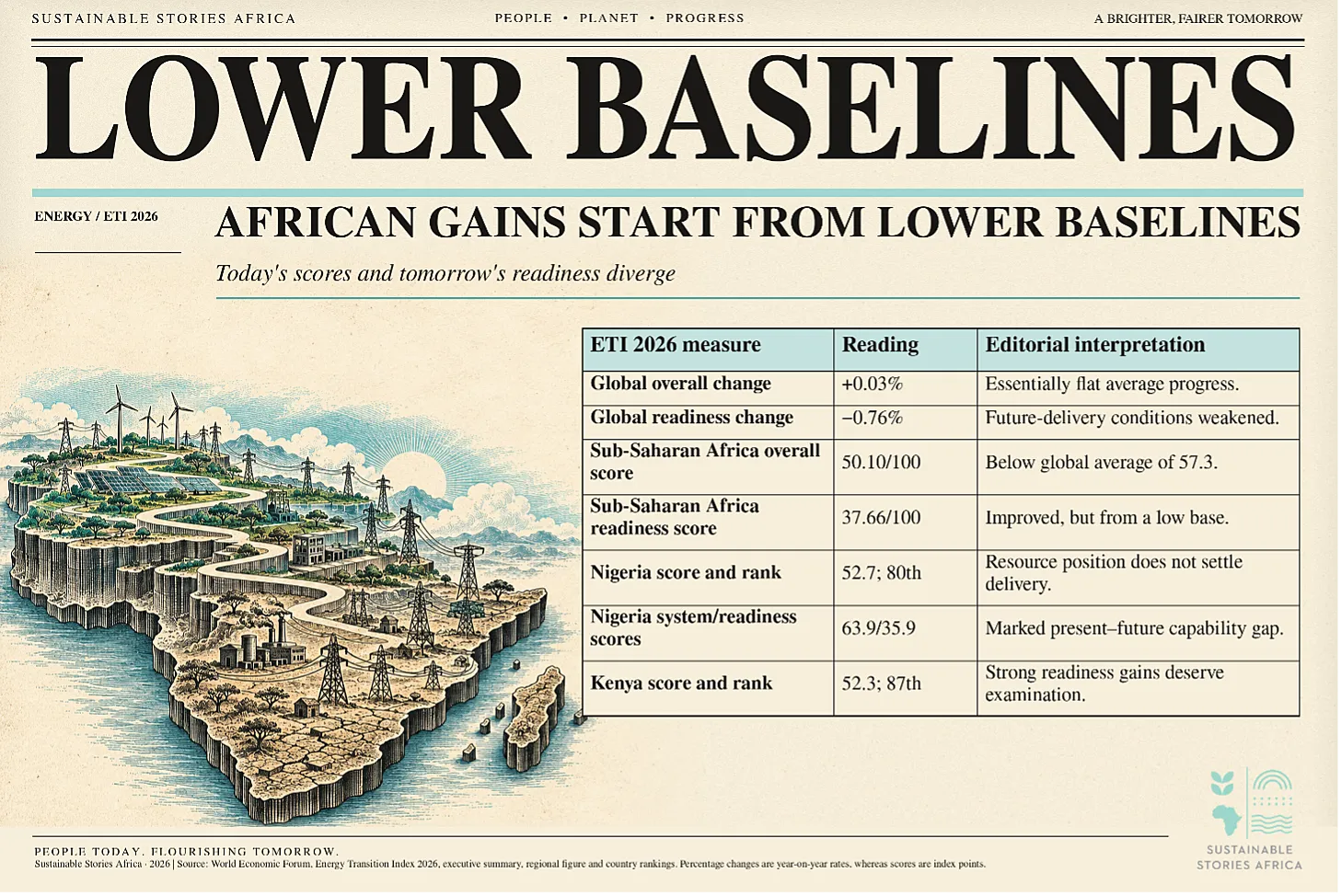
- The global average overall score rose only 0.03% year on year as improved present performance was offset by weaker conditions for future delivery.
For African communities, an energy ranking becomes useful when it identifies a bottleneck that can be fixed.
- A country may be a major fuel producer and still have an unreliable power network.
- A renewable project may be financed and still wait for a connection.
Index results should prompt investigation of those gaps rather than be treated as an end in themselves.
This article draws from the attached report’s executive summary, “Overall results”, “Sub-index and dimension trends” and regional and country tables.
- ETI values use the latest data available to the index, not real-time September 2026 readings.
- Some measures changed in the 2026 edition, which limits simple year-on-year interpretation.
Readiness Weakens Despite Record Spending
The index says only 24% of countries improved simultaneously across security, equity and sustainability.
- Globally, transition readiness fell 0.76% for the first time in more than a decade, despite large clean-energy investment totals.
- Sub-Saharan Africa’s average score rose 1.2%, the strongest regional increase, but remained below the global mean.
This contrast matters because readiness includes finance, regulation, infrastructure, skills and innovation.
- Strong current supply cannot guarantee future resilience if the systems that attract investment and deliver electricity weaken.
- Conversely, a country improving those enablers may be building capacity that does not yet fully appear in access or reliability outcomes.
Interest: African Gains Start From Lower Baselines
The WEF records 3.3% year-on-year improvement in sub-Saharan Africa’s transition readiness, supported by gains in finance and investment, education and innovation.
- That does not mean the region’s investment gap has closed.
- Globally, the finance-and-investment dimension fell 1.8%, and the report says financing costs in markets expected to drive much future electricity demand can be two to three times those in advanced economies.
Nigeria illustrates why leaders must read past headline resource abundance.
- Its system-performance score was 63.9, but readiness was 35.9.
The WEF also includes Nigeria among major energy-supply leaders in a separate appendix.
Supply strength can support national finances and security, but not network reliability, affordability, and the investment environment, which need it.
Kenya presents a different pattern.
- The index gives it an overall score of 52.3 and reports notable readiness progress linked to innovation, education and investment capacity.
- An improvement in a composite score does not guarantee that a specific household gained access that year.
- It does identify where policymakers and investors can test whether enabling reforms are translating into tangible services.
The index reports a global 3% reliability decline, but changed its reliability indicator in 2026, replacing older outage measures with a World Bank-based approach.
- Some movement therefore reflects a data-source transition, not necessarily a like-for-like deterioration of physical grids.
- Any article that treats the whole change as newly measured outages would mislead readers.
Readiness Can Make Resources Useful
Stronger grids, flexible supply and credible investment rules can turn energy resources into dependable services.
- In a city hospital, reliability means power when equipment is needed; for a manufacturer, it means less production lost to outages.
- These are the lived outcomes that should follow from a better readiness score.
- They are not automatically delivered by one.
Regional interconnection and decentralised generation may offer complementary routes to resilience.
- The WEF emphasises grids, storage, risk-sharing and stable policy because project deployment alone is insufficient if connections and markets cannot absorb new capacity.
- Improving these foundations could help African economies attract productive investment without compromising affordability.
The equity dimension also matters.
- The report’s sub-Saharan regional sustainability score is comparatively strong, but its equity score is much weaker.
- Lower emissions intensity can coexist with unmet access needs.
A transition strategy that celebrates a clean power mix while households remain unserved has not delivered the development bargain citizens need.
Protect Reliability And Lower Costs
The WEF sets out three broad priorities:
- Strengthen security and resilience
- Unblock infrastructure delivery
- Restore investability through stable regulation and risk-sharing.
African governments can apply these by mapping connection queues, publishing credible procurement calendars and assessing which projects most improve reliable access.
Utilities should disclose losses, outage performance and connection times.
Lenders and development institutions should prepare projects before calling for private capital and use guarantees where identifiable risks can be allocated fairly.
- Training grid engineers and technicians is as important as announcing a generation target when infrastructure is the binding constraint.
For Nigeria, policymakers should interrogate the gap between supply strength and readiness rather than assume production automatically yields energy security.
For Kenya, the next assessment should test whether improvements in skills, innovation and investment lead to more reliable service.
In both cases, the appropriate metric is what households and enterprises can use.
Path Forward – Convert Readiness Into Reliable Power
Africa’s improvement is encouraging as the global transition has lost momentum.
However, a stronger index score remains a means, not the end.
Track connections, affordability and outage performance aside from readiness.
Durable progress will appear when institutions and investment make energy more dependable for citizens.