McKinsey places energy and sustainability technologies at the centre of the AI infrastructure story.
Capital is available; however, renewable generation, storage and new computing facilities all compete for connections to constrained grids.
African markets face a particular test: digital expansion should add reliable capacity rather than crowd out households and industry.
Power Becomes The Technology Bottleneck
The “14 Future of energy and sustainability technologies” section of McKinsey’s Technology Trends Outlook 2026 describes solar, wind, batteries, grid systems, electrification, low-carbon fuels and emissions measurement as part of a greater energy transition.
Its central message is about deployment: electricity is a foundation of technology growth, not an afterthought to the software sector.
A data centre can be announced faster than a new transformer can be installed.
- In an African market already balancing access needs, industrial demand and reliability, a major new computing load raises questions about who pays for network upgrades and whether added supply is clean and dependable.
- This is an editorial implication, not a forecast for a named African utility.
Investment Cannot Bypass Grid Queues
McKinsey records $194.2 billion in 2025 equity investment linked to energy and sustainability technologies, the largest total among the report’s 14 selected trends that year.
It also cites more than 2,500 GW of renewable, storage and large-load projects awaiting grid connections globally.
- The first number is a financing-flow measure; the second is a physical project-backlog measure.
- Their coexistence illustrates why money alone cannot ensure delivery.
Energy developers can build generation faster than some networks can be expanded.
- Substations, transformers, permitting and transmission corridors must align with the projects waiting to connect.
- The result is not simply an “AI power shortage” but a planning problem affecting homes, factories, clean generators and digital services together.
Hardware Readiness Decides Clean Scale
Technologies in the category have different maturity levels.
- Solar, wind and lithium-ion storage are being deployed widely.
- Enhanced geothermal, advanced nuclear, long-duration storage, low-emission hydrogen and some carbon-removal options face earlier commercial or project-development stages.
A portfolio that labels them all “ready now” can misstate cost and delivery risk.
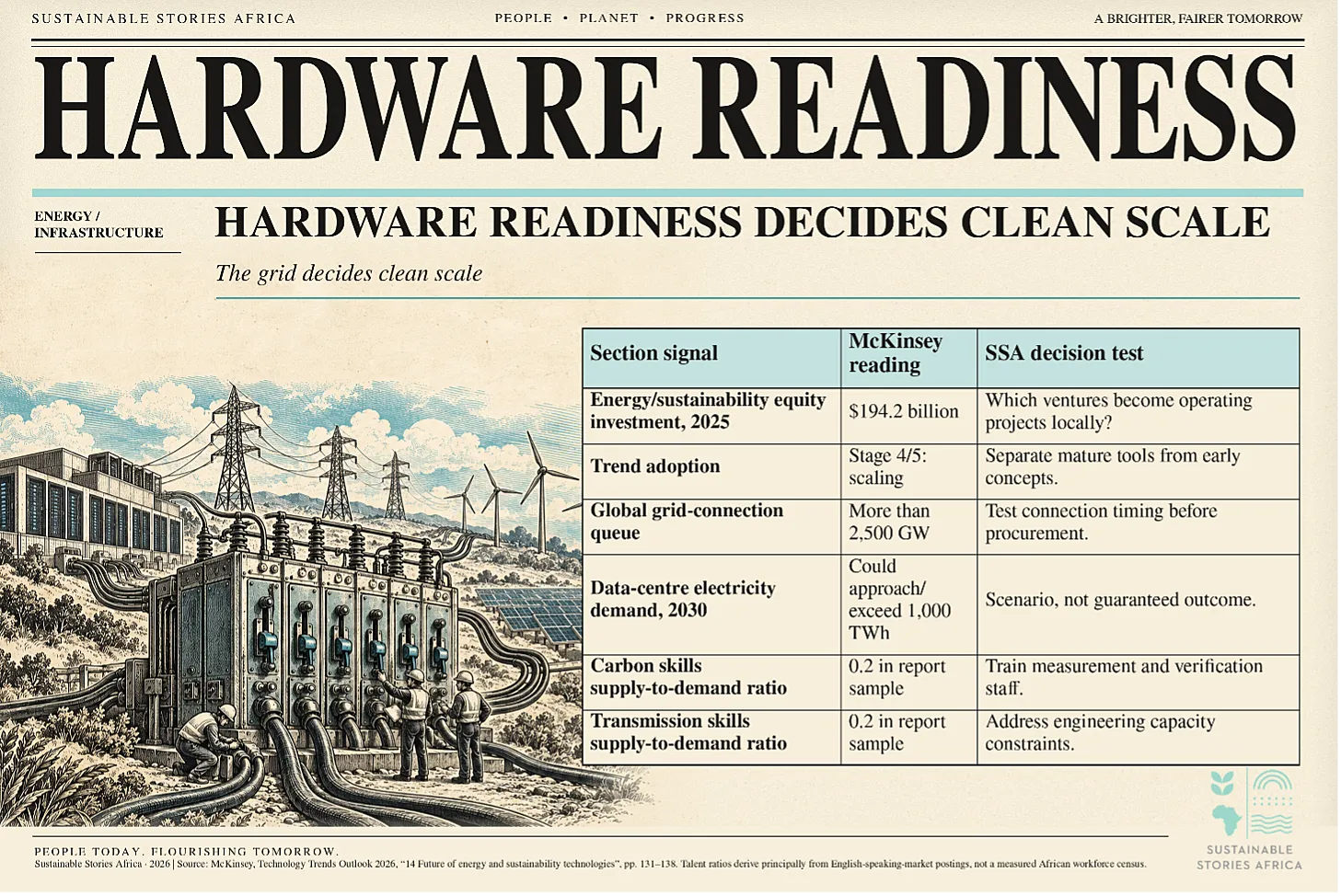
McKinsey also describes major electricity users pursuing direct supply arrangements, including agreements involving nuclear and geothermal projects.
- These illustrate attempts to secure reliable power amid grid delays, not proof that emerging technologies have reached broad commercial scale.
- The report notes that some data-centre growth still relies on fossil generation, complicating claims that digital expansion is inherently low-carbon.
Measurement technology is another strand.
- Sensors and satellites can help identify emissions, while digital tools improve forecasting and grid management.
However, a better dashboard does not create transmission capacity by itself.
Credible environmental reporting must be paired with operational decisions: correcting a leak, dispatching storage or changing procurement.
Digital Demand Could Fund Shared Infrastructure
Large electricity buyers could support new clean generation and network improvements if contracts allocate costs and benefits transparently.
- The broader social benefit would be a more reliable system serving households and smaller businesses as well as a data centre.
- That outcome is conditional on utility planning and regulation; a private connection alone may deliver little for surrounding communities.
A more robust power system also supports non-digital industry.
- Storage, demand response and well-planned networks can reduce interruptions and improve the value of renewable generation.
- Skills in grid engineering and emissions verification can become productive local capabilities rather than consultancy services purchased from abroad.
These possibilities need training and durable investment.
The risk of waiting is equally tangible.
- If new computing facilities and renewable projects pile up in connection queues, investors may seek fossil-backed solutions that are quicker but harder to reconcile with climate commitments.
- Households could then face additional pressure on a constrained system without receiving new access or affordability gains.
Plan Load With The Grid
Regulators and utilities should assess large-load applications alongside existing customers and renewable projects.
- A developer should disclose anticipated electricity demand, connection schedule, generation mix, backup supply and expected emissions.
- Project finance should account for equipment delays, curtailment and the cost of reinforcing shared networks. [file:2]
Public authorities can publish connection queues and apply clear criteria to prioritise ready, system-beneficial projects.
Investors should distinguish proven near-term options from technologies still facing commercial validation.
Data-centre buyers can consider storage, flexible demand and long-term clean-power contracts without assuming those arrangements automatically solve regional access gaps.
Training belongs in the infrastructure budget.
- McKinsey’s report identifies scarcity in carbon and transmission expertise within its talent dataset.
African governments and firms should commission local workforce assessments and develop grid and verification skills rather than simply importing the report’s labour ratios as domestic statistics.
Path Forward – Make New Power Serve Everyone
The energy transition will be judged by functioning networks, not announcements.
AI-linked demand should be matched with reliable connections, fair cost allocation and verifiable emissions results.
For African markets, the stronger proposition is shared infrastructure that advances access and industrial capability while serving digital growth.