
Global airport traffic rose slightly in the first half of 2026 before declining in the second quarter.
Africa recorded the strongest first-half regional passenger growth, but high fares and constrained aircraft supply complicate the outlook.
A growing passenger count is an investment opportunity, not by itself a business case for another terminal.
Airport Growth Now Meets Uneven Demand
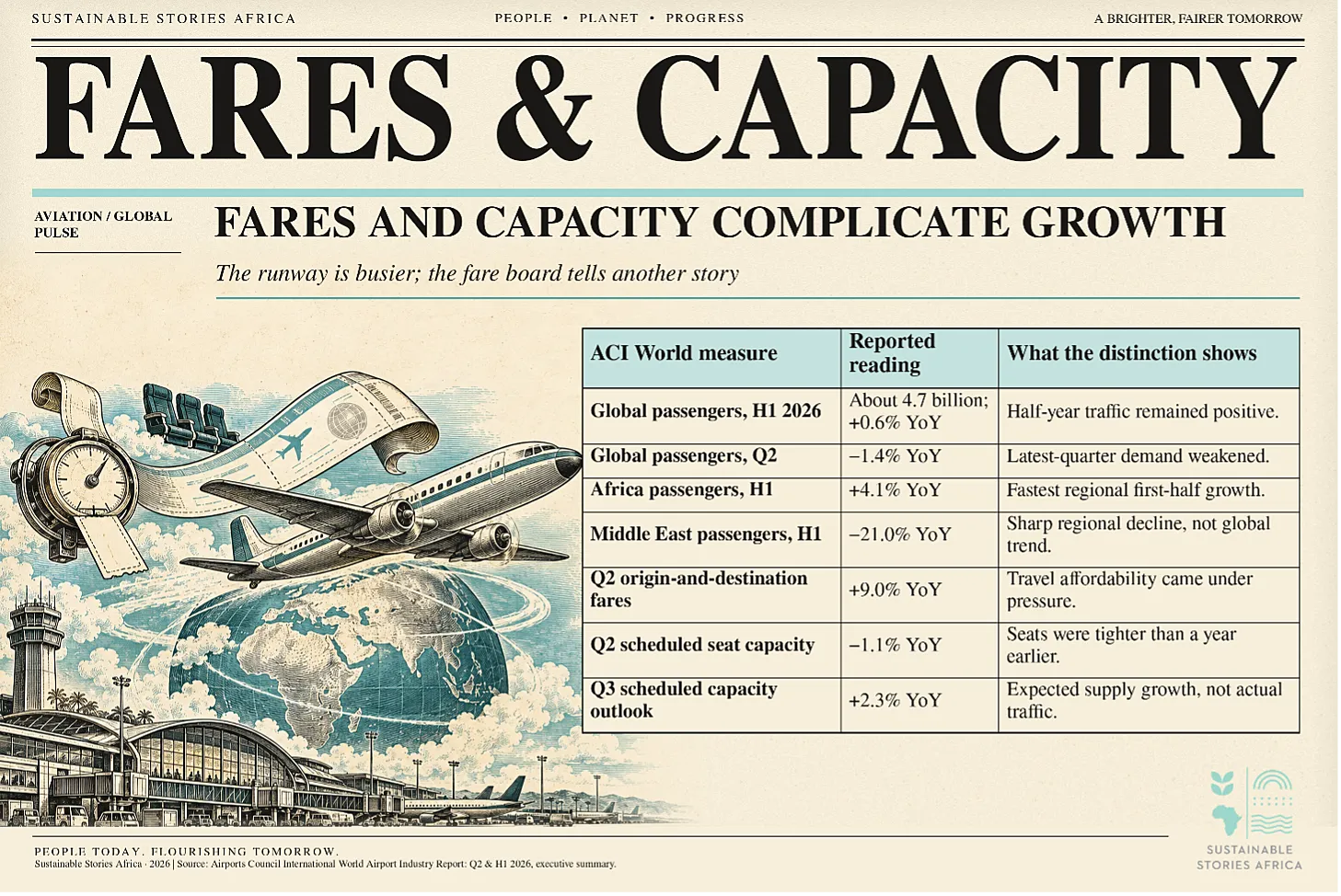
Airports Council International reports approximately 4.7 billion passengers worldwide in H1 2026, up 0.6% year on year.
However, the second quarter fell 1.4%.
- Africa led regional first-half passenger growth at 4.1%
- The Middle East contracted 21.0%.
The figures capture a divided aviation market rather than a uniform recovery.
For a traveller in Lagos or another African gateway, the distinction shows up in ticket prices, available seats and connections.
- For an exporter, the question is whether cargo capacity and airport services enable reliable delivery.
A continent-wide growth figure says little about an individual airport’s route economics or benefits of distribution among cities.
This article draws on the attached ACI World Airport Industry Report: Q2 & H1 2026, particularly its executive summary, traffic discussion and leading indicators.
- ACI World forecasts 10.0 billion passengers worldwide in 2026, up 2.3%; that is a full-year outlook, not an observed total.
- The organisation requires attribution when using its information.
Second Quarter Reverses Global Momentum
Domestic passenger traffic fell 1.3% year on year in Q2, and international traffic declined 1.7%. Cargo, by contrast, rose 3.3%, while aircraft movements fell 1.2%.
- This divergence suggests that a strategy built exclusively on passenger growth risks missing changes in the mix of business passing through airports.
Africa’s H1 lead is significant because the wider market slowed in its latest reported quarter.
It does not establish that every African country or airport outperformed.
- A hub serving intercontinental connections may respond differently to geopolitical disruption than one focused on domestic travel.
- Operators need their own route, load-factor, and yield data to know which pattern applies.
Fares And Capacity Complicate Growth
The fare and capacity readings are particularly relevant for African connectivity.
- Where travellers already face long or expensive journeys, higher prices can narrow the share of people who benefit from a new route.
- ACI World says advanced bookings weakened from March, although overall Q3 bookings remained broadly stable at 0.1% above the same period a year earlier.
That mixed signal argues for scenario planning rather than treating capacity announcements as proof of eventual demand.
Aircraft availability adds another constraint.
- ACI World puts the global backlog at approximately 18,100 aircraft, with delivery timelines approaching seven years.
- An airport cannot fill planned gates merely by completing construction if airlines lack suitable aircraft or choose to deploy them on more profitable routes.
The same constraint may keep fares elevated where demand exceeds seats.
Cargo deserves its own investment lens.
The report’s Q2 cargo growth of 3.3% contrasts with fewer passenger movements.
- Some airports may benefit from better storage, customs processing and freight handling before they need a larger passenger terminal.
- Others may find that route frequency matters more than a new warehouse. Only airport-level commercial evidence can resolve the trade-off.
Connectivity Can Widen Economic Opportunity
When a viable route reduces travel time between secondary cities, communities could gain access to customers, specialist services and tourism markets.
- Better cargo facilities could help producers move time-sensitive goods more reliably.
- These outcomes are possible, not automatic consequences of an H1 percentage.
- Their distribution depends on pricing, service frequency and local supply chains.
Airport expansion also needs an ESG lens.
- Efficient terminals and cleaner ground operations may lower operating costs and emissions, while surface transport access determines whether nearby residents can actually use the airport.
- Conversely, an oversized facility can consume public capital that could have served other infrastructure needs.
These planning implications show in the sector’s uneven performance, not benefits quantified in the ACI report. [file:6]
The strongest financial model is phased and flexible.
- A credible airport business plan should identify airline commitments, passenger and cargo demand, downside cases and the cost of maintaining new capacity.
- Investors should ask how an asset performs when fares rise, bookings soften, or aircraft deliveries slip.
Resilience is worth more than an optimistic single-year forecast.
Tie Investments To Real Demand
Airport operators should publish airport-level trends in passengers, freight, movements, load factors and service quality.
- Governments can use those measures to rank projects by economic value rather than visibility.
- Airlines and tourism bodies should be consulted on viable routes, but their expressions of interest should be distinguished from committed capacity. [file:6]
Financiers should test fuel prices and aircraft constraints in their forecasts.
- ACI World reports jet fuel at roughly $128 a barrel in June, still elevated amid geopolitical and supply pressures.
- A route that appears viable under stable conditions may look different when fuel, currency and financing costs rise simultaneously.
Public-sector contracts should define benefits beyond total throughput:
- Affordable connections, cargo reliability, local employment, energy efficiency and access to the airport.
- That allows a community to evaluate whether aviation growth is improving mobility and trade or merely inflating an impressive aggregate.
Path Forward – Build Routes Before Monuments Rise
Africa’s first-half lead warrants attention, but the second-quarter global slowdown demands discipline.
Route economics and affordability should determine the next investment phase.
Measure actual traffic against fares, airline capacity and cargo demand before building at scale.
The aim is connectivity that survives changing market conditions.