Enterprises are experimenting with agents that can plan and carry out multistep work.
McKinsey reports widespread AI adoption; however, positive earnings impact remains far from universal.
African organisations need to decide which decisions they can delegate, which require human approval and how to measure agent operating costs.
Autonomy Requires More Than Another Chatbot
McKinsey’s Technology Trends Outlook 2026 defines the “Agentic AI” trend as systems that can reason through multistep workflows, interact with tools and enterprise platforms, and adjust actions as circumstances change.
Consider a hypothetical insurer using an agent to retrieve documents, check a claim and propose an outcome.
- Faster processing might benefit a customer waiting for payment.
However, if the system changes a record or denies a claim without a clear appeal route, the same speed can multiply errors.
- This example illustrates a possible application
This article focuses on the report’s Agentic AI section, including its enterprise-use, investment and governance discussion
Usage Has Outrun Documented Returns
McKinsey reports that 89% of organisations regularly use AI, while only 37% attribute any positive earnings-before-interest-and-tax impact to their AI programmes.
- The second figure does not isolate agents, and the first does not mean 89% have put autonomous systems into production.
- Together, they show why adoption is a weak proxy for value.
Agentic work also costs more to run than a single question-and-answer exchange.
- In some enterprise environments, the report says one agentic workflow can consume five to 30 times the tokens of a conventional chatbot query.
- Each tool call, retrieval and re-planning step draws on compute.
For an organisation that saves staff time but fails to control token use, it may not achieve a positive business case.
Interest: Value Depends On Governed Workflows
The section describes agents becoming an orchestration layer between customer-management, planning and supply-chain systems.
- That is a more demanding task than drafting an email. An agent may read information from one application and act through another.
- The quality of enterprise data, the reliability of interfaces and the permissions attached to a machine identity become central to governance.
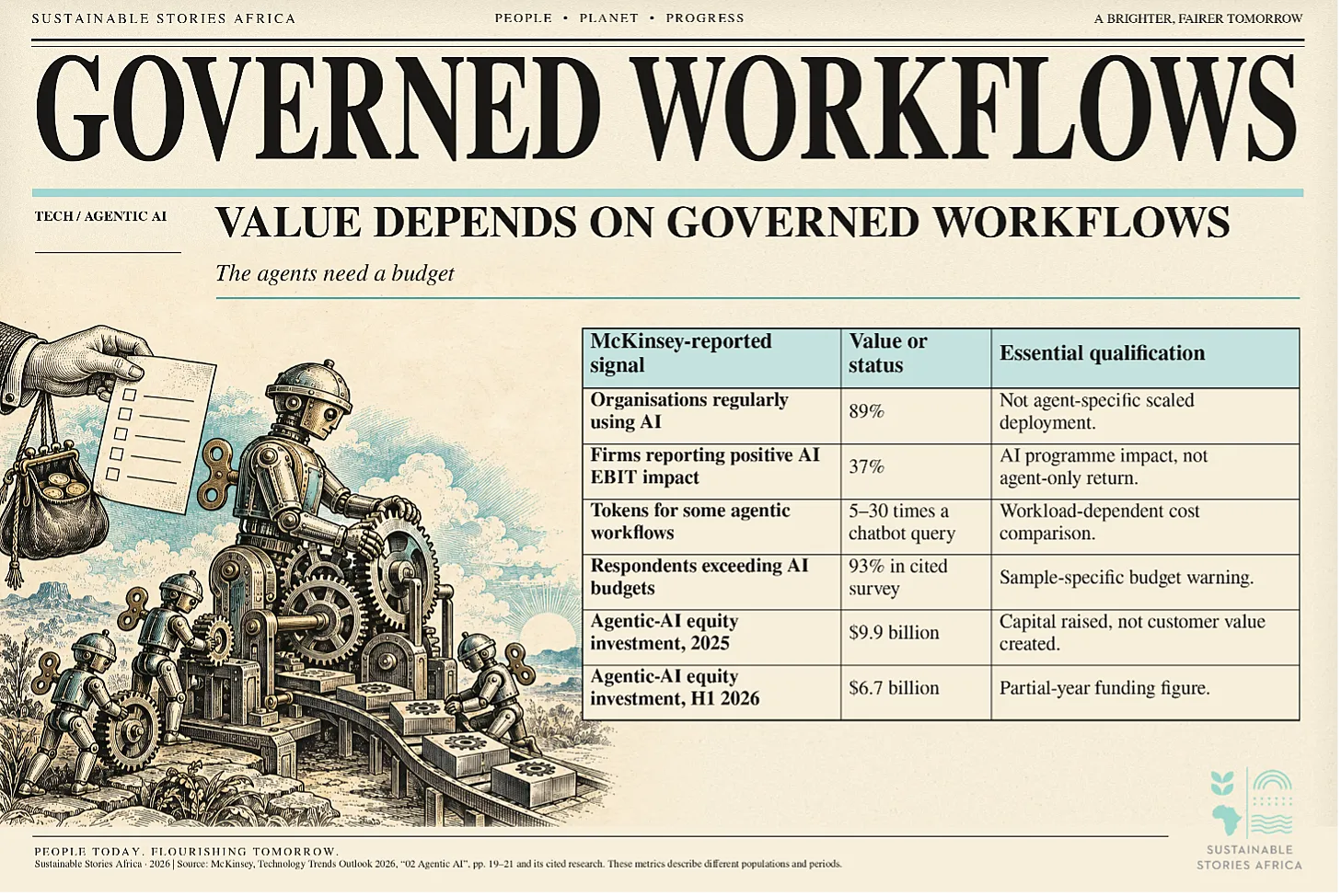
McKinsey also points to “non-human identities”: service accounts, API keys and other credentials through which agents interact with software.
- A system that can approve a payment or change a record has a different risk profile from one that can only suggest text.
- Access should be limited by function, with traceable, auditable actions and a way to contain mistakes or malicious behaviour.
The business case depends on redesigning a process, not layering agents over every existing step.
- If a company still requires three manual handoffs for a routine issue, an agent may add a fourth interface.
- Leaders need to decide where human judgment is indispensable and where a bounded action can safely be automated.
Better Processes Can Unlock Value
Properly governed agents could reduce repetitive work and help staff respond faster to customers.
- A public service might route an enquiry more accurately; a logistics company might coordinate documents and updates across systems.
- These are opportunities that need pilots with clear measures, not forecasts of automatic gains.
Human oversight can improve the result rather than defeat the technology.
- A person can resolve exceptions, approve consequential decisions and review whether a workflow is treating customers fairly.
- That matters in African markets where trust in digital services, access to support and the right to correct mistakes can be as valuable as speed.
There exists a downside to delay.
- If competitors learn how to use agents with careful cost controls, a firm that refuses to test any suitable workflow may lose service quality or efficiency.
- The balanced response is neither full autonomy nor a blanket ban, but a sequence of bounded trials whose benefits and risks are measured.
Define Delegation Limits Before Deployment
Start with an inventory of agents, tool connections and machine credentials.
- Specify what each system may read, change or send, and which steps require human approval.
- Define escalation routes for errors, privacy incidents and disputed decisions.
- For high-impact work, test what happens when source data are wrong or instructions conflict.
Finance teams should track compute and token costs per completed case, including rework.
Operations teams should record time saved, errors corrected and customer outcomes.
- If a pilot accelerates response while increasing corrections or complaints, the workflow needs redesign before the agent receives more authority.
African regulators, enterprise buyers and vendors can align on clear expectations for audit trails and responsibility without assuming one model suits every industry.
- A limited document-routing agent and an agent authorised to move money should not face identical controls.
Oversight should reflect what the system can actually do.
Path Forward – Measure Autonomy Against Outcomes
An agent should earn wider authority only when it completes useful work reliably, securely and at an acceptable total cost.
Adoption figures cannot substitute for that test.
For African enterprises, the sensible path is governed experimentation backed by accountable people, clear permissions and measurable customer benefits.