
Europe is enforcing AI law in stages. For companies supplying AI to European customers, the key question is which obligation applies to which system and when.
An attached infographic names ten enforcement concepts.
African exporters should build their compliance plans from the legal text, not a single date on the graphic.
European Rules Reach African Technology Suppliers
The EU AI Act entered into force on 1 August 2024 and became generally applicable on 2 August 2026, while different provisions began earlier or will apply later.
The European Commission’s implementation information is essential context for firms supplying models and applications into the EU.
Its updated timetable sets Annex III high-risk obligations for 2 December 2027 and certain Annex I product-related obligations on 2 August 2028.
For a Nigerian developer supplying recruitment software to a European employer, this is not a theoretical regulatory milestone.
- The customer may ask whether the tool falls in a high-risk category, who holds provider responsibilities, which tests were conducted and how a person can challenge an adverse result.
- Procurement teams may want evidence before a statutory deadline arrives.
This article draws from the attached “10 EU AI Act Enforcement Terms” image and checks its terminology and dates against the Commission’s official AI Act information and the relevant legal articles.
The image’s bottom line mistakenly treats Article 99, which deals with penalties, as the basis for an August 2025 commencement statement.
- It should not be repeated as a legal timeline.
One Law Carries Several Timetables
The phrase “enforcement is live” is accurate only with qualifications.
- Prohibited AI practices and literacy provisions started applying in February 2025.
- General-purpose AI obligations began in August 2025.
- Wider application arrived in August 2026.
- The amended dates for important high-risk duties extend into 2027 and 2028.
Businesses must identify the obligation before assigning its deadline.
This sequencing matters for governance because a company can face an immediate requirement in one product line and have additional time to prepare a different system.
It also matters for accurate public communication.
- A supplier that describes all high-risk duties as already applicable may overstate the law; one that says nothing applies until 2027 understates earlier requirements.
Both claims trigger customers to evaluate risk.
Ten Concepts Define Practical Oversight
High-risk classification starts with the system’s intended purpose and the Act’s categories, not a developer’s preferred label.
- Conformity assessment is the relevant verification process before specified products enter the market, but the route varies.
- A notified body undertakes third-party assessment where required; it is not a universal approval authority for every AI system.
- Market surveillance authorities supervise and enforce within their remit.
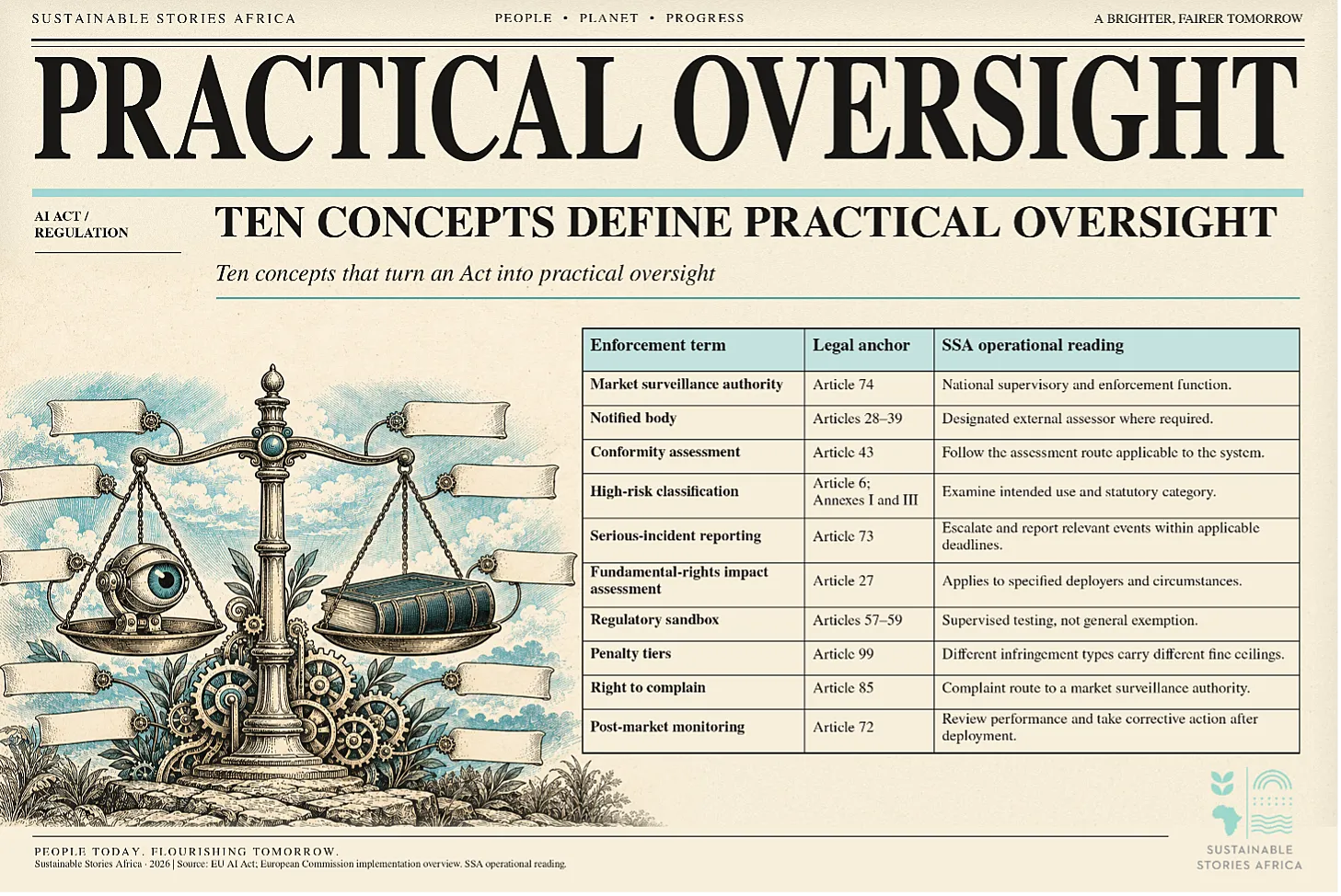
The operational link between the terms is more important than memorising the list.
- Classification determines whether high-risk duties are relevant.
- Assessment and documentation show whether a qualifying system was prepared for deployment.
- Monitoring checks what happens in use.
- Incident reporting and complaints provide signals that something may have failed.
Each stage needs a responsible team and an evidentiary trail.
Article 73 illustrates why “report within set deadlines”.
- The general outer reporting deadline is 15 days after awareness, with faster requirements for specified circumstances.
- Providers should record when an event was detected, whether a causal connection is reasonably established and which authority must receive the notice.
An inbox without trained decision-makers can miss a legally significant event.
Penalties also require nuance.
- Article 99 sets maximum tiers of up to €35 million or 7% of worldwide annual turnover for prohibited practices, up to €15 million or 3% for other specified infringements, and up to €7.5 million or 1% for misleading or incorrect information, subject to statutory qualifications.
These are ceilings, not automatic invoices for every breach.
Evidence Can Strengthen Responsible Trade
For African technology suppliers, compliance evidence can become a commercial asset.
- A system register, documented intended purpose, testing history, human-oversight procedure and clear incident owner allow buyers to understand how a product is governed.
- That does not guarantee approval or access to the EU market.
It does make the supplier’s claims testable, which matters when customers must justify their own deployment decisions.
Citizens have a different stake.
- A recruitment applicant, borrower or patient affected by a consequential system needs a route for concerns to be heard and investigated.
- Rights assessments, monitoring and complaints mechanisms are meaningful only if institutions can trace decisions and correct harmful results.
- Governance should not become a paperwork exercise that leaves the individual without remedy.
Starting early may also reduce costs.
- Teams that wait for the later high-risk deadlines could discover that essential data, contract rights or audit records were never retained.
- Building assurance into development is usually easier than reconstructing a deployment history after a customer, regulator or complainant asks what happened.
This is an editorial inference from the Act’s documentation and monitoring architecture.
Classify Systems Before Buying Compliance
Providers should first list EU-facing products, their intended uses, model dependencies and distribution channels.
Next, legal and engineering teams should map provider and deployer roles and determine which provisions already apply.
Contracting teams can then specify who maintains documentation, who receives complaints and who reports incidents.
- A single company may need different answers for different products.
For potentially high-risk systems, create a roadmap for data quality, testing, oversight, applicable conformity assessment, and post-market monitoring.
- Keep regulatory sandboxes in their proper place as controlled experimentation, not a substitute for safe deployment.
- Review contracts with downstream buyers so responsibilities do not disappear at the handover between a model developer, an integrator and an end user.
African policymakers and business associations can support exporters by offering role-based guidance and technical-assurance capacity.
- They should avoid advertising a blanket “EU compliant” badge divorced from particular products and dates.
- Regulators and investors can ask for specific evidence, while companies update their plans whenever the applicable legal text changes.
Path Forward – Build Controls Before Deadlines Arrive
The effective compliance plan is dated, role-specific and evidence-led: identify the system, classify its intended use and assign an accountable owner.
For African suppliers, the amended timetable is time to improve assurance, not permission to postpone it.
Trusted market access will depend on what can be demonstrated, not what an infographic promises.