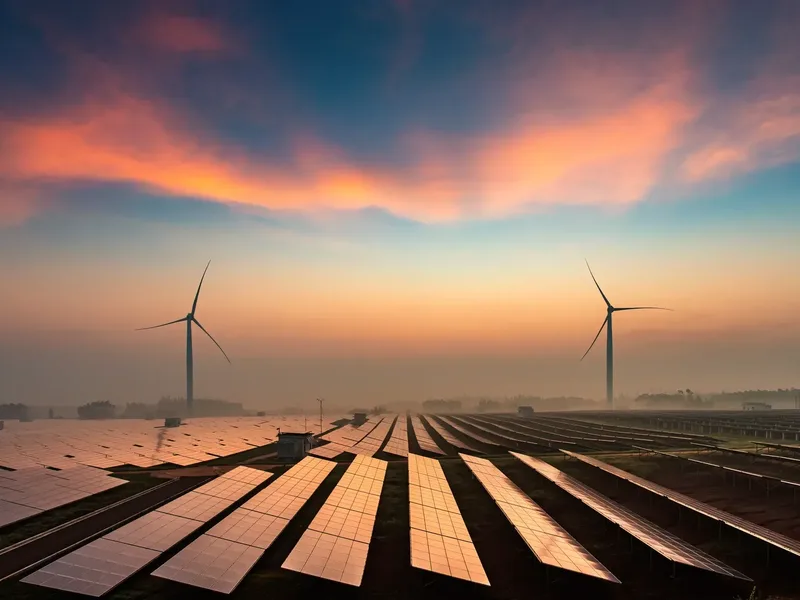
Solar and onshore wind were cheaper than new fossil-fuel generation on a global-average basis in the UN’s 2025 assessment.
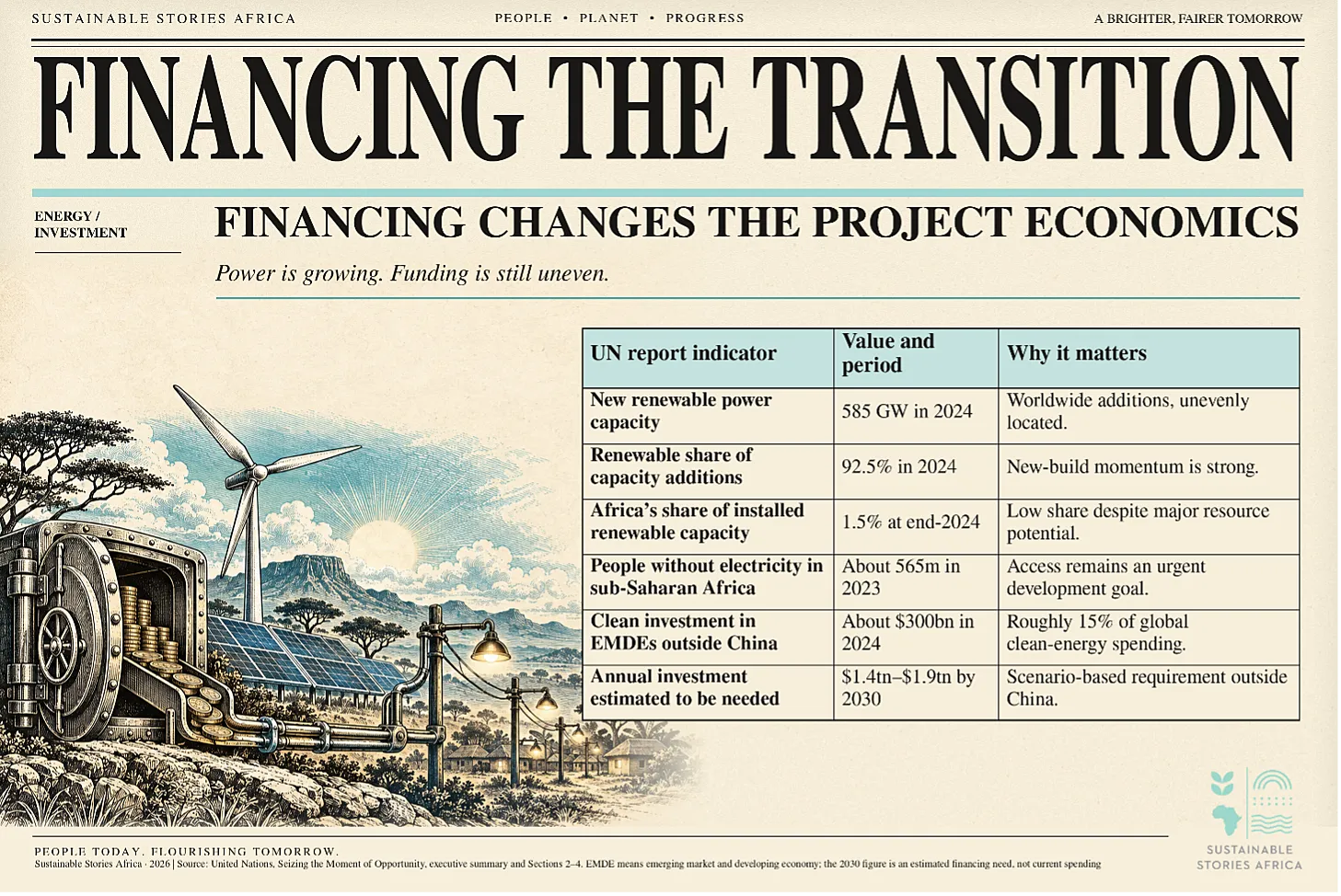
Africa nevertheless held only 1.5% of installed renewable capacity worldwide at the end of 2024.
The next barrier is less the price of a panel than the cost of finance, connection and reliable delivery.
Falling Costs Cannot Finance Themselves Alone
The United Nations’ Seizing the Moment of Opportunity: Supercharging the New Energy Era of Renewables, Efficiency, and Electrification reports that new utility-scale solar generated electricity at a global average levelised cost of 4.3 cents per kilowatt-hour in 2024, and onshore wind at 3.4 cents.
Those benchmarks are not tariffs available to every African buyer.
- Project financing and local infrastructure determine what a household or business actually pays.
In sub-Saharan Africa, approximately 565 million people still lacked access to electricity in 2023, according to the report’s cited data.
- The question facing a clinic without stable power is not whether the cheapest new generation technology has won globally.
- It is whether a project can be financed, connected, maintained and made affordable locally.
This insights and data article draws from the attached UN report’s executive summary, Section 2 on progress, Section 3 on opportunities, Section 4 on barriers and Section 5 on action.
- Its underlying dataset was finalised on 24 June 2025.
- Figures describing 2023 and 2024 must not be recast as measured 2026 outcomes.
Global Expansion Leaves Africa Behind
Renewables accounted for 92.5% of new worldwide electricity capacity in 2024, with 585 gigawatts added.
However, Africa had only 1.5% of the 4,448 GW of renewable capacity installed globally by year-end.
- The region also contained most of the world’s people without electricity access.
- The gap shows why global deployment milestones alone cannot measure an equitable transition.
Nor does capacity alone equal generation or access.
- A power station must operate; a network must deliver; a customer must afford the service.
The UN points to grid, mini-grid and stand-alone solutions as complementary routes to reaching different communities.
- A rural settlement may need a different solution from an industrial corridor, even when both are served by solar power.
Financing Changes The Project Economics
The UN says the cost of capital for utility-scale solar in emerging and developing economies is well over twice that in advanced economies, citing underlying research.
- That premium matters because renewable projects require major upfront spending and relatively low ongoing fuel expenditure.
- Cheap equipment financed expensively may still produce unaffordable electricity.
- Lowering real and perceived risk is therefore a consumer issue, not merely a concern for investors.
Infrastructure poses another hard limit.
- At least 3,000 GW of renewable projects were waiting in grid-connection queues in the report’s source period.
- Investment in generation cannot substitute for substations, transmission, flexible systems and strong utility governance.
In a market where power already fails frequently, adding generation without reliable delivery may leave businesses running backup systems.
The wider energy system remains dependent on fossil fuels.
- The report puts their share of global total energy supply at 80% in 2024, even as renewable electricity expands.
- Slow change in transport, industrial heat, cooking and efficiency explains why a power-sector success does not automatically deliver a whole-economy transition.
Electricity Access Multiplies Social Benefits
Reliable power can support health facilities, refrigeration, learning and small enterprises.
- The UN cites evidence that renewable mini-grids and other distributed systems can improve livelihoods and resilience, particularly where extending the central grid is slow or costly.
- Access must still be defined by useful, dependable service rather than the installation of a device alone.
A fair transition can create jobs.
- The report cites renewable-sector employment in Africa and highlights opportunities for women and young people, while warning that workers in fossil-fuel and biomass-linked activities may face different risks.
- Benefits will depend on skills, social protection and local participation. Calling a project “green” does not resolve those distributional questions.
Affordable local generation could also reduce exposure to imported-fuel price shocks for some markets.
- The value of that protection depends on generation mix, grid capability and financing terms.
- Governments should test claims about lower bills against full system costs and customer tariffs, rather than assume every project immediately reduces prices.
Finance Projects And Their Enablers
The UN recommends coherent national plans, investment in grids and storage, clean supply for new demand and reforms that make finance more accessible.
- African governments can publish transparent project pipelines and bankable offtake terms.
- Development finance institutions can use guarantees, concessional funding and project-preparation support where they genuinely crowd in private finance.
Utilities should plan grids, mini-grids and stand-alone systems against real demand and service standards.
Regulators must protect lower-income customers without making projects unfinanceable.
Education and labour policies should prepare technicians and ensure people affected by legacy energy systems can share in new work.
International lenders also have responsibility.
- If currency and sovereign-risk premiums are treated as immovable facts, the financing gap will persist even as panels become cheaper.
- Local-currency tools, risk-sharing and credible project preparation can tackle some barriers; they must be assessed for cost, accountability and who ultimately bears risk.
Path Forward – Fund Access Alongside Generation
Africa needs lower financing costs and functioning networks alongside renewable capacity.
Measure success through affordability, dependable connections and productive use.
Pair each generation target with a grid, access and finance plan.
Otherwise, the world can build cheap clean power while communities with the greatest need still wait for it.