
McKinsey says AI agents can cut time spent on core transformation-office tasks by 35% to 40%, with larger savings in some cases. The promise is faster insight and less manual reporting.
Automating coordination also magnifies mistakes when data and systems are linked.
African firms and public programmes considering these tools need traceable decisions, reliable data and explicit human accountability before agents act across workflows.
Transformation Teams Face A Reporting Bottleneck
Companies use transformation offices to coordinate changes across divisions, but those offices often rely on manually updated presentations and disconnected spreadsheets.
A September 2026 McKinsey article by Chase Covington, David Pralong and Tomer Slaney argues that AI agents can improve routine tracking and reporting, enabling people to spend more time resolving problems.
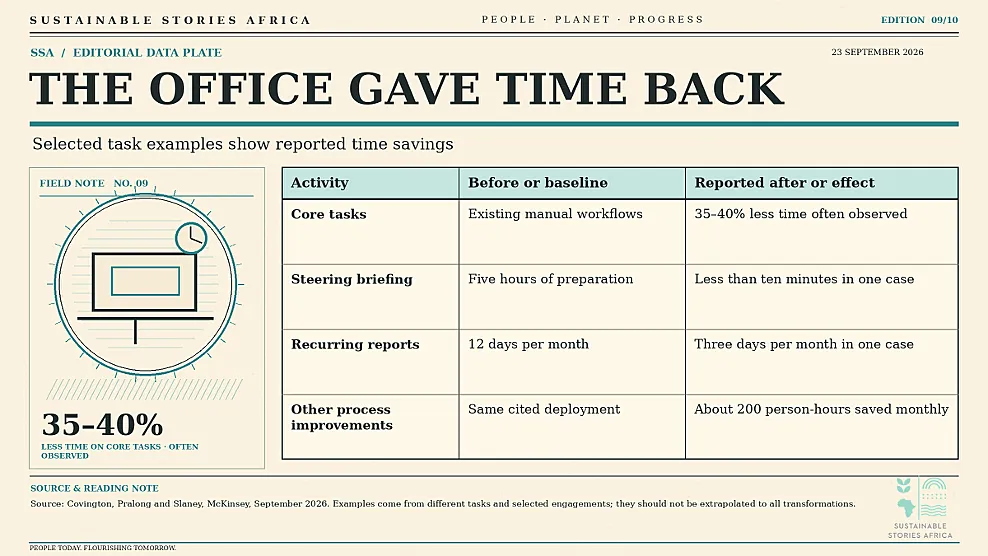
The authors say time spent on many core tasks can fall by 35% to 40% percent, and in some cases by 70% or more.
- These are observations from McKinsey’s work, not a representative estimate for all organisations or a promise of equivalent savings in Africa.
For a public agency coordinating infrastructure or a company integrating multiple sites, the attraction is clear: leaders can receive consistent information while there is still time to act.
The danger is equally clear when an automated conclusion is built on a bad input.
Fragmented Data Hides Costs And Delays
McKinsey describes a two-year global turnaround spanning eight divisions and more than 3,000 employees.
- Its office had over 15 full-time personnel and produced a report exceeding 300 pages every four weeks.
- Staff spent more than half their time validating data and rerunning spreadsheet analyses.
In another transformation, more than 100 documents tracked financial progress across eight divisions.
- Such fragmentation can leave different teams with different accounts of the same initiative.
- The result is not only administrative expense: a missed variance can delay an investment or a corrective decision.
The proposed agentic model has three pillars.
- Performance intelligence flags deviations as data change;
- A connected source of truth links risks, value and decisions;
- Conversation support prepares timely material for leadership reviews.
Each depends on trustworthy definitions and access rights.
Traditional offices can spend so much time collecting information that the review cycle lags behind events.
- When a missed milestone appears only in the next monthly report, a supplier problem or funding gap may already have grown.
An automated exception can shorten that delay, but it must indicate what changed, when and in which record so a person can verify it.
Time Savings Come From Specific Workflows
One cited team reduced a five-hour manual steering-committee briefing to less than ten minutes using an agent.
- Another cut the time spent on biweekly and steering reports from 12 days to three days per month, plus about 200 person-hours monthly from other process changes.
These examples show what happened in selected deployments and should not be added to make an organisation-wide productivity rate.
McKinsey also recounts a deployment that automated ten insight and reporting processes, reducing the central team from a manager plus nine staff to a manager plus two, freeing over 25 days of capacity.
- The description concerns staffing needs within that engagement; it is not evidence of an inevitable net employment loss or gain.
McKinsey describes a case that tracked more than 30,000 improvement measures and 900,000 time-related data points.
- Several staff members had to run manual quality checks and pivot-table analyses across hundreds of spreadsheets and multiple systems.
- An agentic process surfaced actions or omissions that had delayed financial results.
The scale explains the appeal of automation, while the example remains a particular deployment.
Human Judgment Remains The Critical Control
An agent can spot a delayed milestone, assemble evidence and notify the right owner.
- It cannot resolve a contested priority, repair trust between stakeholders or accept responsibility for a high-stakes decision.
- The authors explicitly place escalation, culture and strategy with people.
In African organisations, the data layer may cross payroll systems, project records, vendors and sites with different connectivity.
- That makes record quality and permissions a practical governance issue.
- Automating unreliable information can make an inaccurate status report appear authoritative and distribute it more quickly.
The article warns that an error in linked agents can spread downstream and that excessive false alarms can consume attention.
- A live dashboard should therefore display source provenance, last-update dates and named owners.
These safeguards are an SSA application of the source’s concerns, not an empirically tested package in the article.
A linked data layer also changes what leadership can ask.
- Instead of hearing that an initiative is late, a steering group could test how different funding or staffing decisions affect the schedule.
That possibility depends on models with visible assumptions.
- A convincing simulation should show its data sources, uncertainty and the decisions it can safely inform.
The technology may change roles within the office even where headcount does not fall.
- Analysts can spend less time copying figures and more time checking causes, explaining trade-offs and helping teams implement decisions.
The gain will depend on staff confidence in the system and whether managers accept corrections from the people closest to delivery.
Start With Reporting Then Govern Actions
A sensible sequence is to map recurring workflows, standardise measures and test agents on reporting and anomaly detection.
- Human reviewers should verify exceptions against source records.
- Only after that layer is stable should agents be allowed to initiate requests, update systems or send operational messages.
Boards and programme sponsors should define which actions need approval, log every automated change and set escalation thresholds.
- Privacy, security and procurement teams should examine access to financial, personnel and citizen data before connecting more systems.
Evaluation should compare time saved with correction work, error rates, decision quality and the experience of affected staff.
- An office that produces a deck faster but sends false numbers has not improved the transformation.
- The economic case depends on accuracy and adoption, not speed alone.
For a pilot, a practical scorecard could include time from a data change to an alert, proportion of alerts verified, errors corrected before executive review, hours recovered and decisions made sooner.
- Comparing these measures with a manual baseline would show whether an apparently quicker process improves management rather than simply producing more notifications.
Procurement deserves its own test.
- A pilot built around proprietary tools may lock an office into one vendor before it knows which data connections and controls are essential.
- Contracts can require exportable records, clear ownership of outputs, independent security reviews and a way to halt actions quickly.
These are safeguards for continuity and accountability, not a substitute for evaluating the quality of the underlying transformation.
Programme leaders should also budget for data maintenance, training and control work.
- The apparent saving from producing reports faster can disappear if staff spend equal time reconciling incompatible records or investigating false signals.
A staged trial should include those costs and record whether decisions improved, not only whether a presentation appeared sooner.
The Path Forward Puts People First
Organisations can trial agents on defined reporting tasks, measure results and make the audit trail visible.
Staff need training and authority to challenge outputs before automation expands.
A smaller administrative burden creates value when human teams use the regained time to solve delivery problems.
Governance must link the pace with the agents it oversees.