
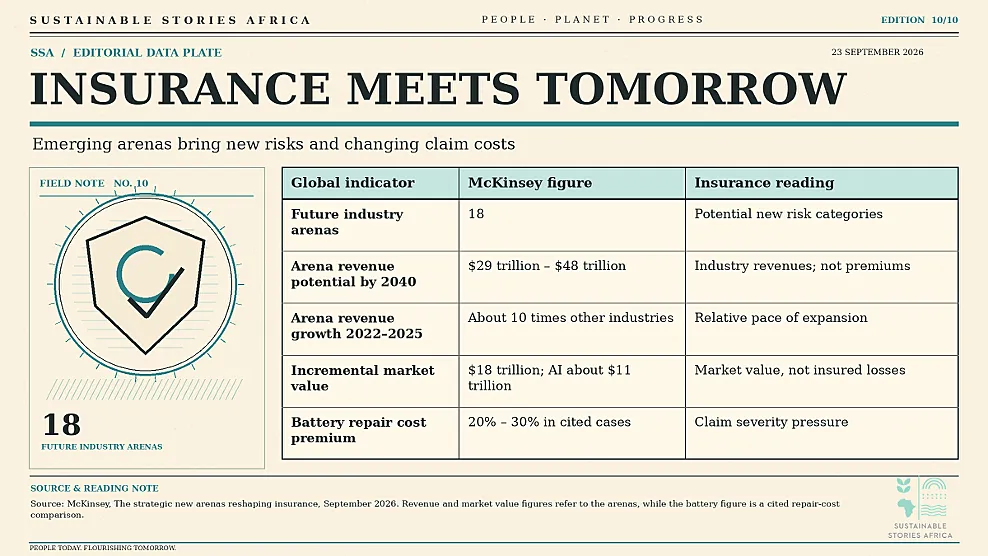
McKinsey identifies 18 high-growth industries that could generate $29 trillion to $48 trillion in revenue by 2040.
They offer insurers new customers and unfamiliar, potentially severe losses.
In African markets, the opportunity is to extend useful coverage as electric mobility, digital commerce and other technologies develop.
Insurers will need local claims data, clear liability rules and products customers can understand and afford.
New Industries Create New Insurance Questions
McKinsey’s September 2026 analysis says 18 potential high-growth industry “arenas” could generate between $29 trillion and $48 trillion in global revenue by 2040 and contribute up to a third of global growth.
For insurers, the opportunities go beyond selling policies to fast-growing companies.
- New technologies change which assets exist, how they fail and who bears the loss.
The report spans AI, cyber, electric vehicles and batteries, space, robotics and biotechnology, among others.
The McKinsey team includes Kevin Russell, Kweilin Ellingrud, Sebastian Kohls and Tanguy Catlin.
- The $29 trillion to $48 trillion figure describes possible revenues across the industries, not insurance premiums.
For African insurers, these are global signals rather than a forecast of local demand.
The pace at which any arena becomes insurable depends on adoption, income, infrastructure, regulation and access to risk data.
Growth Changes Frequency Severity And Liability
McKinsey says revenues in the 18 arenas grew about ten times faster than other industries between 2022 and 2025.
- Their public and large private companies added about $18 trillion in market value;
- AI accounted for about $11 trillion.
The underlying data cover about 4,000 companies representing $50 trillion in 2025 revenue.
Insurance economics can change in four ways:
- New exposures create demand for cover;
- Claim frequency and severity shift;
- Digital tools alter operating costs;
- Health advances change life and disability assumptions.
These are directional findings, not quantified African premium forecasts.
Electric vehicles offer a concrete example.
- McKinsey cites evidence that battery repairs, when possible, can cost 20% to 30% more than comparable internal-combustion repairs.
- Some battery damage produces a total loss, and thermal incidents can connect motor and property risks.
Pricing must account for repair capacity, spare parts and what a policy actually covers.
The report groups arenas into;
- AI foundations
- Digitisation
- Electrification
- Hard technology
- New biological frontiers.
Some are already scaled, such as e-commerce and cloud services, while other lines need more evidence on safety and loss patterns.
This diversity is why one industry growth number cannot translate into a uniform insurance forecast.
Growth Also Concentrates Insurers Emerging Exposures
The report also notes that active satellites rose from about 2,000 in 2019 to more than 18,000 at the time of the report.
- More assets in orbit bring launch, collision and service-interruption risks.
- Such policies are specialist products, yet the example illustrates why old loss histories may be a poor guide to new technologies.
Biomedical advances could change mortality and morbidity assumptions in life and health cover
- Cyber and AI-enabled products could create failures shared by many customers at once.
- An insurer may write many apparently separate policies that depend on the same software provider or data centre, creating accumulation risk.
McKinsey places these opportunities against insured natural-catastrophe losses exceeding $127 billion globally in 2025.
- That figure is a global context measure, not a loss caused by the 18 arenas.
- Insurers seeking growth must still examine climate exposure and the affordability of existing protection.
McKinsey describes a shift toward fewer but more expensive claims in some lines.
- An electric vehicle may avoid certain mechanical failures yet incur a large repair bill for a damaged battery.
- An automated service may prevent routine mistakes but create correlated losses when the same software fails across many customers.
The net effect depends on observed frequency, severity and the ability to prevent or contain incidents.
New Exposure Creates Concentrated Insurance Risk
Electric motorcycles, digital marketplaces, logistics drones and distributed solar systems may offer useful cover opportunities in different African markets.
- This is an application of the global framework, not an assertion that all are already major premium pools.
- The policy question begins with what happens when a battery burns, a platform fails or a delivery system damages third-party property.
Claims data, repair networks and legal definitions will differ across countries.
- Insurers can work with regulators, manufacturers and service providers to gather incident records, define liability and set reasonable exclusions.
- Parametric or embedded models may help distribution in some contexts, but suitability and customer comprehension should be tested rather than assumed.
The industry should avoid a coverage gap in which innovative assets are financed and used before anyone agrees on who pays for failure.
- Equally, a product that looks innovative but excludes the most likely damage provides little protection.
- Clear terms and effective complaints channels are therefore part of market development.
New technologies can also lower insurance costs.
- Connected sensors, drones and digital records can improve inspections, spot hazards and reduce manual claims handling.
- Savings are possible, not automatic: devices can malfunction, data can be incomplete, and a lower operating expense does not ensure that premiums fall for customers.
Insurers should report both service outcomes and costs.
Life and health insurance cover pose a different challenge.
- If obesity treatments and personalised medicine change morbidity and longevity, historic assumptions may need revisiting.
- Early evidence can be uneven across populations.
Product redesign should therefore avoid excluding people or pricing them out of cover based on a narrow data set.
Underwrite Emerging Risks With Better Evidence
Insurers should map exposure across motor, property, cyber, liability, life and health books, paying particular attention to shared vendors and correlated events.
- Pricing pilots can collect repair cost, failure and claims data before assumptions are scaled nationally.
- Reinsurers and regulators can test whether capital and disclosure standards match emerging accumulations.
Product teams should explain coverage in plain language and compare actual loss experience with initial rates.
Governments can clarify liability for autonomous systems and data-related harm, while supporting secure incident reporting.
- More dependable evidence can expand coverage without forcing households to pay for risks insurers have not properly understood.
The 18 arenas present a strategic map, not a ready-made forecast for Africa.
- Decisions should be made line by line and market by market, with climate and inclusion goals alongside premium growth.
The case for prevention is especially strong where recovery after a loss is slow.
- If an insurer helps a commercial client maintain batteries or protect a digital platform, fewer interruptions may benefit employees and users as well as the balance sheet.
- Products should specify prevention services and what happens when a recommended safeguard was unavailable or unaffordable.
Local evidence should also clarify what an insurer cannot cover alone.
- A systemic software failure or extreme climate event may exceed a single firm’s capacity.
- Reinsurance, catastrophe mechanisms and sound public infrastructure can share or reduce exposure, but any public support should specify the risk transferred and the conditions attached.
The objective is useful protection rather than simply shifting losses to taxpayers.
Consumer protection is a useful measure of success alongside growth in written premiums.
- Insurers can disclose the share of claims accepted, the time taken to settle them and the reasons for denial across new products.
- Regulators and customers can then see whether innovation is filling a real protection gap or merely creating a new sales channel.
The Path Forward – Price New Risks Fairly
Insurers can start with targeted pilots, shared incident data and policy language that customers can use.
Regulators should clarify responsibility when technologies fail and watch for concentrated exposures.
New premium pools will be valuable if cover absorbs real losses, reaches underserved users and remains financially sound.
Growth in the underlying industries alone does not guarantee that result.