MIT researcher Andrew McAfee argues that technological progress can create work and prosperity, even as automation displaces existing jobs.
In a McKinsey discussion, he challenges attempts to prescribe some direction of AI before its uses emerge.
For African economies, the sharper question is how to build infrastructure and skills while managing uneven labour outcomes, resource demand and pollution. The hosts’ universal-prosperity scenario makes the physical scale of that ambition plain.
AI Optimism Meets Development Reality Today
In a September 15 McKinsey Global Institute podcast, MIT researcher Andrew McAfee told Chris Bradley and Marc Canal that fears of widespread technological unemployment had not materialised over the 15 years since his earlier work on automation.
He remains concerned about inequality and the hardship of job loss, but argues that people tend to see the jobs technology destroys more clearly than those it may create.
The discussion also exposed a difficult development question.
- Bradley and Canal sketched a hypothetical world in which even the poorest countries attain the living standards of Switzerland today.
- In their scenario, output and demand for electricity and materials rise sharply.
McAfee agreed that emerging economies need more physical infrastructure, while arguing that innovation can lower the resources needed per unit of prosperity.
The podcast presents judgments and a scenario, not measurements of African AI employment or a forecast for African resource use.
Its relevance to the continent lies in the choices it frames:
- Make room for experimentation, protect people facing disruption and plan for the material foundations of wider prosperity.
Why Uncertain Innovation Shapes The Debate
McAfee revisited his earlier concern that increasingly capable software would leave substantially fewer tasks for people.
- He said rich economies had not experienced the mass technological unemployment he feared, and he no longer treats it as the leading risk.
- He did not dismiss the social cost of layoffs or regional decline; he described job loss as damaging to people’s economic future.
He favours what he calls “permissionless innovation”, arguing that policymakers cannot reliably select useful applications in advance.
- Canal similarly questioned whether technologies can be divided neatly into those that complement workers and those that do not.
- That is their position in the debate, rather than evidence that all regulation obstructs progress.
For an African policymaker, the practical distinction is between regulating identifiable harms and trying to predict every future use.
- A system used to allocate credit or make clinical recommendations creates immediate questions about transparency, appeal and accountability.
- Those can be addressed even while entrepreneurs test new tools.
The disagreement has a distributional dimension.
- A tool can increase output overall and still reduce earnings for a particular worker or business.
- McAfee acknowledged that economic disruption can be concentrated in places that lose employers, and that policy tools for repairing those places are imperfect.
For African labour markets, sector-level totals should therefore be read alongside outcomes for young entrants, contractors and workers who lack formal protections.
The Material Arithmetic Behind Wider Prosperity
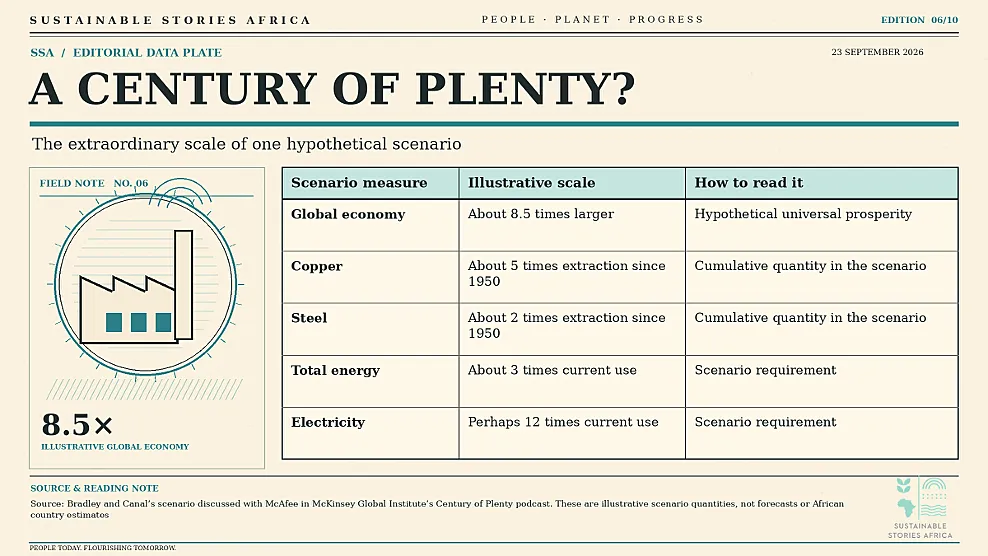
The most consequential numbers in the conversation concern a thought experiment on universal prosperity.
- Bradley said the exercise implies an economy about 8.5 times larger, requiring about three times the total energy and perhaps 12 times the electricity.
- Those ratios refer to the hosts’ stated scenario; they are neither current consumption figures nor predictions for 2040.
McAfee pushed back against the idea that the same level of prosperity must be built with the same amount of material used by today’s rich cities.
- Better design, transport services and technology may reduce intensity.
However, Bradley stressed that replacing informal housing with safe buildings still takes steel, power and other inputs.
Their comparison is useful because it forces resource accounting into the same conversation as digital productivity.
- Electricity must be generated and moved; copper, steel and cement have to be supplied; buildings and transport require maintenance.
- Any discussion of dematerialised growth that omits these physical systems risks confusing lower intensity per unit of output with lower total demand.
Opportunity Depends On People And Place
African cities may bypass some older infrastructure, such as extensive copper telephone networks, while investing in modern grids, housing and public transport.
- That possibility is an inference from the discussion, not a claim measured in the podcast.
- Capital costs, unreliable supply and access to skills will shape whether a lower-intensity path is available in practice.
McAfee distinguished material efficiency from pollution control.
- Firms have an incentive to reduce inputs they pay for, he argued, while pollution imposes costs on others and requires public pressure and effective government action.
This distinction matters where a new data centre promises services and jobs but also raises questions about electricity demand, water and local emissions.
A credible development strategy should therefore link digital opportunity with construction, maintenance and energy skills.
- McAfee highlighted the need for physical trades in building AI infrastructure and completing the energy transition.
Automation benefits can widen if workers can enter those jobs, gain portable skills and move across sectors without bearing transition costs alone.
The speakers also disagreed with a simple claim that resource availability alone places an absolute limit on development.
- McAfee argued that exploration and technical change can expand economically usable supplies.
That does not resolve the local costs of mining, the time required to permit projects or production emissions.
- These are planning and governance questions, especially where the extraction site and the consumers of its output are far apart.
Put Guardrails Where Harms Become Visible
Governments can publish measurable indicators for AI adoption, entry-level hiring, wage changes and affected occupations, then adjust labour support when patterns emerge.
Businesses can identify which tasks change, train staff and report what happened to productivity and employment.
- These are proposed monitoring steps; the podcast does not supply estimates of their effectiveness.
Energy and industry planners should test digital and prosperity ambitions against generation capacity, network reliability and material supply.
Regulators should require recourse when automated systems affect essential services and set enforceable pollution standards.
- Such rules target observed risks while leaving room to develop useful applications.
The evidence gap remains substantial.
- Experience in wealthy labour markets cannot settle what happens where informality, youth employment and access to electricity differ.
- African researchers and public agencies need local data before treating either optimism or a displacement forecast as settled fact.
A useful public dashboard would report more than the number of AI firms launched.
- It could track electricity availability for schools and industry, graduate and apprenticeship placement, the cost of retraining, energy intensity, and complaint outcomes from high-stakes automated decisions.
- Without baselines and disaggregated records, claims that innovation has lifted everyone remain difficult to verify.
The difference between productivity and broadly shared welfare depends on institutions.
- If a firm captures the gain while training costs and unstable work fall on households, the aggregate output figure will hide that distribution.
- Public procurement, tax treatment and education policy can reward tools that improve service quality and widen access, while evaluation should still allow evidence to overturn initial assumptions.
The Path Forward Requires Measured Innovation
African institutions can support experimentation while tracking employment, energy demand and who benefits.
Training policies, public infrastructure and accountability should respond to measured outcomes.
McAfee’s argument invites ambition, but the hosts’ scenario shows the scale of the buildout involved.
A credible path joins new technology to decent work, reliable power and enforceable environmental protection.