China's zero-tariff offer removes a visible barrier for 53 African economies, but it does not create factories, cold chains, standards capacity or buyers.
The ACCPA dialogue showed that near-term gains are likely to come from products countries already export.
Industrial growth will depend on patient policy, regional value chains and firms able to compete beyond preferential access.
Zero Tariffs Open A Narrow Window
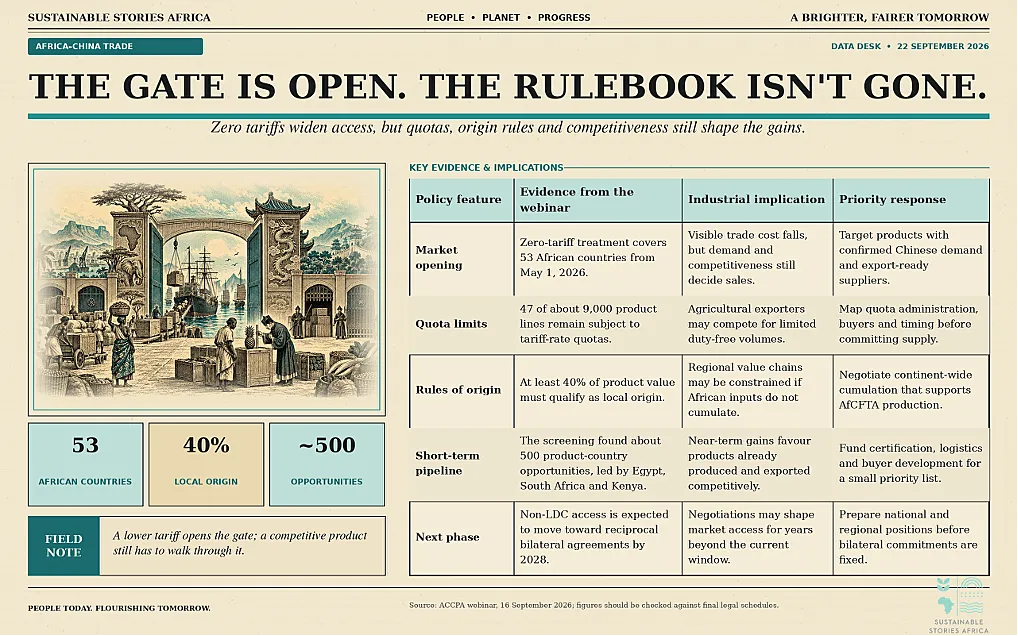
China's decision to grant zero-tariff treatment to imports from 53 African countries took effect on May 1, 2026.
The measure expands duty-free access beyond Africa's least developed countries and gives larger economies, including Ghana, Kenya, Egypt and South Africa, a new opening into the Chinese market.
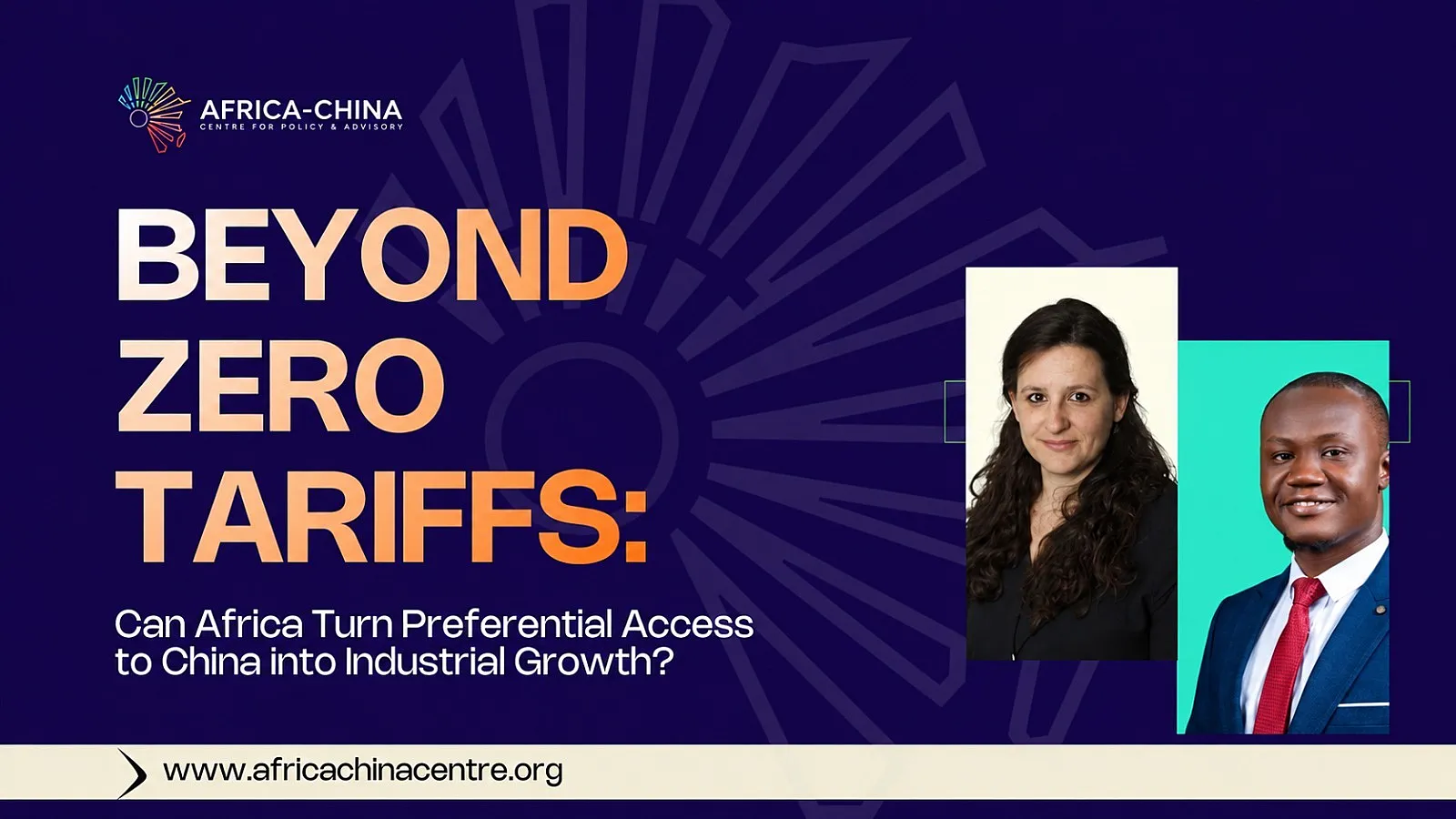
At a September 16 virtual dialogue hosted by the Africa-China Centre for Policy and Advisory, Linda Calabrese, a development economist at ODI Global, examined whether that opening can raise exports, deepen value addition and support industrial growth.
Paul Frimpong, ACCPA's Executive Director, moderated the discussion.
The central finding was cautious.
- Tariffs matter, but they are only one part of an exporter's cost and risk.
- Demand, standards, logistics, scale, finance and competition still decide whether a product reaches a buyer.
As Calabrese put it, "the devil is in the details."
Market Access Does Not Guarantee Export Growth
The policy is broad enough to change trade calculations.
- Calabrese traced China's concessions from 190 tariff-free product lines for African least developed countries in 2005 to 95% of product lines in 2009 and full coverage for those countries in 2024.
The 2026 change extends the treatment to the rest of the eligible continent.
However, a tariff cut creates an opportunity only when a firm already has a competitive product, can meet Chinese requirements and can deliver at the right price.
- A mango exporter with reliable volumes, certification and cold-chain access starts from a stronger position than a manufacturer that still lacks electricity, working capital or an export market.
- The first commercial gains will therefore be uneven across countries and sectors.
The agreement also changes the position of countries that previously held exclusive preferences.
- Uganda or Tanzania once enjoyed a tariff advantage over Kenya on some lines.
- Equal access can erode that advantage and may concentrate trade in larger economies that offer Chinese buyers more scale, stronger logistics and a wider supplier base.
Trade Structure Reveals Africa's Starting Position
The current trade structure explains why market access alone cannot deliver industrialisation.
According to the data presented at the webinar;
- Approximately 31% of China's imports from Africa were raw materials
- 33% were oil and gas.
- A further third was classified as manufactured goods, although that category includes minerals and commodities with limited processing.
China's exports to Africa are much more diversified, spanning machinery, transport equipment and manufactured consumer and industrial goods.
- The imbalance is therefore qualitative as well as quantitative.
- Africa sells a narrow basket with limited processing while buying a wider range of higher-value products.
Zero tariffs can increase the volume of the existing basket without changing its structure.
- If countries export more unprocessed minerals or primary crops, the policy may improve foreign-exchange earnings but leave local productivity, technology and job creation largely unchanged.
The industrial test is whether governments and firms can use the opening to expand processing, manufacturing capability and supplier networks at home.
Fine Print Shapes The Commercial Opportunity
Several rules narrow the headline offer.
- Forty-seven of about 9,000 product lines operate through tariff-rate quotas: imports receive zero duty up to a defined volume, after which tariffs return.
- Many are agricultural goods that African exporters could supply, but access can depend on quota administration and the purchasing decisions of Chinese state trading enterprises.
Rules of origin require at least 40% of a product's value to come from the exporting country.
- Chinese inputs may count as local content, while inputs from another African state count only under specified trade arrangements.
That design can reward bilateral supply chains while making AfCFTA-based regional production harder unless African negotiators secure wider cumulation across the continent.
Value Addition Begins With Existing Strengths
Calabrese screened products against three immediate tests:
- China already imports the product; the African country already produces and exports it competitively; and the product previously faced a tariff that has now been removed.
- The exercise identified roughly 500 possible product-country combinations, including 72 for Egypt, 52 for South Africa and 44 for Kenya.
- Ghana's shorter list included fruits, rubber, metals and processed products.
This is a practical starting point, not a forecast.
- A product may still fail if Chinese demand is weak, domestic logistics are expensive or Asian and Latin American suppliers can deliver more cheaply at scale.
- Cement clinker, for example, may appear export-ready in a dataset but face little opportunity because China is already a major producer.
The most credible industrial gains may come through deeper processing of products Africa already supplies.
- Cocoa, coffee, timber, cashew, rubber and minerals can support packaging, refining, component production and other forms of value addition.
Those steps require investment and technology, but they are closer to existing capabilities than an abrupt move into unrelated manufacturing.
Regional Production Needs Better Trade Rules
The AfCFTA could help smaller economies combine inputs, specialise across borders and reach the scale Chinese buyers require.
- However, that potential depends on rules of origin that recognise African value created across several countries.
- The current arrangement does not yet provide continent-wide cumulation on equal terms.
African governments should coordinate before the next bilateral phase.
- Shared positions on rules of origin, standards recognition and regional sourcing would reduce the risk that countries negotiate separately and weaken the production networks they are trying to build through the AfCFTA.
- Export promotion agencies can also pool market intelligence, identify Chinese buyers and organise regional supplier groups around a small number of viable products.
Governments And Firms Must Build Capability
Governments should begin with product-level action.
- For each priority line, they need to map Chinese demand, competing suppliers, landed costs, certification requirements and the domestic firms able to deliver.
- Standards bodies should work toward recognised testing and certification pathways, while ports, roads, power systems and cold chains must serve the products selected for export growth.
Industrial policy must then address the deeper constraints.
- Stable sector plans, development finance, working capital, supplier development, technical training and credible investment conditions are more important than temporary tax incentives.
- In minerals and agro-processing, foreign investment agreements should support local processing, workforce development and technology transfer without assuming that investors will provide them voluntarily.
Businesses also carry responsibility.
- Firms need buyer relationships, consistent quality, competitive prices and enough volume to fulfil contracts.
- Exporters that already serve demanding markets may adapt more quickly to Chinese standards, but new entrants must budget for testing, documentation and certification before treating a tariff preference as profit.
Path Forward – Industrial Strategy Must Outlast Tariff Preferences
African countries should pursue products that can win orders now; however, they must keep the larger goal in view: competitive industries able to sell in Africa, China and other markets.
The zero-tariff window is useful leverage for buyer access and negotiation.
Its lasting value will depend on whether countries build productive capacity, align regional rules and secure technology and skills that remain after trade preferences change.