A new IDOS flagship report argues that geopolitical disruption is occurring alongside practical reform in trade, finance and environmental cooperation.
It advises governments to build coalitions and institutions that can survive in a divided world.
The stakes for African countries are concrete: a larger voice in global rules, more credible development finance and stronger domestic revenues.
An approach based on cooperation that delivers measurable results, not simply preserving diplomatic language.
Cooperation Persists Amid Rules-Based Strain
The German Institute of Development and Sustainability has published its 2026 flagship report, Disruption & Reform, edited by Anna-Katharina Hornidge and Axel Berger.
- It rejects a simple account of multilateral collapse and identifies reform through middle-power coalitions, smaller agreements, financing changes and new capacities to act.
For African governments, the question is whether such arrangements will broaden their influence and support public investment, or recreate decisions made elsewhere.
- The report treats reform as a political process requiring persistence, not an automatic consequence of crisis.
Its four thematic sections span geopolitics, multilateralism, sustainable transformation and social innovation.
They do not yield a single numerical score for cooperation. Individual chapters offer indicators and proposals that can be tested against outcomes.
Sustainable Goals Reveal An Implementation Gap
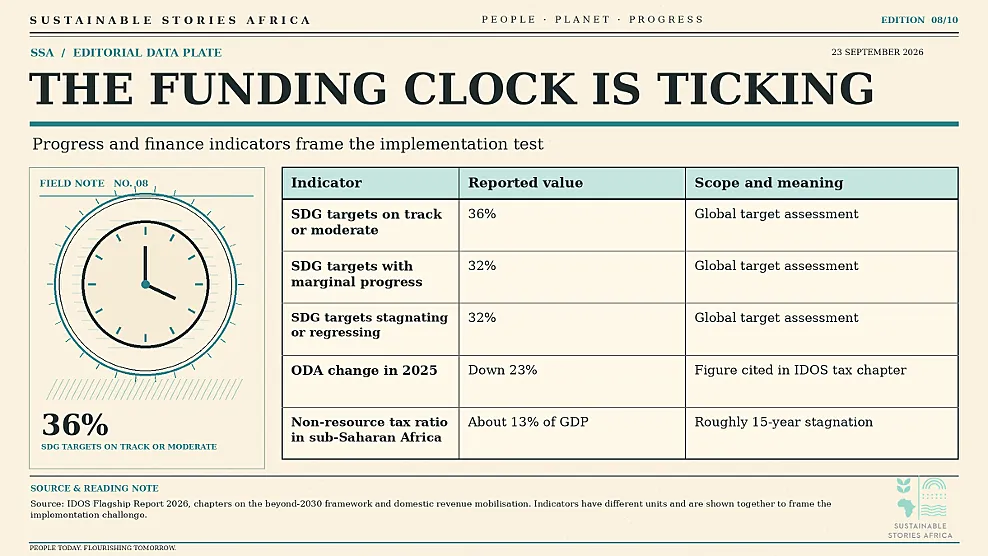
A chapter on a framework beyond 2030 cites United Nations figures: 36% of Sustainable Development Goal targets are on track or show moderate progress, while 32% show marginal progress and another 32% are stagnating or regressing.
- These are shares of targets globally, not outcomes for each African country.
The authors argue that a shared framework can supply common language, a reference point for smaller coalitions and a basis for accountability.
- They acknowledge that renegotiating global goals would be difficult; continuing existing goals with stronger implementation may be another route.
The report describes an example of African diplomatic agency.
- During debate over the Pact for the Future, the Republic of Congo initiated a procedural response on behalf of the African Group that won support from 143 members, with seven opposing and 15 abstaining.
The episode demonstrates coalition capacity; it does not prove that all subsequent financing or policy commitments will be honoured.
The report does not portray cooperation as a return to one uncontested global order.
- It proposes coalitions that can act on defined problems while preserving a broader framework of shared goals.
For African states, participation means they can shape standards early and seek technical and financial support for compliance, rather than join after the main terms have already been decided.
Financing Reform Must Be Measured Honestly
The report's chapter on domestic revenue mobilisation says official development assistance fell 23% in 2025 and cites an annual developing-country financing gap of $4 trillion.
- It reports that 75% of low-income countries and 46% of lower-middle-income countries collect taxes worth less than 15% of GDP.
- These are cited estimates, using different populations and periods.
The same chapter puts the non-resource tax-to-GDP ratio in sub-Saharan Africa at about 13% over roughly 15 years.
- Its argument goes beyond better enforcement: taxpayers are more willing to contribute when public services, transparency and accountability make the fiscal bargain credible.
Another chapter asks why blended finance has often fallen short in mobilising private investment.
- A promise that a small public contribution will unlock capital is useful only when projects can show additional investment, fair risk allocation and outcomes for the communities they serve.
The global goal figures are sobering precisely because even marginal improvement leaves many targets distant from success.
- A future framework could create clarity on priorities, but only if it improves the link between targets, national budgets and independently visible results.
- Replacing one set of indicators with another without addressing implementation would preserve the gap described in the report.
The report’s tax chapter raises a second dimension of the financing problem: revenue forgone through exemptions and other tax expenditures.
- Reviewing them can reveal whether public resources support investment and social goals or chiefly benefit narrow groups.
However, recovering revenue is a political choice, not a mechanical calculation.
- Governments need to evaluate the economic effects of each incentive and disclose who benefits.
African Coalitions Can Shape Fairer Rules
A country facing debt service, climate exposure and reduced external grants cannot treat trade, tax and development finance as unrelated negotiations.
- Coalitions could align positions on fair market access, more workable financing terms and the information needed to track commitments.
The report considers plurilateral cooperation, in which willing countries move on a defined issue even when universal agreement stalls.
- Such arrangements can build momentum, but they should remain open to additional members and avoid standards that impose compliance costs without support for lower-capacity states.
Environmental cooperation, the authors say, has held up better than narratives of wholesale collapse imply.
- For African communities experiencing floods, heat and biodiversity loss, the test is whether global pledges become accessible funds, early warning systems and accountable adaptation projects.
The development-finance debate cannot be reduced to the headline amount of capital mobilised.
- A project may secure commercial lending while passing currency risk or high tariffs to the public.
- A more complete assessment asks whether finance was additional, whether the project would otherwise have happened and whether households can afford the service delivered.
Those questions follow from the report’s emphasis on effective partnerships.
Translate Diplomatic Reform Into Public Results
African negotiators and regional institutions can publish shared priorities before major trade, climate and finance meetings, specify where cooperation should change national budgets and disclose what was agreed afterwards.
- Ministries should link external commitments to domestic delivery plans with dates, responsible agencies and indicators.
Tax reform needs scrutiny of exemptions and predictable public reporting, together with services that demonstrate value to citizens.
- Financing deals should state who bears currency, first-loss and performance risks.
- Civil society and researchers should be able to inspect whether projects reach intended groups.
IDOS calls for new leadership and knowledge infrastructure as well as institutional redesign.
- The risk is that broad appeals to solidarity become substitutes for implementation.
- Tracking a few verifiable commitments across coalitions would be a better measure of progress than counting declarations.
Universities, local researchers and public auditors should be part of this process.
- They can compare negotiated goals with expenditure and community outcomes, including who benefits and who bears costs.
- The report’s attention to knowledge and transformative capacity makes evidence production part of cooperation itself, rather than a publication exercise after decisions have been taken.
Regional institutions can increase negotiating influence by comparing their own needs, yet countries do not start from identical fiscal or climate positions.
- A common platform should allow specific commitments and clear financing terms rather than force uniform policy.
- This is particularly relevant when international partners propose new reporting standards that require data systems and trained staff many administrations still need to build.
The next negotiation cycle offers a practical checkpoint.
- Governments can ask whether a coalition secured a workable provision, whether a financing mechanism approved projects and whether public reports show delivery.
Repeating these tasks annually would link the diplomatic calendar to the 2030 targets and the communities the targets were designed to serve.
The Path Forward Requires Accountable Coalitions
African governments can use regional and wider coalitions to shape post-2030 goals, trade rules and finance terms.
Each initiative should identify resources, responsible institutions and public measures of delivery.
The report’s case for perseverance becomes persuasive when cooperation improves tax capacity, protects vulnerable communities and funds a just transition.
Political agreement is a starting point; results are the test.