
A victim can sometimes trace a fraudulent payment to an account without knowing who controls it.
Legal researchers argue that courts need a narrowly guarded route to the identifying information.
The safeguard remains the remedy: an innocent witness should not become an unrestricted source of private data.
Hidden Wrongdoers Expose An Evidence Gap
The attached paper Beyond the Mere Witness: Compelling Third-Party Disclosure to Identify Wrongdoers in Nigeria asks when an information holder may be ordered to help a claimant identify someone responsible for a wrong.
Its authors, Adeyinka Aderemi, SAN, Benjamin Idahosa, Okechukwu Okoro and Gafar Okanlawon of StreamSowers & Kohn, argue for a graduated approach for private people, companies and state agencies.
That question impacts significantly in a digital economy.
- A bank may know the controller of an account receiving disputed money.
- A platform may hold registration records.
- A public body may retain corporate ownership information.
The claimant needs a usable identity, but other people have privacy interests and institutions have legitimate confidentiality duties.
This article is based on the paper’s introduction, its discussions of the traditional mere-witness rule and the Norwich Pharmacal exception, and its separate sections on private individuals, corporations and government agencies.
- It explains the authors’ argument, not a newly enacted Nigerian disclosure rule or legal advice on a particular case.
Hidden Identities Can Defeat Claims
The mere-witness rule traditionally prevents separate proceedings against a person outside a dispute simply to extract evidence.
- Its rationale includes shielding innocent people from harassment and preserving ordinary litigation procedures
However, a claimant cannot necessarily sue an unknown wrongdoer and then subpoena a witness: the missing identity can stop the case before it starts.
The equitable exception associated with Norwich Pharmacal does not abolish that protection.
- The paper explains that relief may be considered where a third party became sufficiently mixed up in the wrongdoing, even innocently, and their disclosure is necessary to identify a person against whom the wronged party has a viable claim
- It is exceptional, discretionary relief rather than a general investigatory entitlement.
Involvement Defines The Disclosure Boundary
The private-person distinction is easiest to understand through a comparison.
- Someone who saw a suspect enter a building may have useful information but no connection with the alleged wrong beyond chance observation.
- Someone whose account was used to receive proceeds occupies a different position, although the court must still examine the facts.
The question is not simply “who knows?” but whether the relationship and necessity justify intrusion.
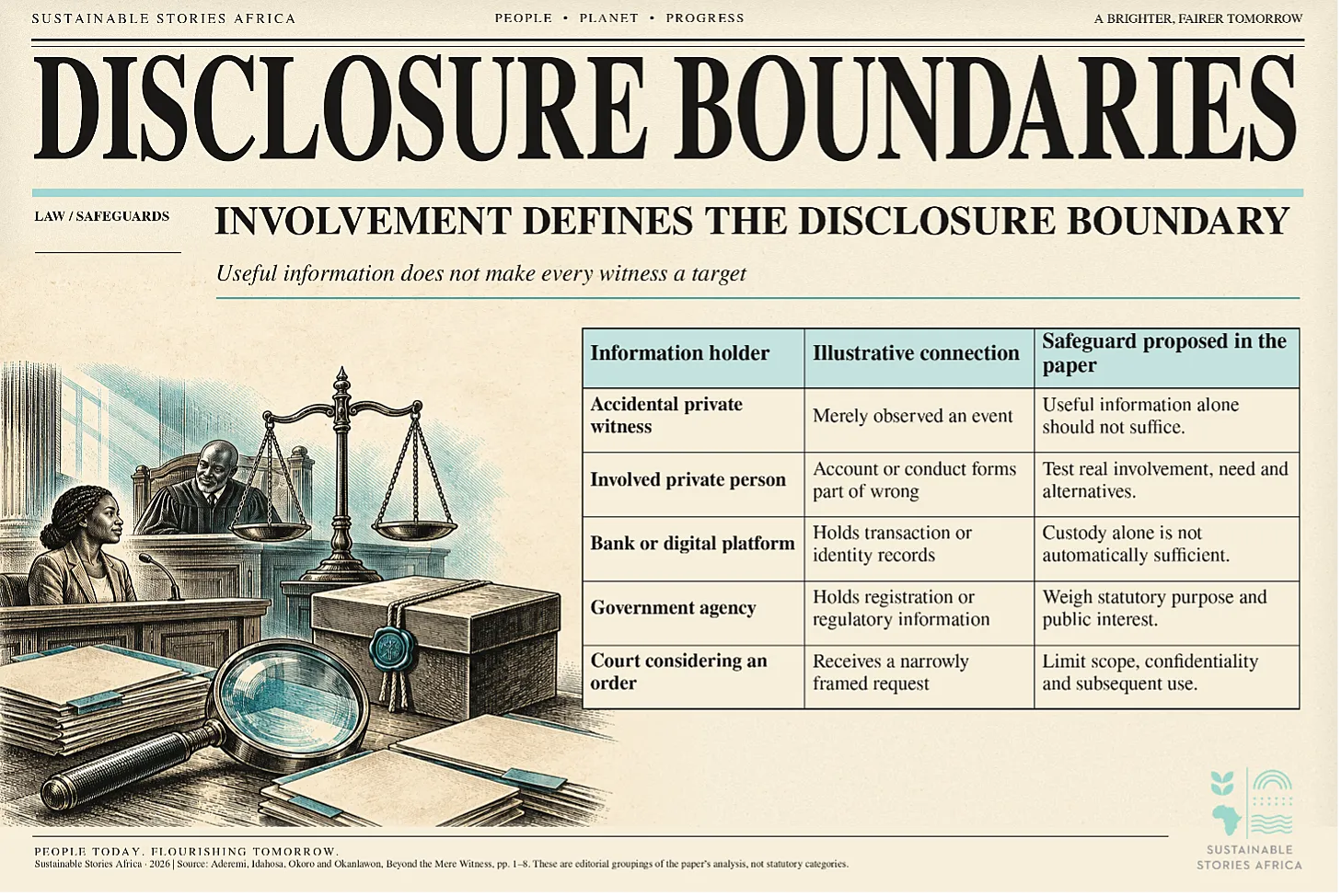
For corporations, the paper warns against a shortcut.
- A bank does not automatically facilitate fraud merely because its infrastructure processes a payment.
- A telecommunications provider does not automatically become “mixed up” in a wrong because a message travelled on its network
Still, some intermediaries create or retain the only records capable of identifying an anonymous actor.
- A court must examine the closeness of the connection, alternative sources and the extent of the proposed order.
Public records add complexity.
- Ordinary company-registration data may differ from material obtained confidentially through an investigation or intelligence process.
The authors argue that confidentiality is not always absolute, but neither is it irrelevant.
- Nigerian constitutional privacy protections and statutory duties must inform the balance; broad requests for government data should not masquerade as exceptional identity disclosure.
Redress And Privacy Can Coexist
A disciplined route to disclosure could make civil remedies meaningful where digital anonymity would otherwise defeat them.
- For consumers and small companies harmed by an identifiable transaction but an unknown counterparty, that may turn a theoretical right into a case they can actually bring.
- The benefit is contingent on a claimant satisfying the legal threshold; it is not a promise of access to any dataset they want.
Privacy protection can improve trust in that remedy.
- Narrow time periods, specified transactions, confidentiality undertakings and limits on later use help keep innocent people’s data outside a dispute.
- A narrowly drawn order may also reduce the compliance burden on banks and platforms compared with a speculative demand for wide-ranging records.
Predictable procedure serves institutions as well.
- Respondents need to know when they can resist a request
- Claimants need to know what evidence to provide
- Courts need a record showing why less intrusive sources will not work.
The authors suggest expressly addressing non-party disclosure in procedural reforms and aligning any route with data-protection and sector-specific regimes.
Demand Narrow And Reviewable Orders
An applicant should identify an arguable legal wrong, the precise information required, the respondent’s connection and why the material cannot reasonably be obtained elsewhere.
- A request should say how the data will identify or enable pursuit of the wrongdoer, rather than ask for anything that “might be relevant”.
Courts should assess necessity, proportionality, statutory confidentiality and public interest, then limit any order to the information actually justified.
- Public bodies may raise distinct concerns about investigations and sensitive sources.
- Banks and digital services should preserve records appropriately, but a private demand should not be treated as equivalent to a lawful court order.
Lawmakers could consider clearer civil-procedure rules for non-party disclosure with privacy and use restrictions.
- Such reform would need to respect the traditional mere-witness safeguard while recognising how digital transactions locate decisive evidence in third-party systems.
The attached paper advocates that direction; it does not say the proposed reform has already been adopted.
Path Forward – Define A Guarded Disclosure Route
A Nigerian doctrine can retain protection for genuine witnesses while allowing exceptional, supervised disclosure when a wrongdoer would otherwise remain unidentifiable.
The guiding test should be involvement, necessity and proportionate scope.
That offers victims a possible route to redress without turning every information custodian into an open-ended investigator.