RE100 members reported 59% renewable electricity in its 2025 disclosure edition, up from 53% in the previous report.
The initiative recognised only 43% after testing the detail and eligibility of claims.
The gap is an important warning for businesses: purchasing a renewable attribute and demonstrating a credible market-level claim are not the same task.
The Gap Behind Corporate Renewable Claims
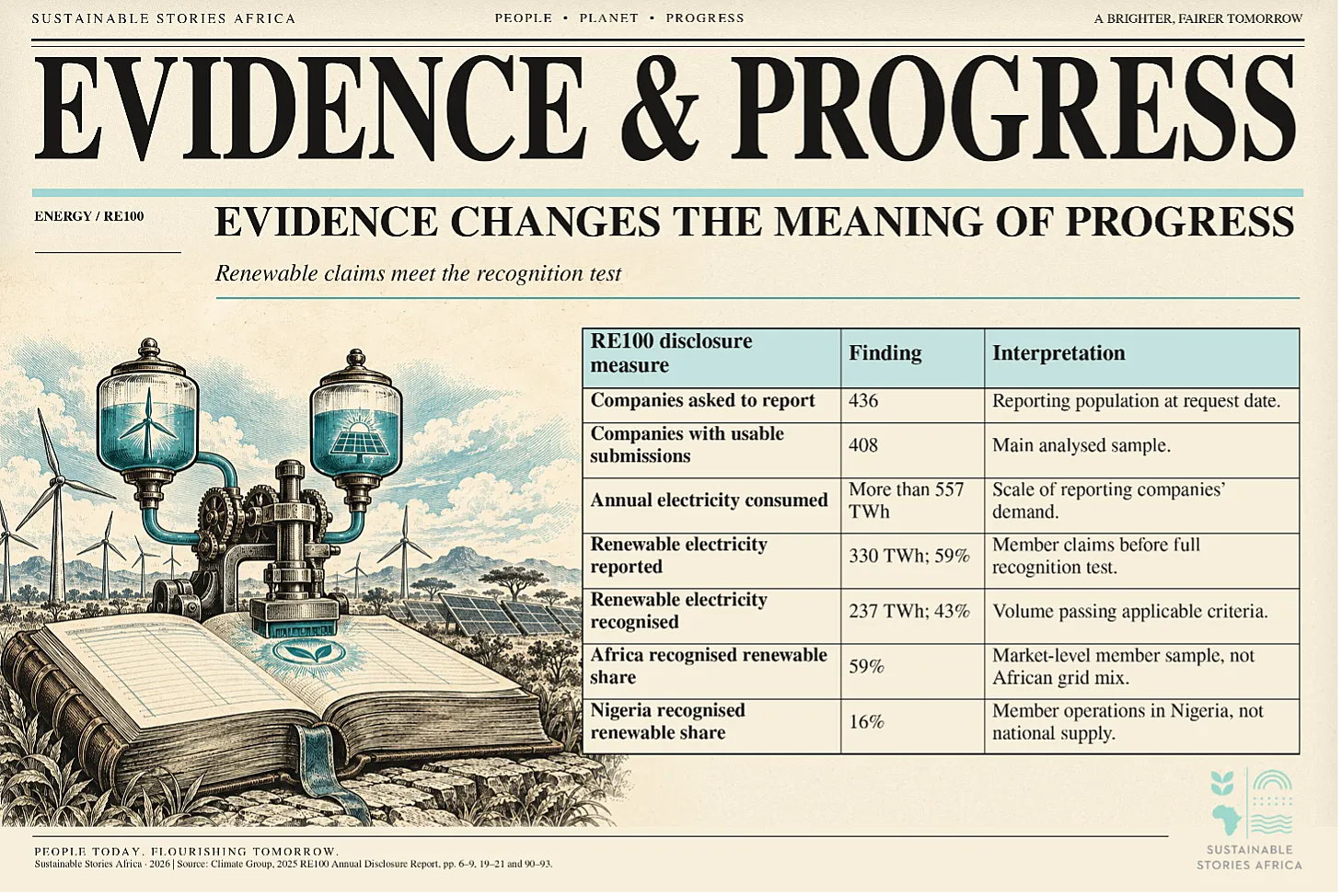
Climate Group’s 2025 RE100 Annual Disclosure Report, published in September 2026, reviewed usable information from 408 of 436 companies asked to report.
The respondents consumed more than 557 terawatt-hours of electricity annually.
Most supplied data relating to the 2024 calendar year, so the title identifies the reporting edition rather than a single universal year of electricity consumption.
For an African manufacturer selling into global supply chains, the distinction between reported and recognised renewable power can shape customer confidence.
- A buyer may want an assurance trail that identifies where electricity was used, what procurement instrument supports the claim and whether it meets applicable market boundaries.
- A percentage alone cannot answer those questions.
This article draws on the attached report’s “Key findings”, “About the claims”, “Sourcing and impact trends”, “Barriers reported by RE100 companies” and African market appendix. The initiative’s recognition rules are its own technical criteria; its figures should not be confused with the renewable share of national grids.
Reported Progress Exceeds Recognised Progress
Members reported 330 TWh, or 59% of consumption, as renewable electricity.
- RE100 recognised 237 TWh, equal to 43% of reported consumption, after reviewing sufficient detail and applying the relevant criteria.
- The 16-percentage-point difference is not proof that all unrecognised electricity came from fossil fuels
It reflects what the initiative’s evidence and eligibility rules should not accept.
The apparent progress is therefore two stories at once.
- Reported sourcing rose six percentage points from the preceding edition.
- Recognised progress remained around 43%.
- A company can increase purchases but fail to increase its verified share if documentation, geography or facility-age requirements are not met.
That matters for investors who need to distinguish ambition, spending and substantiated results.
Evidence Changes The Meaning Of Progress
One reason claims fail recognition is missing geographic detail.
- The report links 479 TWh of 557 TWh of total electricity use to a country or area, leaving a gap that affects verification.
- Its rules also address older generation assets, over-procurement and other non-credible or insufficiently documented claims.
These categories should not be described as fraudulent: some may reflect inadequate information rather than a failure to buy renewable attributes.
The report says 65% of renewable electricity purchasing came from facilities commissioned within the previous 15 years.
- That suggests a larger share of sourcing from newer projects, but purchasing from a younger plant alone does not prove a particular buyer caused that plant to be built.
- The technical criteria include exemptions and grandfathering, so facility age must be analysed using the applicable rule for each member’s reporting period.
A more consistent view comes from the 285 companies that appeared in all four disclosure editions from 2022 to 2025.
- Within that group, self-reported renewable share rose from 49% to 65%, while the share recognised by RE100 moved from 41% to 44%.
- The comparison is still affected by changes to companies’ boundaries through mergers and divestments, which the report explicitly notes.
Credible Demand Can Unlock Supply
Better evidence can help corporate demand translate into real investment.
- Market-level consumption data signals where buyers need clean electricity; traceable contracts and certificates can help suppliers offer credible products.
- For South Africa and other African markets, RE100 discusses procurement options, green tariffs and policy barriers.
Existence of demand is not the same as an operating project, but it can strengthen the case for one.
Transparency also protects public trust.
- A firm that reports both its claimed and recognised shares tells investors more than one that promotes the larger number alone.
- When assurance uncovers a gap, management can act on specific weaknesses: country attribution, contract terms, certificate cancellation or the age of generating facilities.
The limits of the African figures need equal care.
RE100’s appendix includes only the electricity use and claims of relevant member operations for which its market method applies.
- Nigeria’s 16% recognised member share cannot be described as the renewable percentage of Nigerian electricity generation.
- Equally, South Africa’s 84% member-market reading does not establish that all South African consumers enjoy renewable supply.
Audit Claims At The Market Level
Companies should match electricity consumption to specific markets, document procurement type and instrument, verify facility dates and apply relevant boundary rules.
Assurance teams should distinguish between power reported as renewable and the portion recognised under the criteria.
- That will make an ESG disclosure more useful than an unqualified headline percentage.
Policymakers can widen credible procurement routes through transparent grid access, project contracting and attribute tracking.
Utilities and certificate systems need to minimise duplicate claims and disclose how a buyer’s claim is linked to power use in the relevant market.
These steps highlight where supply or contract options are limited.
Financiers should treat corporate demand as a potential offtake signal while testing the underlying contract and infrastructure.
- RE100 reports that 155 members identified high costs or limited supply as barriers and 103 cited a lack of suitable procurement options.
Solving these constraints needs market reform and delivery, not merely more reporting.
Path Forward – Make Every Claim Traceable
RE100’s next credibility test is whether evidence addresses renewable purchasing.
Reported growth deserves attention, but recognised progress provides stronger assurance measures.
African buyers should pair procurement with market-level metering, sound contracts and traceable attributes so investment and disclosure reinforce one another.