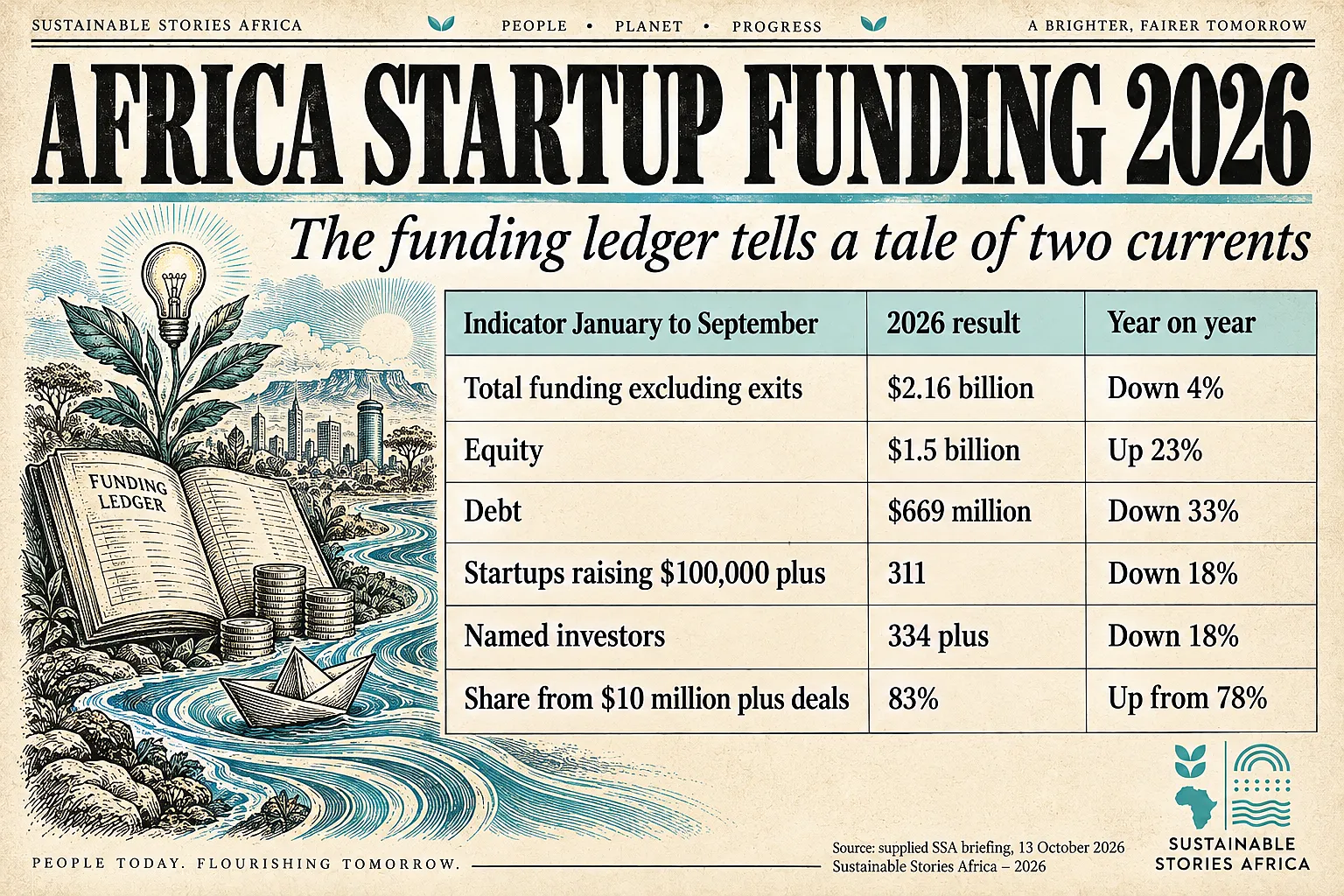
African startups raised $2.16 billion in the first nine months of 2026, 4% below the comparable 2025 total.
Equity rose 23% while debt fell 33%; however, fewer startups and investors participated, and large deals captured a record share.
The headline recovery therefore masks a thinner early-stage pipeline that could weaken future growth.
Equity Rebounds as Funding Participation Narrows
African startup funding remained broadly stable through September 2026, but the composition and distribution of capital changed sharply.
- Startups raised $2.16 billion excluding exits in the first nine months, down 4% from $2.24 billion in the same period of 2025 and 46% above 2024.
- Equity climbed 23% to $1.5 billion, its strongest January-to-September performance since 2022.
- Debt fell 33% to $669 million.
However, despite these totals, fewer companies and investors participated, while a growing share of capital moved into deals worth at least $10 million.
Larger Deals Capture Record Funding Share
Only 311 startups raised at least $100,000 in the first nine months, down 18% from 381 a year earlier.
- The steepest decline was in rounds between $100,000 and $1 million, where the count fell 22% to 171.
- At least 334 named investors participated, also down 18%, while the number of equity investors declined 26% to 271.
- Deals of $10 million or more captured 83% of all funding, up from 78 percent in 2025.
- Spiro and Moove alone accounted for 28% of the continental total.
Exits remained comparatively active, with 34 recorded through September.
Concentrated Capital Can Threaten Ecosystem Renewal
The funding data also reveal a tension between financial performance and ecosystem renewal.
- Large rounds can sustain headline totals and may create companies capable of regional expansion, employment and exits.
- However, concentration increases exposure to a small number of ventures and sectors.
If one large transaction is delayed, quarterly totals can shift sharply.
- A broader base of smaller investments spreads experimentation and develops new management teams.
- Local angel networks, accelerators and seed funds are therefore part of market infrastructure.
They cannot replace institutional capital, but they can help founders reach the evidence and governance standards required for larger rounds.
Patient Capital Can Rebuild Startup Pipelines
Equity’s return will help growth companies with capital without more immediate repayment pressure, and continued exits can recycle experience and money into the ecosystem.
- A stable funding total also shows that investors have not abandoned African technology markets.
However, a healthy ecosystem needs more than large late-stage transactions.
- Companies that cannot secure a first $100,000 or $500,000 round may never reach the point where institutional capital becomes available.
A narrow pipeline also reduces experimentation across climate, health, agriculture and local enterprise software, including sectors that may require patient development before scale.
Investors Should Track Breadth Beyond Totals
Investors should report not only total capital, but the number, stage, sector and gender distribution of companies funded.
- Funds and development finance institutions can use co-investment, first-loss structures and local manager programmes to expand early-stage capacity without lowering diligence standards.
- Governments can reduce friction by simplifying company administration, improving payment systems and clarifying investment rules.
- Founders should plan for longer fundraising cycles and demonstrate disciplined unit economics.
Exit activity should also be studied closely to show whether returns are reaching local teams and investors.
Path Forward – What African Funding Recovery Must Include
The next measure of recovery should be a wider pipeline of companies receiving first and follow-on cheques, not only a higher total raised.
More active investors and transparent stage data will show whether opportunity is broadening.
Equity momentum and exits provide a base for growth, but ecosystem resilience requires patient early capital.
Today's small rounds create the companies capable of raising tomorrow's larger ones and solving problems that concentrated capital may overlook.
Culled from: Q3 2026: Equity takes the wheel 🚗 and Q3 2026: Fewer start-ups. Fewer investors. Bigger cheques 🎯