Microsoft’s Nairobi engineering operation faces reported closure amid global restructuring, according to technology media.
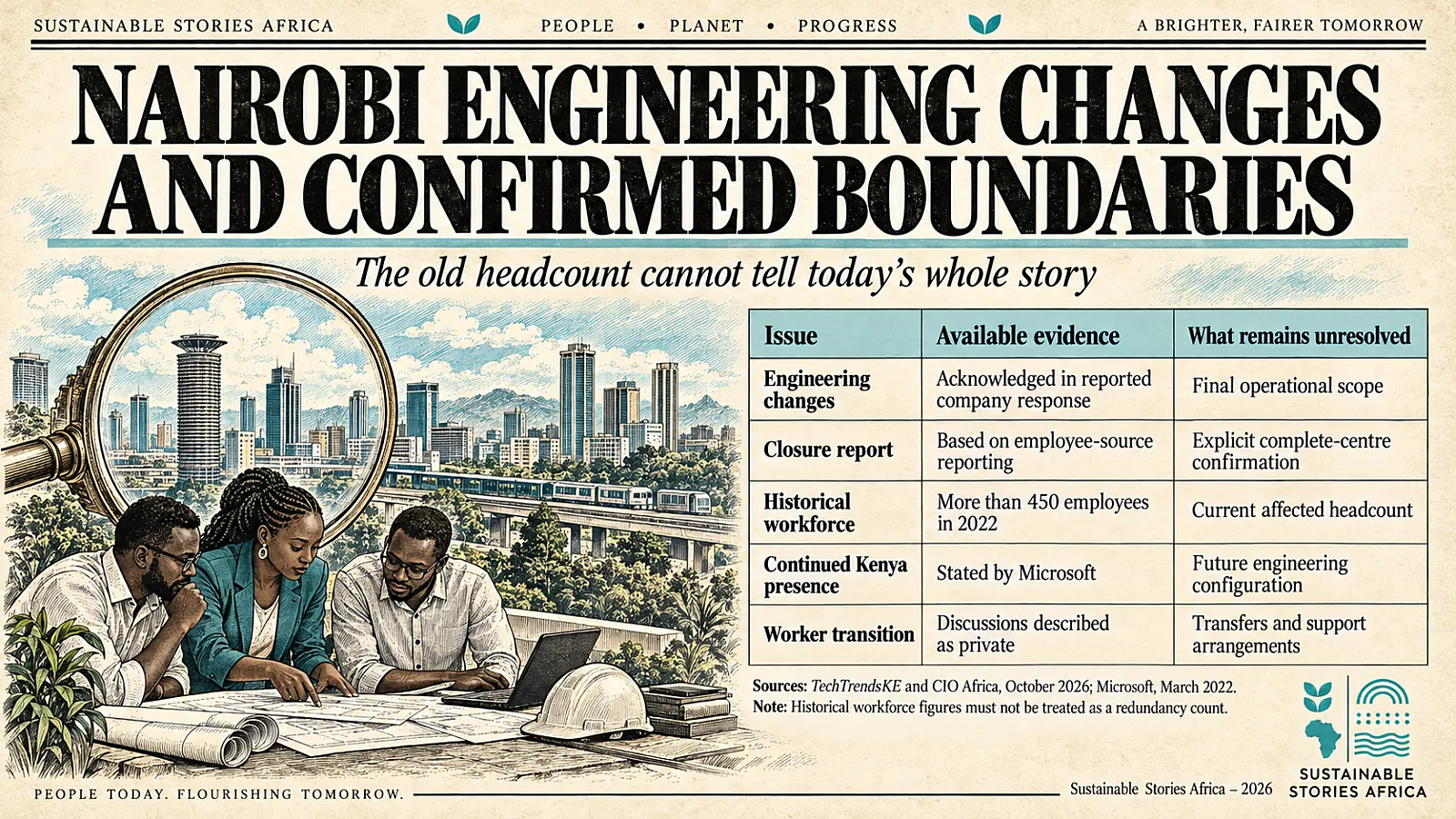
The company has acknowledged proposed changes affecting Kenyan engineering but has not explicitly confirmed a complete centre shutdown.
Immediate questions concern affected workers, transition arrangements and the future of engineering opportunities built around the Africa Development Centre.
Reported closure puts engineering jobs under scrutiny
Microsoft’s Africa Development Centre engineering operation in Nairobi faces reported closure, after employees were informed of changes on 12 October.
TechTrendsKE attributes the report to CIO Africa, which cited an employee source.
The company’s response requires careful distinction.
- In comments reported by CIO Africa, Microsoft acknowledged proposed changes affecting engineering in Kenya as part of global restructuring, while saying it would continue operating in the country.
- It did not explicitly confirm that the entire centre would close.
The immediate consequence is uncertainty for workers.
Available reporting does not establish a final number of affected roles, a completed closure date or the full terms of any transition.
Earlier investment built a substantial workforce
Microsoft’s own March 2022 account described Nairobi’s centre as having grown to more than 450 full-time employees since its establishment in 2019.
These employees worked across engineering, machine learning and data science.
- That historical figure is not a current estimate of jobs at risk.
The company also described research and innovation functions associated with its Nairobi presence.
- Its original development-centre announcement set out an expected $100 million combined investment over five years across the initial Nairobi and Lagos sites.
- That commitment was not a Nairobi-only spending figure.
Together, the earlier announcements show why the reported restructuring attracts attention beyond a single employer.
- The centre provides African technical professionals a route to contribute to products serving wider markets.
Retaining skills matters beyond one employer
SSA assesses that engineering capability has value extending beyond the organisation that first develops it.
- Experienced teams can train colleagues, contribute to research and help other businesses solve difficult technical problems.
That potential does not make a restructuring painless.
- Workers may face interrupted careers, income uncertainty, and difficult relocation decisions.
- Protecting the value of accumulated skills requires attention to those immediate circumstances.
Local employers and research institutions could benefit from connecting with affected professionals who want to pursue new opportunities.
- Any matching programme should respect confidentiality and avoid assuming every employee is seeking the same outcome.
The wider investment lesson is to distinguish different forms of technology activity.
- Commercial operations, infrastructure spending and product engineering can support an economy in different ways.
- Continued activity in one category does not answer every question about another.
Clear communication should guide the transition
SSA recommends a public explanation of the operational scope and timetable once decisions can be disclosed.
- Workers should receive direct information about their options before broad claims are made about the restructuring’s consequences.
Reporting should also keep allegations about employment practices separate from established findings.
- Restructuring does not prove misconduct, and uncertainty should not be filled with unsupported explanations of motive.
For public authorities, the useful task is to support an orderly transition and strengthen opportunities for technical work across multiple employers.
- That could include dialogue with local firms, universities and investors about sustained demand for experienced engineering talent.
Assess outcomes by inquiring what happens to people and capability:
- Whether roles continue, whether workers move into suitable employment and whether Kenya retains opportunities to build globally relevant products.
- A general statement of commitment cannot answer those questions on its own.
The continuity question arises for universities and other partners that built relationships with the centre.
- Where programmes may change, early information would help them plan research, mentoring and student opportunities.
- These partnerships should be assessed individually rather than assumed to disappear with every proposed operational change.
Path Forward – Protect Engineering Talent Through Transparent Transition
The next requirement is clarity on the scope of proposed changes and the options available to employees.
A reported closure should remain distinguished from an explicitly confirmed complete shutdown.
Supporting workers and opportunities to retain skills locally can help preserve the centre’s wider contribution.
The sustainability test is how responsibly the transition is managed.
Sources: Microsoft To Close Nairobi Africa Development Centre | CIO Africa, Microsoft Africa Development Centre Nairobi Faces Closure