The United States has proposed substantial fees for institutions recommending international students for Optional Practical Training.
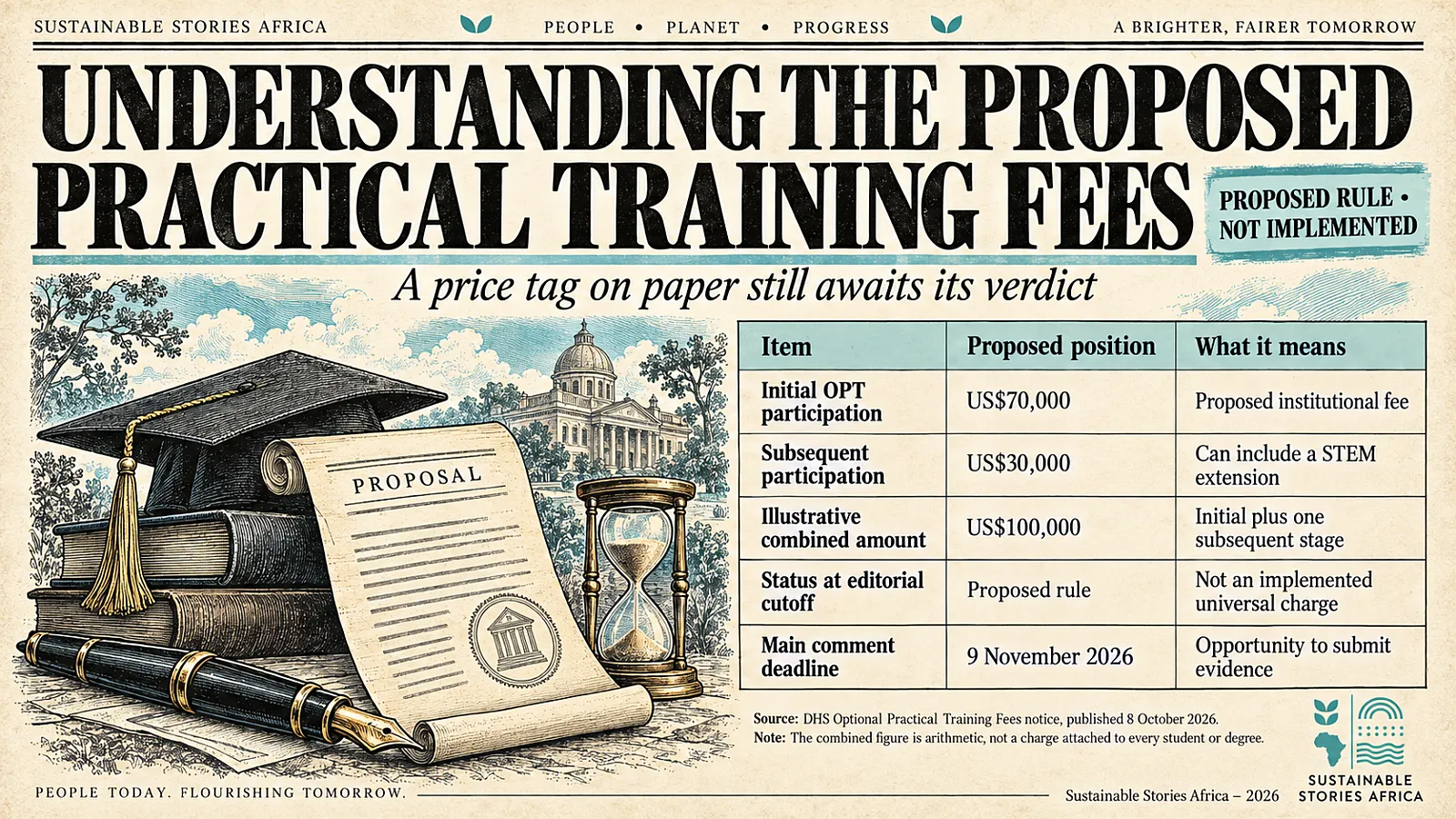
The proposal says that $70,000 is for initial participation and $30,000 for subsequent participation, potentially totalling US$100,000 across stages.
For African students and universities, the immediate issue is uncertainty about access to practical experience, not an already implemented universal student charge.
Proposed fees put practical training under review
The United States Department of Homeland Security has proposed fees that could substantially change the economics of Optional Practical Training for international students.
- The notice reveals $70,000 for initial participation and $30,000 for subsequent participation, payable through certified educational institutions.
As of 13 October, this is a proposal, not an implemented blanket fee charged to every international student.
- Its distinction between initial and subsequent participation is essential to understanding the widely reported $100,000 figure.
Nature reported the proposal on 8 October, highlighting specialists’ concerns about its implications for the science, technology, engineering and mathematics talent pipeline.
- For prospective African graduates, it poses more uncertainty in decisions already shaped by tuition, funding and career plans.
Practical training connects education with experience
Optional Practical Training, or OPT, allows eligible F-1 students to undertake work related to their studies.
- Congressional Research Service guidance explains that the standard authorisation can provide up to 12 months, with an additional 24-month extension available to qualifying STEM graduates under specified conditions.
- It is distinct from the H-1B visa programme.
That distinction matters for the article’s scope.
- The proposal concerns participation in practical training, not the price of admission to a postgraduate degree and not a universal tuition surcharge.
The Federal Register notice presents fraud prevention, immigration integrity and protection of United States workers as the policy rationale.
- Comments on the proposed rule are due by 9 November.
- These stated aims should be examined alongside evidence about the effects of the proposed financial mechanism.
Unequal resources could reshape access decisions
SSA assesses that a substantial institutional cost could influence which practical training opportunities remain available.
- Universities and other institutions have different financial resources, and students cannot assume that every institution would make the same decision.
The possible consequences therefore extend beyond a simple question of who writes a cheque.
- Institutions could review the scale of support they offer, while applicants could reconsider where to study and how to finance the period after graduation.
- These are potential responses, not outcomes established by the proposal.
For students whose education is supported by family savings or scholarships, uncertainty has its own costs.
- Career planning becomes harder when an anticipated route to practical experience may change before graduation.
African scholarship providers and universities also have an interest in the debate.
- They may need to examine how international training pathways support their objectives and whether alternative partnerships could preserve access to relevant experience.
Consultation should test costs against objectives
SSA recommends that institutions and researchers submit evidence on participation, compliance problems and the likely distribution of costs.
- Any argument for a fee should explain how the amount relates to the policy problem it is intended to address.
The debate should also distinguish preventing abuse from restricting legitimate training.
- Evidence about one does not automatically establish that a large fee is the most effective response to the other.
Students should seek institution-specific information from authorised advisers before changing plans.
- Universities can help by explaining what is known, what remains proposed and when they expect to issue further guidance.
For African education policymakers, the broader task is to build more options for practical learning and research collaboration.
- That would strengthen resilience to changes abroad without treating uncertainty as proof that every international pathway has closed.
Reliable communication is especially important for people already enrolled.
- They should be able to distinguish current programme rules from proposed changes and understand where to obtain updates.
- Clear explanations would reduce the risk that incomplete headlines drive expensive or irreversible decisions before the regulatory process has concluded.
Path Forward – Preserve Fair Access To Practical Learning
The immediate priority is an evidence-based consultation before the 9 November deadline.
Institutions should clarify potential effects while avoiding claims that the proposal is already in force.
For African students and education partners, reliable guidance and diversified training partnerships can reduce uncertainty.
The development objective remains access to skills, experience and meaningful work.
Sources: DHS Publishes Proposed Rule Establishing Fees for Optional Practical Training | Study in the States, US proposes $100,000 charge for international students to do postgraduate work | Nature, Optional Practical Training (OPT) for Foreign Students in the United States