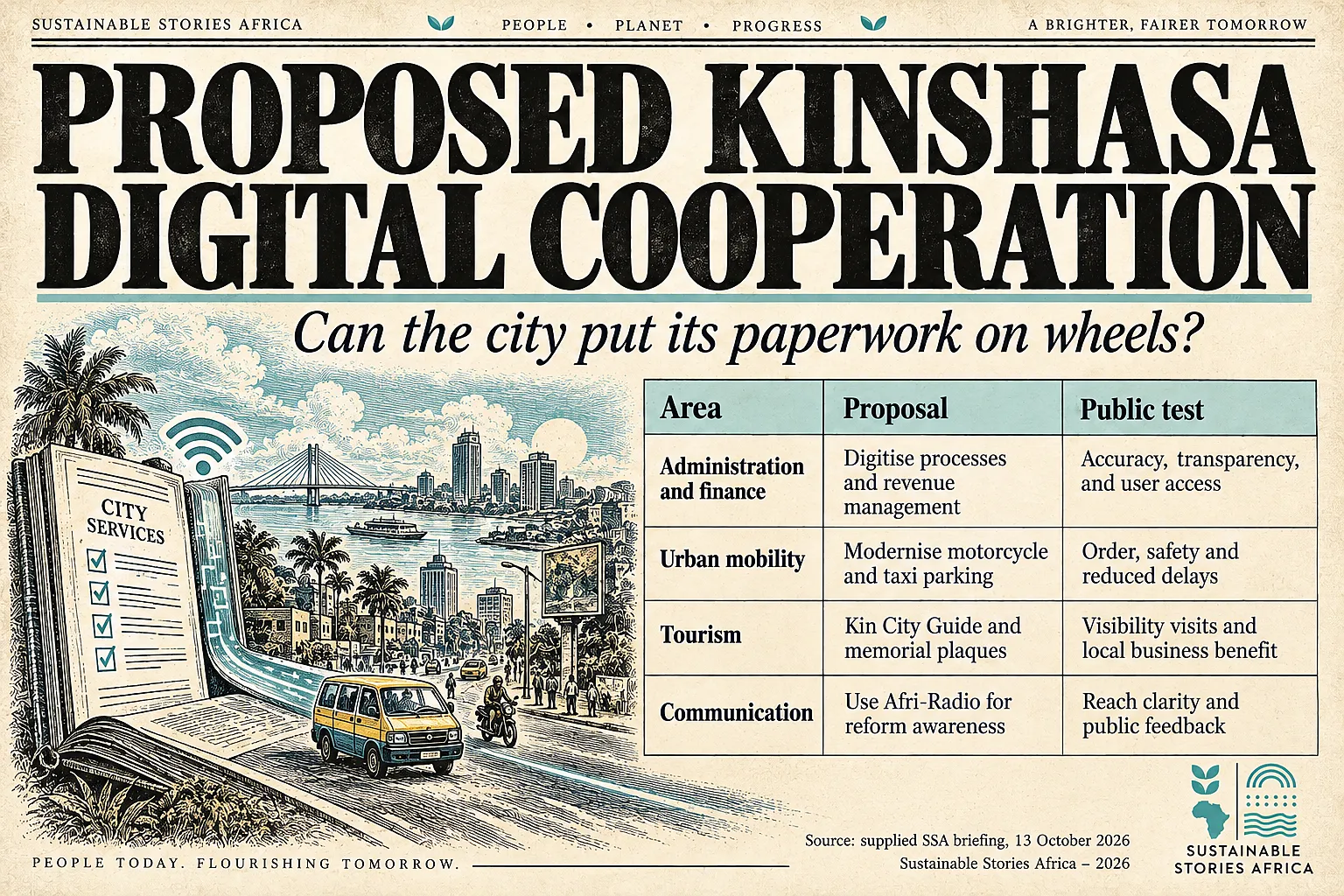
Kinshasa and Africell DRC have opened discussions on digital administration, city finances, motorcycle and taxi parking, tourism and public communication.
The talks point to practical uses for telecom infrastructure in a fast-growing capital where service delivery and mobility are daily pressures.
No project, investment or timetable has yet been confirmed.
Kinshasa Explores Technology for Everyday Services
Kinshasa's provincial government is exploring a partnership with Africell DRC to digitise parts of city administration and finance, modernise motorcycles and taxis parking, and strengthen tourism services.
The discussions followed an October 5 meeting between provincial minister Jésus-Noël Sheke and Africell DRC managing director Kory Webster.
The proposal remains exploratory:
- The parties have identified possible areas of cooperation, but have not announced a contract, investment value or deployment timetable.
That distinction matters because the potential public value lies in services that residents can actually use, not in the existence of a technology meeting.
Proposed Tools Span Revenue, Mobility, Tourism
The agenda links several city functions that are often managed separately.
- Digital financial tools could improve recording and collection of provincial revenue.
- Better organised parking facilities could bring more order to motorcycle and taxi operations.
The Kin City Guide, planned in print and digital formats, would promote destinations, while a memorial tourism programme would place commemorative markers at historic sites.
Africell's Afri-Radio was also identified as a possible channel for explaining reforms to residents.
Africell has operated in the DRC since 2012 and expanded its services in 2026 for institutions, creating a commercial platform for connectivity, private networks and other digital services.
Digital Systems Can Exclude Vulnerable Residents
Digital public services can improve who is visible to government and who remains outside its systems.
- A revenue platform may improve accountability, but it can also create new barriers if registration is complex or payment channels exclude cash users.
- Parking technology may help manage scarce space, yet rules designed without drivers can shift costs onto people whose livelihoods depend on motorcycles and taxis.
Kinshasa can reduce these risks by mapping the full user journey before procurement.
- The city should identify who benefits, who pays, what data is collected and what happens when the service fails.
These questions are governance requirements, not details to be solved after launch.
Better Design Could Improve Urban Access
A well-designed partnership could make routine interactions with the city easier and more transparent.
- Digitised revenue records can reduce manual gaps and give administrators a clearer view of collections.
- Structured parking data can support transport planning and reduce conflict over informal spaces.
- Digital tourism information can help local guides, cultural sites and small businesses reach visitors.
These gains are not automatic.
- Systems must work on affordable devices, support local languages where needed, protect personal and payment data, and offer offline alternatives for residents who lack reliable internet access.
Public Safeguards Must Guide Every Pilot
Before selecting technology, Kinshasa should define the public problem, service owner and measurable outcome for each proposal.
- Procurement terms should make data ownership, cybersecurity, fees and vendor responsibilities explicit.
- The city should test services in limited pilots, publish performance results and create channels for motorcycle operators, taxi drivers, traders, tourism businesses and residents to report problems.
- Africell should be required to separate verified capabilities from marketing claims.
Transparent oversight will be especially important if digital platforms become part of revenue collection or public identification systems.
Path Forward – What Kinshasa Must Decide Next Clearly
The city and Africell should move from broad themes to written project scopes, budgets, safeguards and pilot locations.
Each proposed service needs a public objective and a measure of success.
Kinshasa should also publish how residents will access services, contest errors and protect their data.
A partnership will be credible only when it improves administration and mobility without excluding people who remain offline or rely on informal transport.
Culled from: DRC: Kinshasa Eyes Africell Digital Tools for City Finances, Transport and Tourism | Extensia