
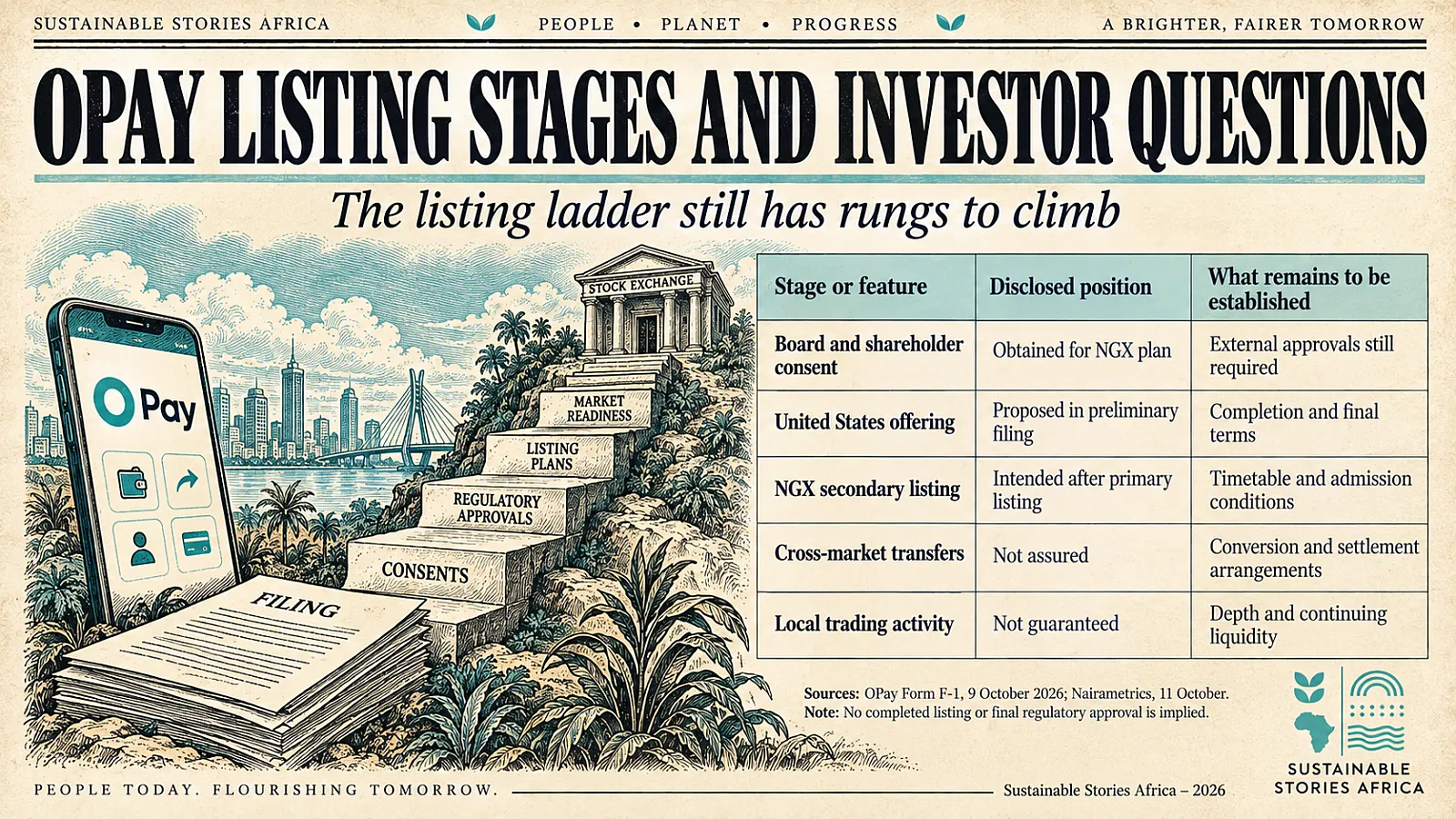
OPay’s board and shareholders have approved pursuing a listing on the Nigerian Exchange after its planned New York flotation.
The decision is an internal authorisation, as market conditions and regulatory requirements still need approval.
A Nigerian listing could expand access to the company’s shares, but investors would need clarity on trading rights and transfers between markets.
Nigerian listing ambition clears internal hurdle
OPay has obtained board and shareholder approval to pursue a secondary listing on the Nigerian Exchange after completing its proposed primary listing in New York.
The plan appears in its registration statement filed with the United States Securities and Exchange Commission on 9 October.
The development advances the company’s capital markets ambitions, but it should not be read as confirmation that either listing has been completed.
- Nor does internal approval establish that Nigerian regulators or the exchange have authorised admission.
For Nigerian investors, the prospect raises a straightforward question:
- Could a company used in everyday financial transactions eventually become accessible through the local stock market?
The answer remains conditional on the steps ahead.
Two markets would require clear arrangements
The filing says the Nigerian listing would depend on market conditions, applicable legal requirements, necessary approvals and operational arrangements.
- It also warns that securities traded in Nigeria might not be exchangeable with the American depositary shares proposed for New York unless cross-market mechanisms are established.
Nairametrics highlighted that limitation in its 11 October report.
- In practical terms, holding a security in one market would not necessarily give an investor the ability to move it freely into the other.
This is more than settlement detail.
- If investors cannot transfer holdings, prices may respond differently to local demand, exchange rates and available liquidity.
A familiar brand name would not make the securities economically identical in every respect.
Wider ownership needs understandable investor information
SSA assesses that a domestic listing could create a useful connection between a digital business and the market in which many people encounter its services.
- It could also give local institutions another company to evaluate within the financial technology sector.
Those possibilities depend on understanding what it means in practice.
- Investors would need to understand information about the security being offered, the rights attached to it, the reporting framework and the costs of buying or selling.
- Public familiarity with a payment product cannot substitute for those disclosures.
The same discipline applies to social impact.
- Making shares available locally would not, by itself, establish that lower-income users benefit.
- That question requires separate evidence about affordable services, responsible lending, security and complaint resolution.
For a small merchant who uses a payments application, customer status and shareholder status would remain different relationships.
A service complaint would not become an investment dispute, and a promising commercial outlook would not guarantee a successful personal investment.
Explain the security before promoting participation
SSA recommends that any eventual Nigerian offering explain market differences in plain language.
- Communications should identify whether investors are buying ordinary shares or depositary instruments, how their rights operate and whether conversion is possible.
An accessible comparison of settlement arrangements and currency exposure would be more useful than presenting a second listing as a frictionless bridge to Wall Street.
- It would also help prevent misunderstandings before trading begins.
For market institutions, the governance opportunity lies in consistent disclosure.
- Material developments should reach investors through clearly identified channels, while promotional claims should remain aligned with filed documents.
The immediate action is to follow formal announcements on approvals and offer terms.
Until these details are available, the accurate news is that OPay’s decision-maker has permitted it to pursue the plan.
The proposed structure also makes investor education an operational requirement.
- Brokers and the company would need to answer basic questions consistently, including where distributions are paid and which entity issues the security.
Resolving these details before an offer would make participation easier to understand for people encountering a cross-border listing for the first time.
Path Forward – Turn Listing Intentions Into Transparent Participation
OPay’s next steps concern execution:
- Completing the proposed primary offering and meeting the conditions for a Nigerian secondary listing.
Clear disclosure of rights, approvals and cross-market arrangements would help turn potential local ownership into informed participation.
The development case rests on accountable finance and useful services, alongside access to shares.
Sources: Form F-1, OPay secures approval for NGX secondary listing after NYSE debut - Nairametrics