A OneStop ESG commentary argues that cheaper reporting should free companies to act on sustainability information.
PwC research supports the growing use of AI in reporting, while showing that adoption remains at an early stage.
For African businesses, the opportunity is to connect reliable data with operational decisions and accountable action.
Reporting automation puts management decisions under scrutiny
Growing use of artificial intelligence in sustainability reporting is sharpening a question for companies:
- What will they do with the information once producing disclosures becomes easier?
In a September 21 commentary, OneStop ESG adviser Daniel Dun argues that the report should serve operational change, rather than become the main objective of the sustainability function.
The piece is an argument about business practice, not a new regulatory announcement.
PwC’s Global Sustainability Reporting Survey 2025 provides a measurable backdrop.
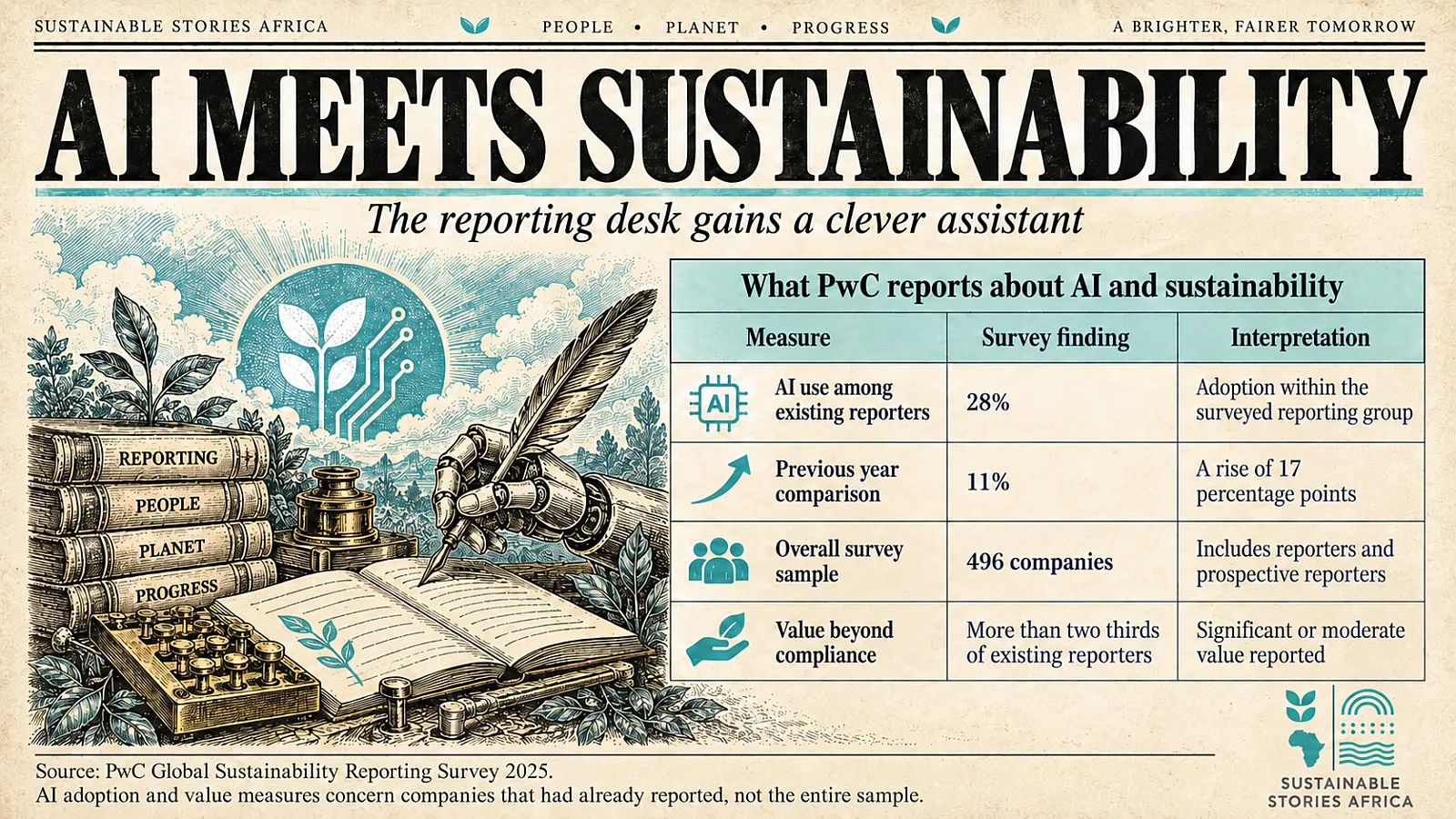
- Among companies that had already reported, AI use for sustainability reporting rose to 28%, from 11% a year earlier.
- The survey covered 496 companies that had reported, or planned to report, under CSRD or ISSB frameworks.
It is not a census of all businesses.
For an African company, faster drafting could release staff time.
- The more important outcome would be a clearer understanding of which operating decisions need to change and who is responsible for making them.
Survey evidence points beyond document production alone
PwC identifies common AI uses including drafting or summarising disclosures, identifying risks and opportunities, and collecting or validating information from multiple systems.
- Many respondents were still exploring or piloting these applications.
- The findings show adoption, rather than proof that every tool produces reliable information or delivers financial savings.
More than two-thirds of companies that had already reported said they gained significant or moderate value beyond compliance from the information collected.
- PwC links the strongest reported value with the use of insights across business decisions.
- The relationship is an association in survey responses, rather than a guarantee that installing software creates value.
The management test should begin with a decision.
- If a business wants to reduce energy costs at a facility, the system should supply evidence that supports that task.
- A polished paragraph about energy efficiency is a weaker result if no one can use it to assess the site.
Useful information should support specific operational improvements
A practical reporting system would let a manager examine a number, understand its origin and investigate unexpected change.
- This matters when information is assembled from facilities that use different units or recording practices.
- Automation could speed up consolidation, but someone still needs to decide whether the comparison is meaningful.
For smaller African businesses supplying larger customers, consistent information requests could reduce duplicate work.
- Buyers should explain which records they need and why.
- A supplier with a manageable process for collecting evidence may be better placed to respond than one repeatedly asked to complete unrelated questionnaires.
There is also a risk of confusing fluency with verification.
- AI can produce convincing language around incomplete records.
- A company should therefore preserve the connection between published statements and source evidence, including any assumptions used to estimate missing information.
Reviewers need a way to identify uncertainty rather than have it smoothed out of the narrative.
- The potential benefit is a sustainability team with more capacity to investigate issues and follow through on decisions.
That benefit would need to be demonstrated.
- Time saved in drafting should be measured alongside changes in data quality and the actions informed by the resulting analysis.
Boards should ask which decisions reporting changes
Management should identify a small number of material questions that the reporting process ought to answer.
- These might concern a facility’s resource use or a supplier-related concern, depending on the business.
- Each question should have an owner, usable evidence and a route from analysis to action.
Procurement teams evaluating AI tools should request demonstrations using realistic records and difficult cases.
- They should examine how the tool handles contradictory figures, missing documents and revised assumptions.
- Human review should remain proportionate to the significance of the disclosure or decision.
Boards should then ask for evidence of the operational result.
- Producing a report sooner is one measure of efficiency.
- A stronger account would explain which problem was identified, what management decided and how the company will assess whether its response worked.
Managers should use data records to make informed decisions so they can be examined later.
That would make the value of the reporting process more concrete.
Path Forward – Turn disclosure data into operational action
Companies should link material indicators to management decisions and retain evidence for review.
Evaluate AI tools against accuracy and practical usefulness.
The opportunity is to move staff time towards investigation and improvement.
Demonstrate progress through better decisions and verified outcomes, alongside any reduction in the effort required to produce disclosures.
Culled from: The sustainability report was never the point | OneStop ESG