
Kenya’s regulator has introduced a tariff provision for electricity exported to the grid without authorisation.
The change concerns unauthorised injection into the Kenya Power network, while approved net metering follows a separate framework.
For solar owners, the priority is understanding their system’s export behaviour and the applicable approval.
Kenya targets electricity exported without required approval
Kenya’s Energy and Petroleum Regulatory Authority has amended Kenya Power’s tariff schedule to address electricity injected into the distribution network without approval, according to African Sustainability Matters’ October 1 report.
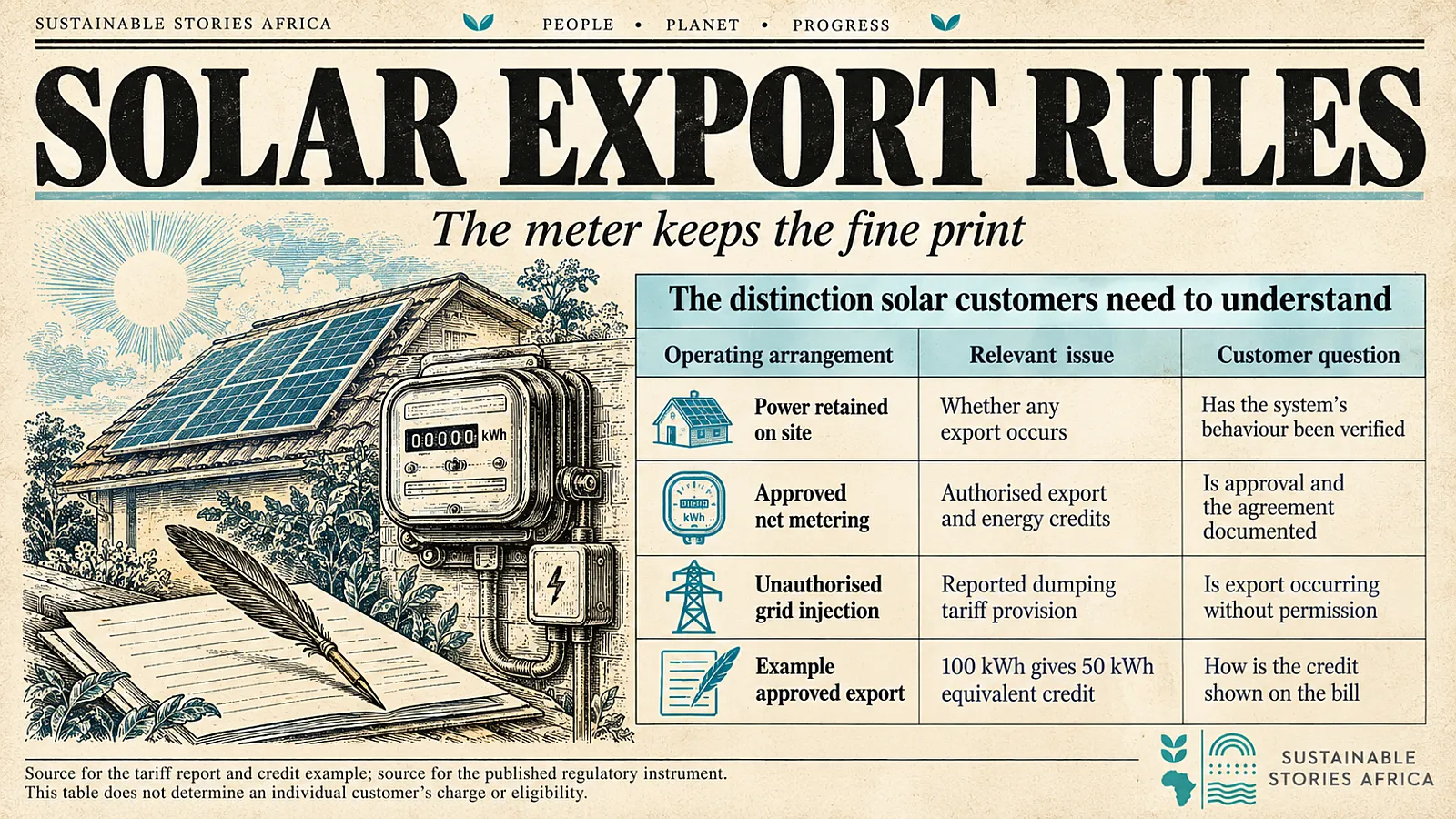
- The outlet says a Gazette Notice published on September 18 defines unauthorised injection as dumping, with electricity measured and charged at the applicable base tariff.
The reported provision concerns grid exports.
- Ownership of solar panels does not, by itself, establish that a customer is exporting electricity or subject to the charge.
- A system designed to retain production within the premises presents a different question from one that sends power into the distribution network.
For a household or business, that distinction can be easy to miss.
- An installation may have been bought to improve power reliability.
- Understanding whether it operates in parallel with the grid and can export is now a necessary part of assessing its regulatory position.
Approved net metering follows its own framework
Kenya’s Energy (Net-Metering) Regulations, 2024 provide a framework for eligible renewable generators to export surplus power under an approved arrangement.
- The regulator’s published legal register lists the instrument as Legal Notice 104 of 2024.
African Sustainability Matters reports that approved customers receive an energy credit equivalent to 50% of the electricity exported during the billing period.
- On that basis, an export of 100 kilowatt-hours corresponds to a credit equivalent to 50 kilowatt-hours, rather than a cash payment for every exported unit.
- The outlet also describes limits and conditions governing eligible systems.
Consumers need a clear explanation of the distinction between approval, metering and billing.
- A technically capable inverter does not establish an authorised export arrangement.
- Equally, an approved arrangement should give the customer enough information to check the credit applied to their bill.
Clear rules could support safer solar integration
An orderly export process could help solar owners and network operators understand their respective responsibilities.
- Customers need clarity on permitted operation and financial treatment.
- The operator needs reliable information about the installation and its connection to the distribution system.
The challenge is making those requirements understandable and accessible.
- If consumers cannot identify the right procedure or obtain a timely response, formal rules may be difficult to follow.
- Public guidance should use practical examples of common installation types and explain which questions require a technical assessment.
Installers have a useful role in that communication.
- Before commissioning a system, they should explain its intended operating mode and provide documentation that the customer can retain.
- A business should not have to discover its export configuration only when a billing dispute occurs.
There is also a wider confidence issue.
- Households and businesses need to understand the likely consequences of their investment decisions.
- Clear information about approvals and billing would help them assess solar options.
- Poor communication could cause customers to confuse a charge for unauthorised exports with a general levy on solar ownership.
Grid reliability and distributed generation should be considered together.
- Effective integration requires a process that addresses technical concerns while preserving a workable route for eligible customers.
- The relevant measure is whether approved systems can operate under arrangements that all parties understand and can verify.
Owners should verify export behaviour and approvals
Solar owners should ask their installer or a qualified professional to explain whether the system can send electricity into the network and how that behaviour is controlled.
- Where export is intended, the customer should obtain confirmation of the approval and agreement required by the relevant authorities.
EPRA and Kenya Power should provide accessible guidance on the tariff provision, including its scope and billing treatment.
- Any questions about implementation dates or retrospective application deserve clear official explanation.
- Consumers should seek that confirmation before assuming the treatment of their own installation.
Industry associations can help by translating requirements into understandable customer information.
- The immediate objective should be a documented operating arrangement.
- It would protect confidence in solar investment while allowing network integration to proceed with clearer responsibilities.
Clear customer records could also help resolve disagreements without leaving either party dependent on an installer’s verbal explanation.
Path Forward – Make authorised exports understandable and workable
Consumers should verify their installations and retain evidence of the approvals relevant to export.
Installers should explain the system’s operating behaviour before commissioning.
Regulators and utilities should clarify billing and implementation consistently.
A transparent approval process would help eligible solar owners participate responsibly while reducing confusion about the distinction between generating electricity and exporting it to the grid.