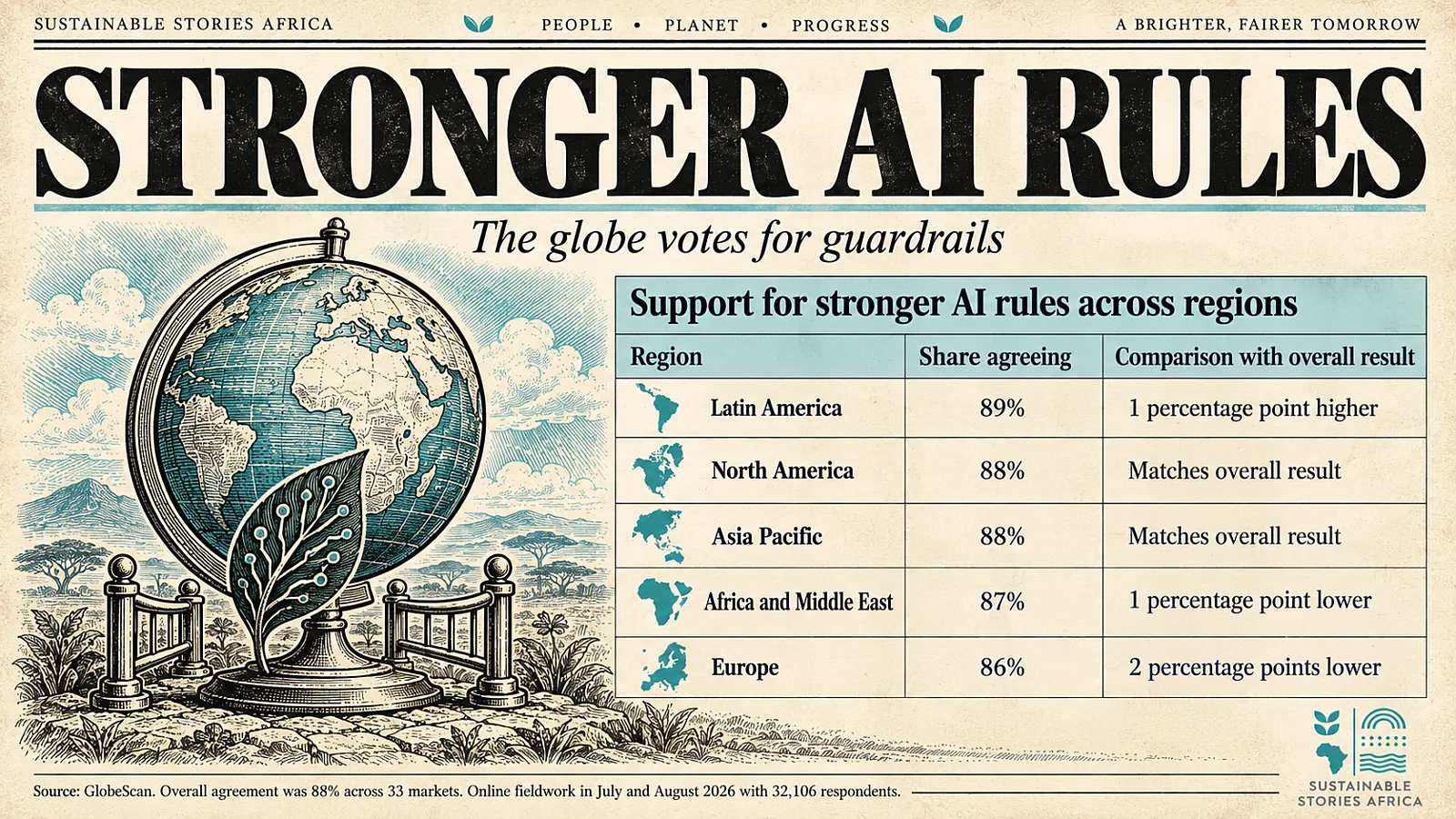
GlobeScan’s latest survey finds that 88% of respondents across 33 markets support stricter rules for artificial intelligence.
Regional differences are small, even where attitudes towards AI’s benefits diverge.
The findings give policymakers a clear signal to examine accountability, while leaving the design of specific rules open.
Public support for AI rules crosses regions
Nearly nine in ten respondents in GlobeScan’s latest international survey say stricter rules and regulations are needed for the development and use of artificial intelligence.
Published on October 1, the findings record 88% agreement across 33 markets, with 46% strongly agreeing. Support in Africa and the Middle East was 87%, close to the overall result.
The research was conducted online among 32,106 respondents in July and August 2026.
- It is evidence of attitudes among the surveyed population, rather than a vote by every person worldwide.
- Nevertheless, the small differences between regions make the result a significant signal for governments considering how to govern AI.
For an African citizen, accountability becomes tangible when an automated system affects a service, an application or a piece of information they rely on.
The policy question is whether people can understand when such systems are involved and obtain a meaningful response when something goes wrong.
Agreement does not mean opposition to innovation
Support ranged from;
- 86% in Europe to 89% in Latin America.
- North America and Asia-Pacific each recorded 88%.
- GlobeScan also found support for stricter rules in both AI-optimistic and more sceptical markets.
The findings therefore should not be interpreted as a uniform demand to stop using AI. [1]
Nor does the survey identify a single regulatory model preferred by respondents.
- Agreement with a broad statement about stricter rules does not tell policymakers which obligations people would support, how they would balance costs or which institution should enforce them.
African governments should translate the signal into questions about specific harms and responsibilities.
- A rule designed for a high-stakes decision may need different safeguards from one governing a low-risk productivity tool.
- Public consultation should explain those distinctions in accessible language before asking people to assess proposed measures.
Clear accountability could strengthen confidence in services
Useful safeguards would make responsibility visible.
- If a business adopts an AI system to support a consequential decision, a person affected should know where to direct a question or complaint.
- That route should lead to someone with the authority to examine the decision and correct a problem.
This could benefit responsible businesses as well.
- Clear expectations would help managers assess suppliers and decide which uses require additional review.
- Without an agreed process, each customer may have to discover for themselves whether a system was tested and who is accountable for its operation.
African markets should also consider language and access.
- A complaint process that depends on technical vocabulary or reliable broadband may exclude the people most in need of it.
- An effective safeguard should be usable by the affected population, including people who do not know the name of the technology behind a service.
There are costs and trade-offs.
- Extensive documentation can absorb scarce staff time, while weak requirements can leave harms unaddressed.
- A practical approach would connect the depth of review to the seriousness of potential consequences, with clear examples that smaller organisations can apply.
Governments should turn broad support into dialogue
Policymakers should identify the decisions for which transparency, testing and review are most urgent, then consult users and businesses about workable safeguards.
- The consultation should ask what evidence would reveal a problem and what remedy a person could reasonably obtain
- These are proposals arising from SSA’s assessment, not preferences established by the survey.
Organisations using AI should map their current applications and assign responsibility for oversight.
- They should pay particular attention to tools that affect access to employment, finance or essential services
- Procurement discussions should cover the system’s limitations and the records available when an outcome is challenged.
Citizens and civil society can contribute examples of where automated decisions are difficult to question.
- Specific accounts would help shape practical rules.
The broad consensus identified by GlobeScan is a starting point; the next task is to make accountability concrete enough to protect people and support useful innovation.
Public bodies should explain their own use of AI with the same clarity they expect from businesses.
Procurement records and service notices could help people identify the responsible institution before a problem requires formal escalation.
Path Forward – Turn support into practical AI accountability
Governments should consult on safeguards matched to consequential uses of AI.
Businesses should identify accountable decision-makers and provide accessible routes for questions and complaints.
The survey establishes broad demand for stronger governance, not agreement on every policy detail.
African responses should test proposed rules against the needs of people who will use or be affected by the systems.
Culled from: The One Thing the World Agrees On