
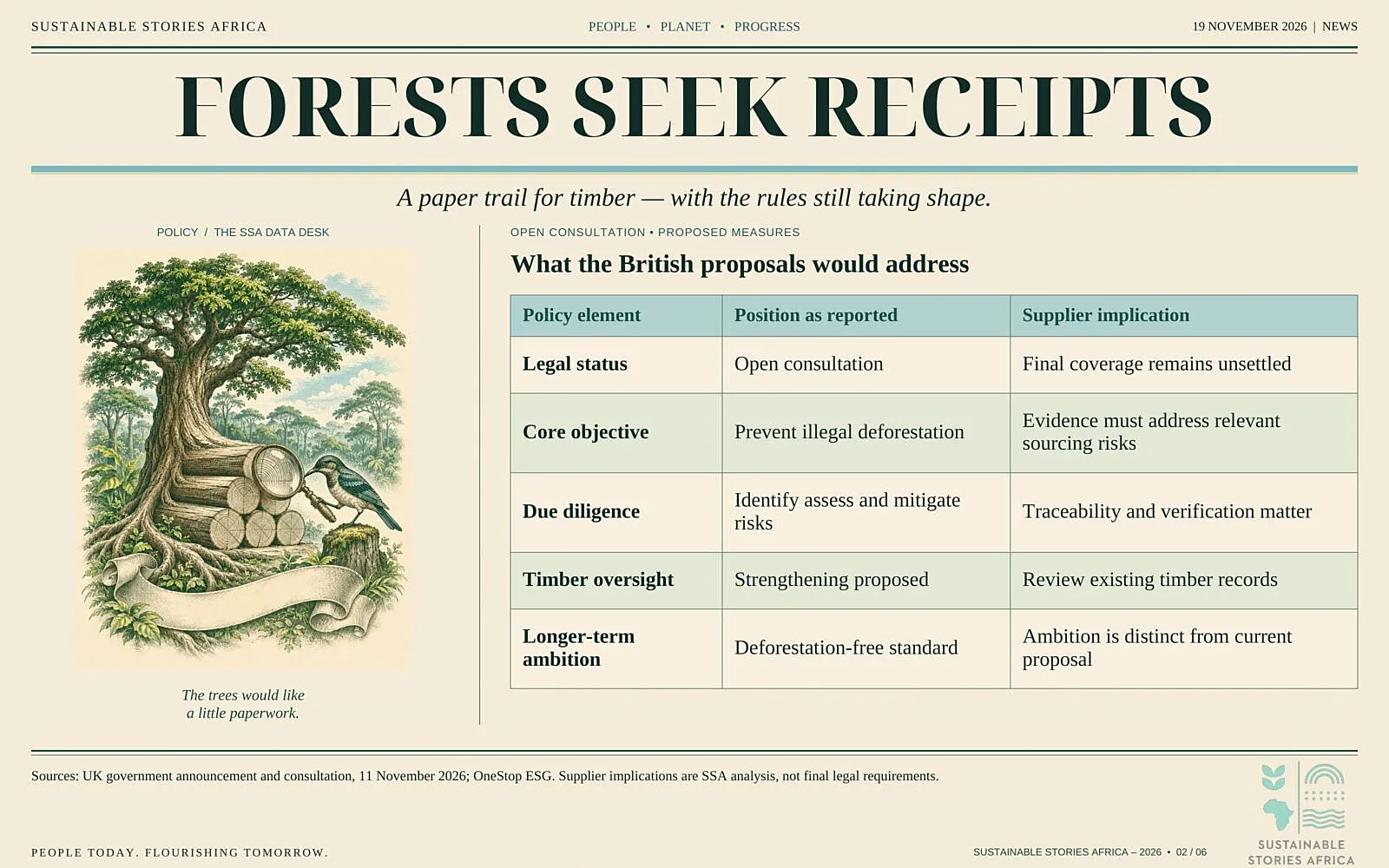
Britain has proposed mandatory checks to prevent goods sold in Great Britain from driving illegal deforestation overseas.
The consultation covers the design of due diligence obligations and potential changes to timber oversight.
For African suppliers, the emerging question is how to document production responsibly without excluding smaller producers from valuable markets.
Britain seeks evidence behind everyday goods
The UK government has opened a consultation on mandatory supply chain due diligence intended to tackle illegal deforestation linked to goods consumed in Great Britain.
- Announced on November 11, the proposals would use existing legal powers, including the Environment Act 2021, and strengthen the UK Timber Regulation.
- They are proposals, not a newly operational compliance regime.
The development matters to African exporters because a buyer’s duty to investigate sourcing can translate into requests for evidence from producers and intermediaries.
- That commercial implication does not mean every African supplier would face a direct statutory obligation.
- The final scope remains part of the consultation.
Scope and evidence remain under discussion
The government identifies soy, palm oil, cattle, cocoa, timber, coffee and rubber as commodities associated with deforestation.
- Its consultation seeks views on covered products and businesses, effective due diligence systems, and how to identify, assess and mitigate illegal deforestation risk.
- It also invites evidence on costs and impacts.
Official estimates link UK consumption of relevant goods in 2023 to around 29,000 hectares of deforestation and 9.4 million tonnes of carbon emissions worldwide.
- The figures describe a consumption footprint, rather than a forecast of the proposal’s eventual impact.
OneStop ESG distinguishes the proposed focus on illegality under producer-country laws from a broader deforestation-free requirement.
- Britain’s stated longer-term ambition is a deforestation-free standard.
- These concepts should not be treated as interchangeable: legally cleared land can still involve forest loss.
Protect forests without losing smaller suppliers
The potential gain is a trading relationship in which buyers can explain where commodities originate and how environmental risks were addressed.
- For communities living near forests, credible scrutiny could help make land clearance harder to conceal.
- For responsible producers, reliable evidence could strengthen the case for continued market access.
The implementation quality will depend partly on who bears the cost of producing that evidence.
- A small farmer cannot necessarily commission the same systems as a multinational buyer.
- If compliance costs simply cascade downwards, the result could be exclusion without a corresponding improvement in forest protection.
Cooperatives, exporters and buyers could instead explore shared recordkeeping, practical training and support for resolving missing information.
- Such arrangements would need safeguards against inaccurate records and against treating membership of a scheme as proof that every shipment meets requirements.
- These are options for consultation, not features already guaranteed by the proposals.
The challenge also extends beyond paperwork.
- An invoice can identify a seller without establishing the production location.
- A supplier declaration can express a policy without demonstrating the treatment of a particular consignment.
A credible system would link commercial records with evidence that answers the relevant land-use questions.
Use the consultation to expose practical gaps
African producer organisations and businesses trading with British buyers have a reason to examine the consultation now.
- They can identify where existing records are dependable, where traceability stops, and what additional evidence buyers may realistically request.
- Preparing that inventory does not require pretending the final rules are settled.
Consultation responses would be more useful if they describe actual operational constraints: fragmented purchasing, gaps between producer and exporter records, verification costs and the time needed to correct them.
Regulators can then assess whether proposed requirements are clear enough to enforce and workable enough to support legitimate trade.
Buyers should likewise explain the evidence they need and avoid imposing inconsistent formats on the same supplier.
- Where a problem is identified, a proportionate improvement process could help distinguish a remediable recordkeeping gap from an unacceptable sourcing risk.
- This distinction must not become an excuse to overlook illegal clearance.
The policy’s credibility will ultimately depend on whether due diligence changes purchasing behaviour.
- Gathering information without investigating warning signs would add administration while leaving the central risk intact.
- Transparent expectations and a credible response to failures would give businesses a clearer basis for investment in better sourcing.
Trade associations can make a useful contribution by gathering examples from suppliers of different sizes.
- This would help expose whether a proposed requirement has the same practical effect on an integrated exporter and on a producer selling through several intermediaries.
Path Forward – Make forest protection workable for producers
The next priority is to turn the consultation into clear rules on scope, evidence and implementation.
African suppliers and their buyers should use this stage to explain practical costs and propose credible traceability support.
Forest protection will be stronger if responsible smaller producers can demonstrate compliance and retain market access.