
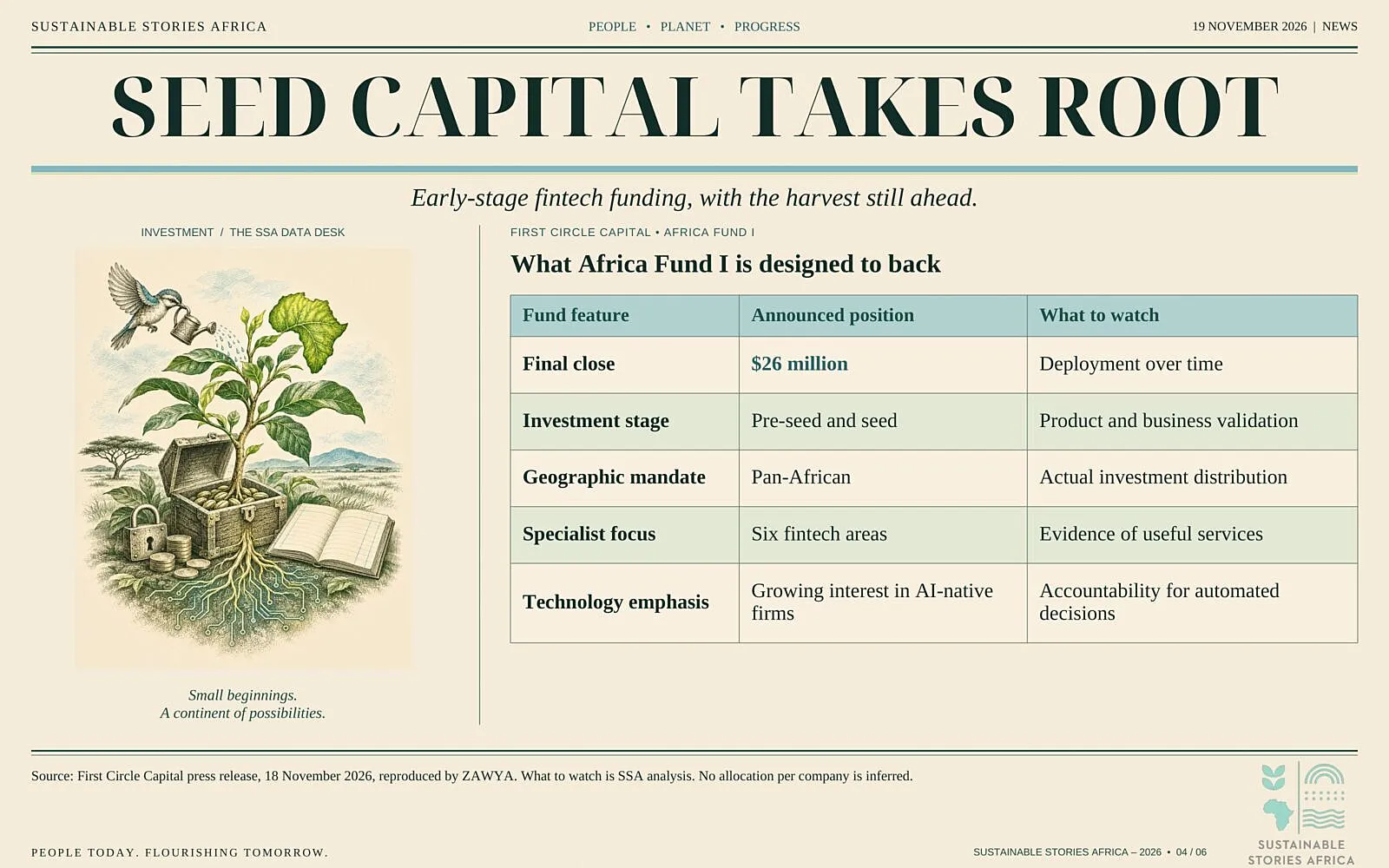
First Circle Capital has announced a $26 million final close for Africa Fund I.
The specialist fund targets early-stage African financial technology businesses, including companies building financial infrastructure.
The opportunity extends beyond fundraising: its eventual impact will depend on whether portfolio businesses deliver useful, dependable and affordable services.
New capital targets financial infrastructure
First Circle Capital announced on November 18 that Africa Fund I had reached a $26 million final close.
- The female-led venture capital firm is backing pre-seed and seed businesses across African fintech, with an increasing emphasis on companies built around artificial intelligence and automation.
The announcement gives founders another source of early institutional backing.
- For customers, however, a fund closing is the beginning of a longer chain.
- Capital must become a viable product, survive operational and regulatory tests, and reach people who find it useful before a financial inclusion claim can be demonstrated.
A specialist strategy takes shape
The fund’s six areas are insurance technology, alternative lending, interoperability and infrastructure, climate fintech, financial software as a service, and regulatory technology.
- Investors named in the announcement include IFC, Bpifrance, MSMEDA, Axian, the Dutch Good Growth Fund, Stellar Foundation and FSD Africa.
The company says it had already backed 18 businesses.
Its website illustrates the breadth of its interests:
- Opareta works on mobile money agent infrastructure
- Scale provides a platform for fintechs
- Balad develops remittance infrastructure.
These examples describe company activities, rather than independently verified customer outcomes.
First Circle’s published approach combines early capital with knowledge and networks.
- It describes support for founders in accessing expertise, mentors and additional investors.
- This operating model is relevant because an investment cheque alone does not solve distribution, product design or the challenge of building partnerships.
Judge technology through the customer experience
The potential benefits are concrete.
- A better connection between financial systems could make a service easier to use.
- More dependable fraud controls could help protect customers
- Better software could reduce avoidable administrative work.
Each proposition still needs evidence from the business that claims to deliver it.
The most useful impact measures would link operating improvements with customer outcomes.
- Lower internal processing costs do not automatically mean lower fees.
- A faster credit decision does not establish that a loan is affordable. An account registration does not demonstrate sustained access to a valuable service.
The growing interest in artificial intelligence makes these distinctions more important.
- Automated systems require clear responsibility for errors and a practical way for customers to challenge decisions.
- A founder should be able to explain the role of data, the limits of a model and the circumstances that require human review.
The same applies to climate fintech.
- A product described as climate-related should show how its finance reaches an activity with a credible environmental purpose.
- Portfolio reporting would be stronger if it identified the underlying service, the beneficiaries and the evidence used to assess results.
A sector label alone cannot provide that assurance.
Make growth and accountability develop together
For founders, the immediate task is to demonstrate a workable business with an identifiable customer need.
- Useful evidence includes repeat use, the cost of delivering the service and the ability to handle complaints.
- Expanding before these foundations are dependable can make later problems harder to correct.
For investors, governance should develop alongside product distribution.
- Clear responsibilities for data protection, model oversight and customer redress can be built into the operating plan.
- These safeguards need to reflect the service being offered and the markets in which it operates, rather than relying on a generic claim of responsible innovation.
Development-oriented investors also have a reason to ask how benefits are measured over time.
- Where a business serves smaller enterprises or underserved customers, reporting should distinguish intended reach from verified use.
- It should explain what changed for the customer and acknowledge results that fall short of expectations.
The final close should therefore be read as additional investment capacity.
- It is not evidence that $26 million has already reached startups, nor that the portfolio has achieved a quantified social return.
- Keeping that distinction visible allows the next phase of reporting to focus on deployment, business performance and customer experience.
For Africa’s fintech market, the opportunity is to connect specialised backing with services that earn continued trust.
- The strongest evidence will emerge when customers can use those services reliably and understand their costs, protections and limits.
Path Forward – Turn fresh capital into dependable services
The next stage is investment deployment and support for early-stage companies developing financial products and infrastructure.
Founders and investors should publish evidence of service quality, customer protection and useful access.
The fund’s sustainability case will strengthen when commercial progress can be linked to verified improvements for the people and businesses it serves.