A Ghanaian digital marketplace is connecting businesses with solar expertise, service providers and financing institutions.
A November 12 interview highlights how borrowing costs and currency exposure can complicate investment.
The opportunity is to make procurement more understandable while keeping project quality and financing terms open to scrutiny.
A marketplace tackles the steps before installation
BisaConnect, developed through the Association of Ghana Industries Energy Service Centre and Swisscontact, aims to connect commercial and industrial businesses with solar consultants, providers and finance.
AGI announced the platform’s launch in August; a Renewables Rising interview revisits the investment barriers it seeks to address.
- This is not an Amazon-owned solar service.
- The interview’s headline describes a marketplace concept.
- The November interview is not the platform’s launch date.
Keeping these distinctions clear helps readers understand both the organisation behind the service and the stage of the story.
Finance is part of the procurement problem
Daniel Nsuison, an AGI renewable energy engineer, told Renewables Rising that some companies had borrowed at around 35%, while some financing options being pursued offered rates as low as 10%.
- He also highlighted the exposure created by dollar borrowing against cedi revenues.
These are attributed examples, not a universal interest rate or guaranteed offer.
- A business would still need to establish eligibility, loan currency, fees, security requirements and repayment terms.
- A headline financing rate is only one component of a project’s cost.
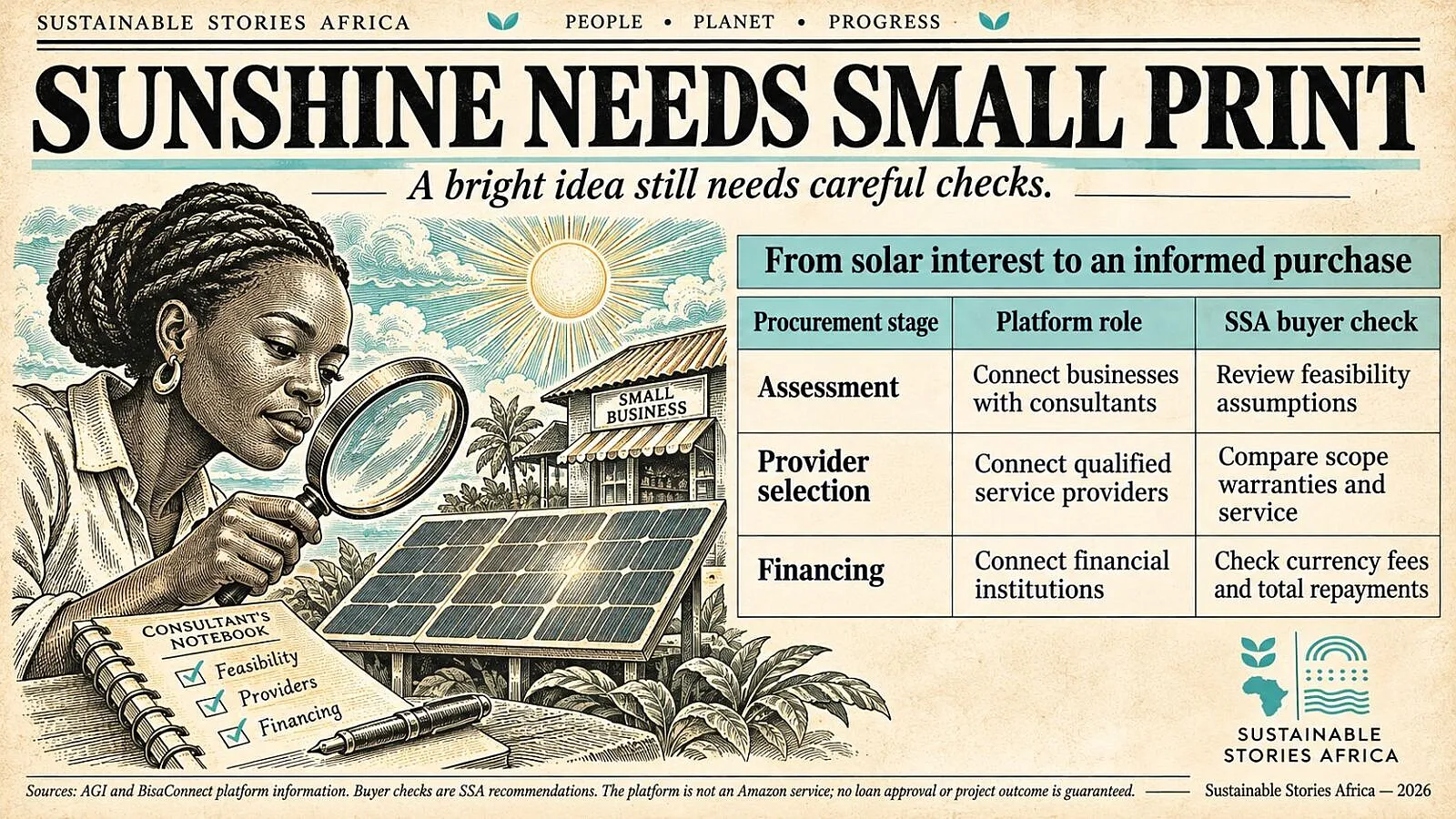
The platform describes a process involving feasibility studies, qualified providers and financing connections.
- Its value would therefore need to be judged across the whole procurement journey, including whether the advice is useful and whether the resulting installation performs as expected.
Better decisions start with comparable information
The marketplace can be most useful when it makes offers easier to compare.
- For an illustrative manufacturer considering solar, the relevant comparison would include expected generation, the basis of that estimate, maintenance responsibilities and the financial assumptions behind projected savings.
- A lower installation price would not settle every question.
The same business would need to understand which risks it retains.
- A provider’s technical assessment, a lender’s approval and a marketplace listing answer different questions.
- None should be treated as a substitute for a clear contract.
Financiers and other service providers need to understand the responsibilities for performance, repairs and disputes before funds are committed.
Transparency could also help businesses decide when to wait.
- A credible assessment may show that a proposed configuration is unsuitable or that financing terms weaken the business case.
- A useful platform should support that conclusion as readily as a sale.
Its development contribution would lie in better investment decisions, including decisions to redesign a project.
Measure outcomes beyond connections and listings
Assess the platform’s progress through completed, operating projects rather than registrations alone.
- Useful measures could include time to reach an informed decision, the financing terms secured and installation performance.
- These are proposed evaluation measures, not results reported by the initiative.
For businesses, the practical next step is to request a written explanation of the project assumptions.
- They should be able to identify what is included in the price, what service is available after installation and how any financing changes the total obligation.
- Providers and financiers can support trust by using clear, comparable documentation.
The wider African relevance is the potential to organise a fragmented purchasing process around usable information.
- Replication would require attention to the market in which a platform operates, including available expertise and finance.
- The Ghana example offers a procurement model to examine; it does not yet show that the model has delivered a particular level of savings or investment at scale.
Comparisons should also use consistent assumptions.
- A quotation based on one operating schedule cannot be meaningfully compared with another that assumes a different pattern of electricity use.
- Buyers must ask providers to show the basis of their calculations and identify which factors could materially change the outcome.
Financing deserves the same discipline.
- A low advertised rate may be useful information, but the business needs to understand the full repayment obligation over the agreed term.
- Clear disclosure would help buyers distinguish an attractive headline from an affordable arrangement.
Furthering the platform’s credibility includes clarity, independent of how many providers or financiers it lists.
Path Forward – Connect credible advice with affordable finance
BisaConnect seeks to bring expertise, providers and finance into a clearer solar investment process.
The priority is to translate those connections into well-designed projects with transparent obligations.
Businesses should compare complete offers and financing terms, while the initiative reports measurable delivery outcomes.
Better information can support cleaner investment when buyers understand both the opportunity and the responsibilities involved.