UNDP says early help for vulnerable households could cost substantially less than responding after El Niño damage has occurred.
Its warning puts the timing of climate finance at the centre of the COP31 debate.
For African communities, acting on forecasts could mean protecting food, incomes and essential services before a shock deepens.
The price of waiting becomes clearer
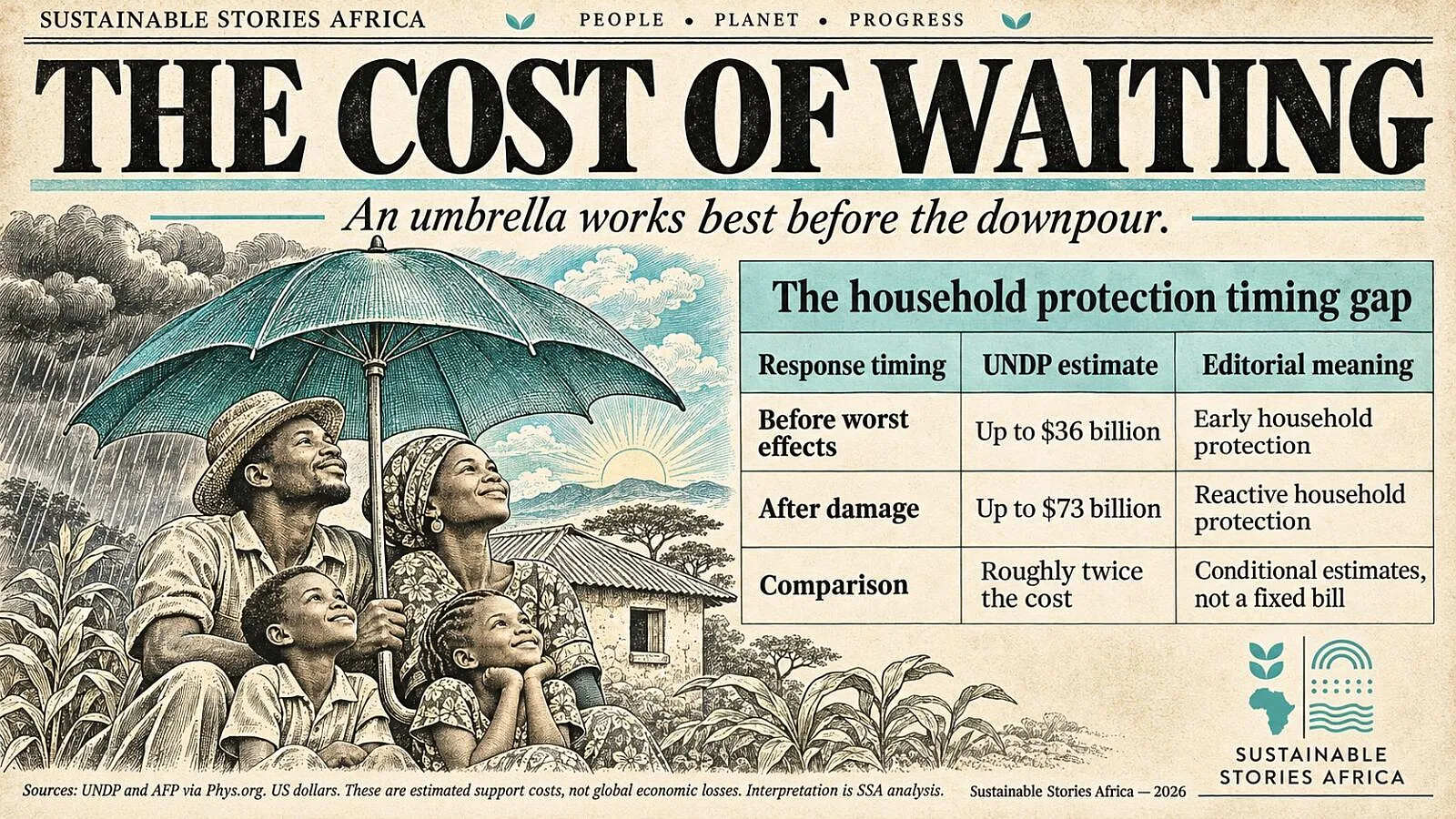
Protecting vulnerable households before the worst effects of the 2026 – 2027 El Niño could cost up to $36 billion, compared with up to $73 billion after damage occurs, UNDP said in a report released on November 10 in Antalya.
The warning was reinforced in an AFP interview published by Phys.org on November 13.
The comparison concerns the estimated cost of household protection in developing countries.
- It should not be described as the total global damage bill or as money already committed.
The central message is about when support arrives: financing after a crisis has escalated may buy less protection at a higher cost.
Forecasts need a route into budgets
UNDP is urging governments, development banks, climate funds and private investors to accelerate support for developing countries’ adaptation plans.
- Administrator Alexander De Croo told AFP: “Not acting is the most expensive climate policy that you could have.”
For African budget planners, the analytical implication is that a warning needs an operational owner.
- A forecast cannot release a payment, clear a procurement request or arrange transport by itself.
- These decisions require rules, responsibilities and funds before an emergency dominates attention.
SSA assesses that early action should therefore be evaluated as a delivery system.
- These questions include who receives support, what event activates it and whether the assistance arrives while households still have meaningful choices.
Protecting choices before losses accumulate
Consider an illustrative farming household facing a credible warning of a difficult season.
- Timely assistance could let it protect an asset or adjust spending before making an urgent sale.
The point is not that every forecast leads to disaster.
- The usefulness of support depends partly on the options still available when it reaches people.
An anticipatory programme should make its reasoning visible.
- Communities need to understand why an area qualifies, why a particular response is chosen and how to challenge an exclusion.
- These are safeguards for effectiveness as well as fairness: assistance designed around an inaccurate understanding of local needs may arrive early and still fail to help.
The benefits should also be measured carefully.
- Lower emergency spending is one possible indicator, but a programme could be valuable because households retained productive assets or avoided a prolonged interruption to schooling or work.
- Such measures would need baselines and follow-up rather than assumptions about what the funding achieved.
Build accountable routes for early support
SSA identifies a practical next step for governments: agree the financing and delivery rules before the next warning becomes an appeal.
- This means assigning responsibility for decisions, specifying eligible uses and preparing a clear public explanation of the trigger.
- Build oversight into the mechanism, rather than postponing it until a hurried emergency review.
Development partners should assess whether their procedures permit support to arrive within the useful window.
- A commitment that requires extensive approval after a threshold has been reached may offer limited anticipatory value.
- Financing terms should be assessed alongside speed, local administrative capacity and the recipient’s ability to sustain the response.
Early action also requires a learning process.
- Authorities should compare forecasts, decisions and outcomes after the season, including cases where the feared event did not fully develop.
- That review can improve future thresholds without treating every precaution as a failed prediction.
- The objective is a defensible system for making decisions under uncertainty.
There is a trade-off to manage between speed and precision.
- Waiting for perfect information could leave too little time to act, while poorly designed triggers could misdirect resources.
- SSA recommends publishing the reasoning behind thresholds and identifying the level of uncertainty that decision-makers are prepared to accept.
Local delivery partners should also be involved before a trigger is reached.
- A national financing mechanism may be ready on paper while the organisations expected to distribute support lack instructions or capacity.
- Rehearsing the process and identifying practical constraints would help determine whether the promised response can operate within the available time.
These checks would make preparedness a demonstrable capability.
Path Forward – Fund protection before the crisis deepens
UNDP’s warning calls for earlier financing of household protection and adaptation.
The immediate priority is to connect credible warnings with authorised, accountable delivery.
African governments and their partners should make those arrangements reviewable, including who qualifies and when support is released.
Success means reaching people while assistance can still prevent avoidable harm.