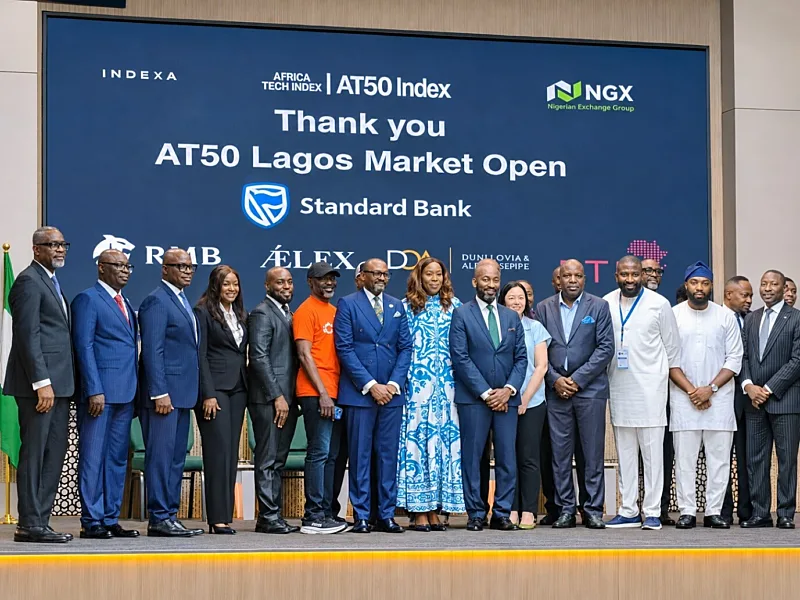
ETK Group’s Bolaji Sofoluwe urged African companies at the AT50 Lagos Market Open to consider regional markets before looking farther abroad.
Her message: success in Nigeria does not tell a founder what it will cost to win customers or comply with regulations in another country.
Getting those decisions right could help businesses reach more customers and show investors how they can grow beyond one market.
A case for looking closer to home
African companies looking to expand should consider home markets before defaulting to Britain or the United States, ETK Group Managing Director Bolaji Sofoluwe said on Wednesday.
Addressing founders, investors and capital-market executives at the AT50 Lagos Market Open, she pointed to Kenya and South Africa as examples of markets Nigerian businesses could assess before looking farther afield.
The event, hosted by Nigerian Exchange Group at Exchange House in Lagos, brought private technology companies into discussion with exchanges, regulators and institutional investors.
For Sofoluwe, questions about attracting long-term capital start with an operational one:
- Can a company sell beyond its home market without losing what makes the business viable?
A successful business may not travel well
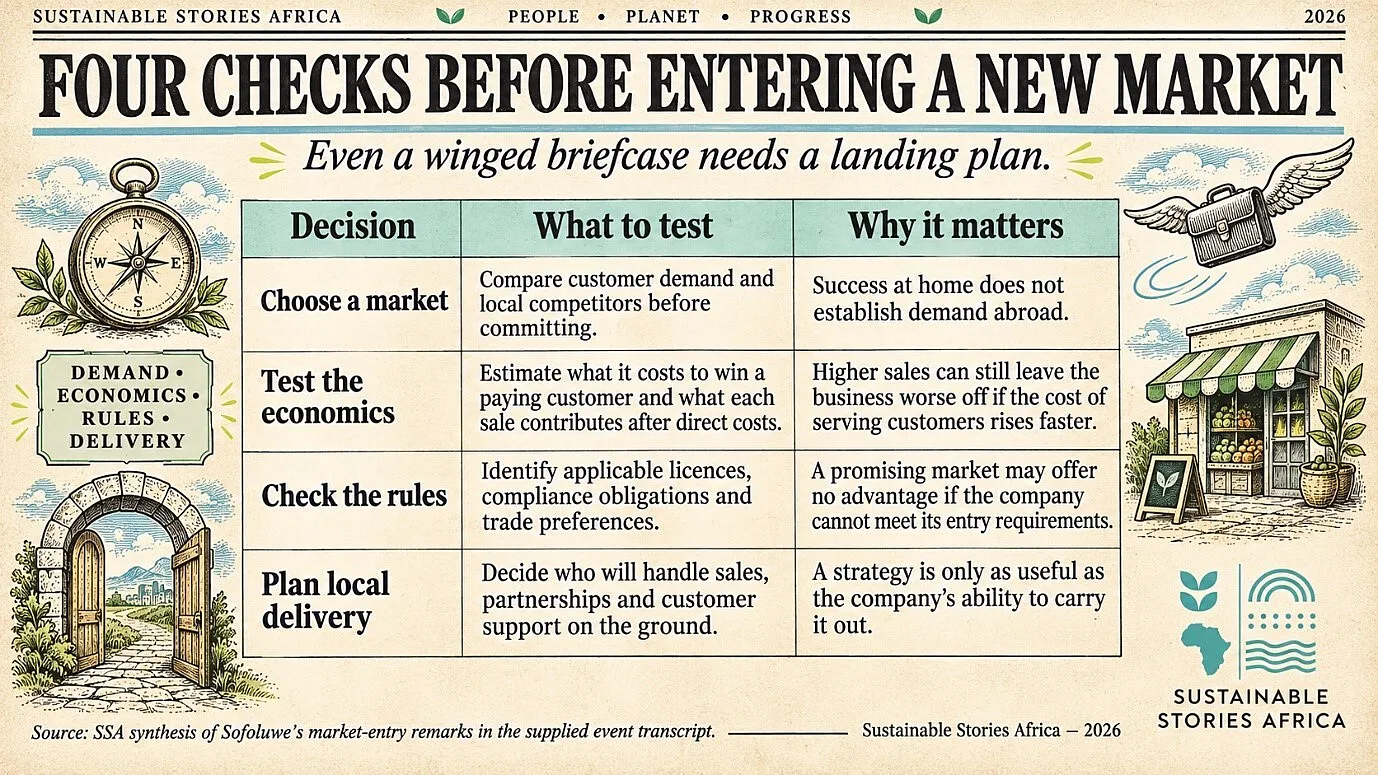
Sofoluwe warned against treating expansion as a “plug-and-play scenario”.
- A company may have a recognisable brand and an efficient sales operation in Nigeria, but that does not tell it how much it will spend to attract a paying customer in Ghana, Kenya or Britain.
She uses these markets to show how widely acquisition costs might vary, not to suggest that any one country is consistently cheaper.
The same scrutiny applies to licensing, competition and distribution.
- Sofoluwe said ETK had helped more than 300 businesses grow across Africa and elsewhere.
She said the experience shows that research and strategy matter, but so does having people on the ground who can put a plan into practice.
More customers, less dependence on one market
Sofoluwe cited digital services and financial technology as areas where African companies could sell expertise beyond their home countries.
- She linked that opportunity to a broader argument for retaining more value locally:
- A business that develops a product or service at home can look abroad for customers without assuming that its next stage of growth must be built outside Africa.
A second market can reduce dependence on demand in one country, but entering it also brings new costs and obligations.
This distinction matters to investors:
- A company that can show what it takes to win and serve customers in another country has a stronger case for expansion than one whose growth plan rests on the size of its own market alone.
Turn trade agreements into business decisions
Sofoluwe urged executives to read the trade agreements that might apply to their businesses, pointing to the African Continental Free Trade Area (AfCFTA) as one tool for regional expansion.
- The practical question is whether a provision affects the particular product or service a business wants to sell, and whether the company can meet the conditions needed to benefit.
- This is more useful to an expansion decision than citing the agreement in an investor presentation.
Her remarks on how businesses choose markets, navigate regulation and build local operations brought together perspectives from digital banking, payments, stablecoin infrastructure and mobile networks.
Path Forward – Test Demand Before Committing Expansion Capital
Founders can start by comparing two plausible markets on customer demand, compliance, acquisition costs and the strength of potential local partners.
A pilot can then test whether the business can reliably reach customers before it commits to a full launch.
For investors, the results offer a way to distinguish geographic ambition from an expansion plan that can be financed and sustained.