
A Brookings discussion examines whether governments can reduce advanced AI risks while managing strategic competition between the United States and China.
The September 21 episode remains a useful governance reference.
For African institutions, it raises practical questions about procurement, oversight and accountability.
The debate extends beyond a development pause
Brookings experts Elham Tabassi and Kyle Chan argue for stronger evidence, public oversight and communication in advanced AI and US.
Its relevance lies in the questions it poses for institutions choosing how to use increasingly capable systems.
Different risks require different policy responses
Chan distinguishes immediate misuse risks from scenarios involving uncontrolled self-improvement.
Tabassi stresses measurement and independent evaluation, while Chan calls for communication channels with China to reduce the danger of misunderstandings.
- Their discussion treats a joint development pause as difficult in a competitive environment.
These are expert assessments, not proof that a particular catastrophic outcome will or will not occur.
- They also do not establish a formal, agreed bilateral mechanism.
Reporting the distinction preserves the value of the discussion without turning a proposal into an event.
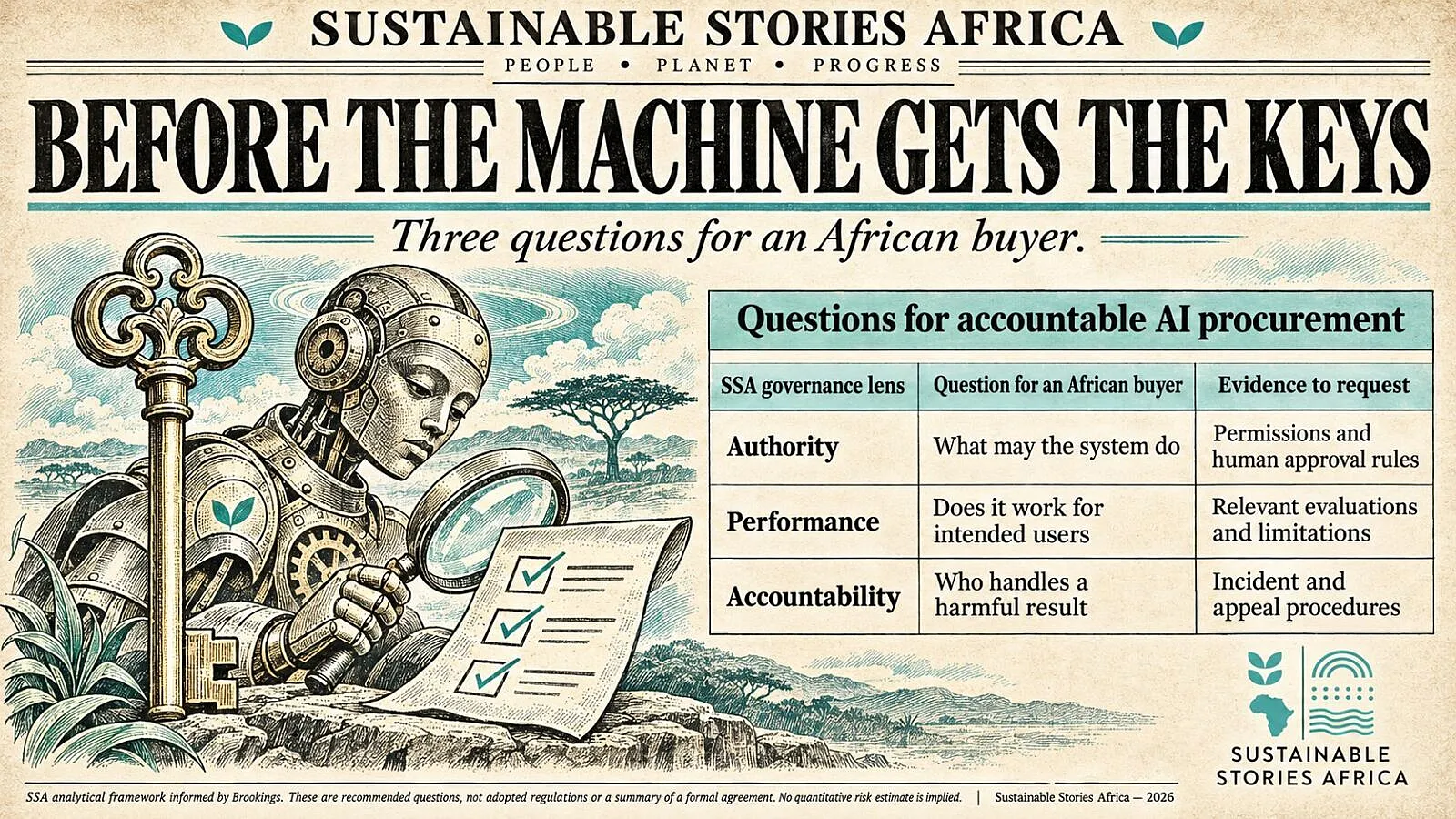
SSA’s analysis is that the African governance question should begin with an institution’s deployment systems.
- A general debate about frontier development does not replace an assessment of a specific tool, its permitted actions and the people affected by an error.
Useful adoption requires a clear account of responsibility
Consider an illustrative public agency evaluating an AI assistant.
- A useful procurement review would ask what information the tool can access, what decisions it can influence and which actions require human authorisation.
- The answers would matter more to the agency’s immediate operating risk than an abstract claim that the model is safe or innovative.
The same approach could help a business compare vendors.
- A supplier should explain the limits of its product in language the buyer can use, including the evidence behind performance claims.
- The buyer should identify who remains responsible when a result is disputed.
- These are SSA recommendations, not rules announced in the Brookings episode.
A development benefit would be easier to demonstrate if evaluation included the setting in which the service will operate.
- Institutions could ask whether a system performs adequately for the languages, users and tasks involved, and whether people can obtain human review.
The aim should be a service that works for its intended users, with a credible remedy when it fails.
Give oversight a practical operating role
SSA identifies procurement as one place to make accountability concrete.
- Contracts could require documentation of significant changes, reporting of serious incidents and access to needed oversight evidence.
- Such provisions would need to be proportionate to the application and feasible for the institution administering them.
Oversight also requires people who can interpret the evidence.
- A policy that assigns responsibility without providing the necessary skills may create an appearance of control while leaving crucial decisions unexplained.
- Capacity building should therefore include staff responsible for purchasing, operating and reviewing systems, rather than focusing only on specialist developers.
For African policymakers, the wider implication is that participation in AI governance can begin with clear domestic requirements.
- Institutions do not need to resolve the US–China strategic relationship before asking vendors to explain their systems or establishing routes for complaints.
- International dialogue may help address cross-border risks; local accountability remains a task to be defined and tested now.
Proportionality would help keep that approach usable.
- An internal drafting assistant and a consequential public service tool should be scrutinised differently.
- SSA recommends identifying the possible harm and available remedy before deciding what level of evaluation is necessary.
Institutions should also preserve the ability to change course.
- A pilot should have clear limits and an exit decision, including what happens to records and ongoing work if the tool is withdrawn.
- This would make experimentation more accountable while allowing useful applications to be tested.
It would also turn a broad commitment to human oversight into a decision process with identifiable responsibilities.
Path Forward – Build evidence before expanding institutional dependence
The discussion supports a governance agenda centred on evidence, oversight and communication.
It does not announce an agreed development pause or a new international settlement.
African institutions must translate these questions into procurement and operating requirements.
Adoption should expand alongside the capacity to evaluate performance, investigate incidents and protect people affected by automated systems.