Africa: The Big Deal identifies Morocco and Ghana as leading contenders beyond the continent’s four dominant startup funding markets.
Its November 16 analysis finds a widening pool of funded companies without a corresponding shift in capital share.
The challenge is to turn emerging entrepreneurial activity into durable local investment ecosystems.
More markets enter the funding conversation
Morocco and Ghana stand out in an Africa: The Big Deal analysis published on November 16 examining startup ecosystems beyond Nigeria, Kenya, Egypt and South Africa.
- The research compares funding activity with other signs of ecosystem depth rather than simply declaring four successors.
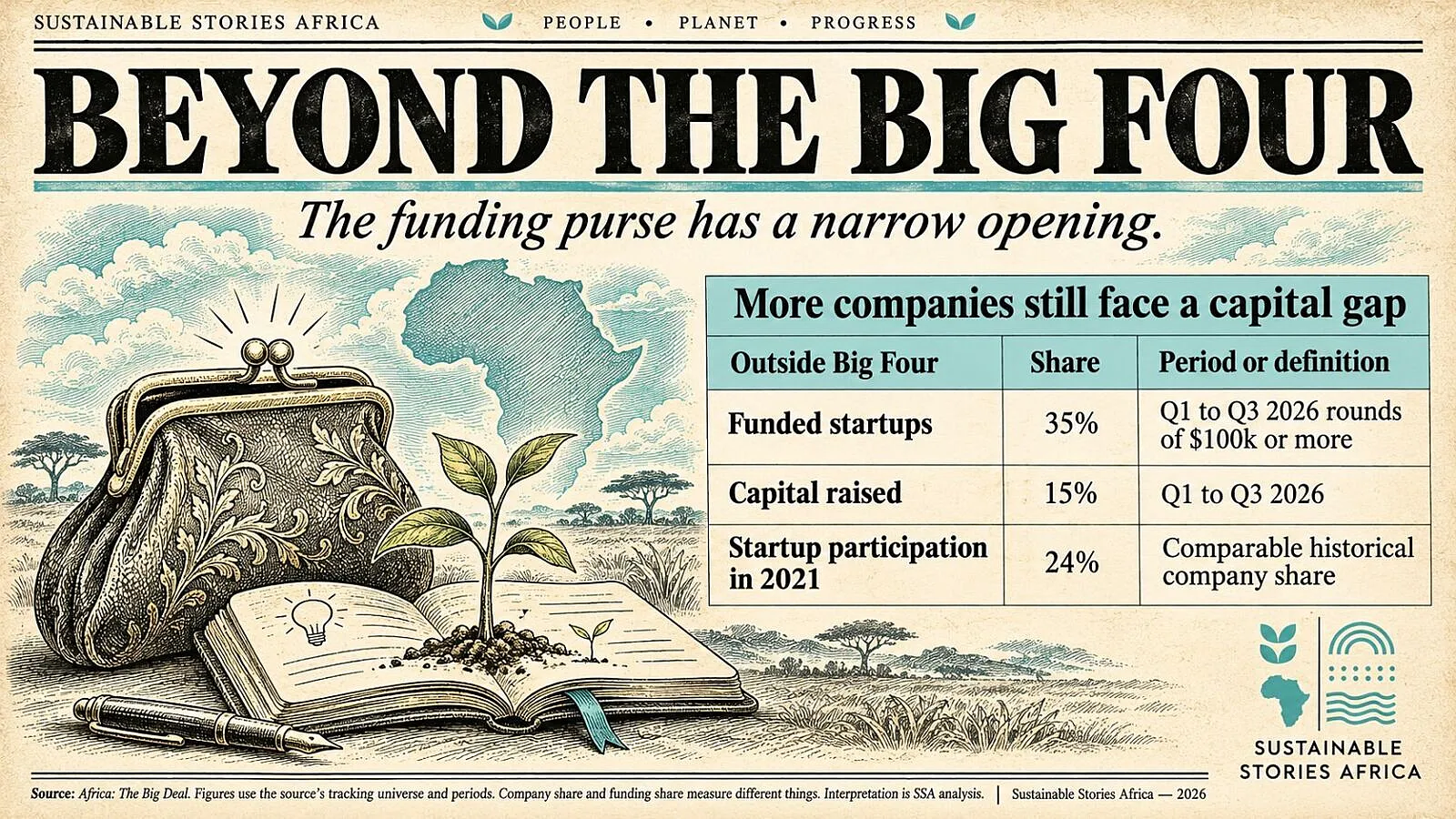
Its key finding is a mismatch: markets outside the Big Four accounted for 35% of African startups raising at least $100,000 in the first three quarters of 2026, but attracted 15% of funding.
- The distinction matters because a broader distribution of companies does not necessarily mean these companies have access to the capital needed to grow.
Ecosystem depth needs more than deal totals
The analysis highlights Morocco’s local investor participation and Ghana’s breadth of funded businesses.
- These are different strengths.
- A market can support a varied entrepreneurial base while still having gaps in domestic finance; another may have a stronger investment network without matching every other market’s scale.
The table provides a compact reading of the headline comparison.
- It distinguishes the number of funded companies from their share of capital.
- Neither measure alone shows how profitable those businesses are, what working conditions they offer or how widely their services are used.
For SSA, that limitation is central to interpreting the development story.
- Startup funding can be an indicator of investor attention, but attention is an input.
- A sustainability assessment also needs evidence of useful services, viable operations and benefits that persist beyond a financing round.
A wider investment map could broaden opportunity
An entrepreneur building a service for a local market needs investors who can assess that market on its own terms.
- SSA’s analysis is that a broader investment map could improve the chances of such businesses being understood.
- It would not remove the need for financial discipline or establish that every emerging ecosystem is ready for the same type of capital.
The useful question for a prospective investor is therefore more specific than which country comes next.
- It is whether a particular business has customers, a workable route to revenue and financing suited to its stage.
- At the ecosystem level, the corresponding question is whether founders can move between stages without relying on a single exceptional transaction.
Governments and development partners could support this assessment by improving availability of comparable information.
- A consistent account of financing stages, investment instruments and company outcomes would make it easier to distinguish a temporary surge from an enduring change.
- Such transparency could also reveal which kinds of businesses remain outside the funding conversation.
Build the institutions behind repeatable investment
SSA identifies a practical policy priority: strengthen the conditions for repeated, informed investment rather than treating a headline ranking as a development strategy.
- Market participants could examine the availability of local fund managers, credible company information and pathways through which investors can eventually realise returns.
For public institutions, support should have an explicit purpose and a reviewable outcome.
- If a programme aims to widen access, it should report who received capital and who did not.
- If it aims to improve company survival or growth, it should track those outcomes over time.
- A larger funding total cannot answer every policy question.
Founders also benefit from a more precise conversation.
- A market’s rising profile should not be presented as a guarantee that finance is readily available.
- Matching the instrument to the business, clarifying investor expectations and planning beyond the next round remain useful tests.
- The opportunity is to build investment relationships that can be repeated and improved.
The composition of finance deserves attention.
- Equity, debt and grants create different obligations and should be reported separately when comparing markets.
- SSA recommends looking at what the funding enables and what repayment or ownership conditions accompany it, rather than treating every dollar as equivalent.
This is especially relevant when a small number of large transactions influence a market total.
- Reviewing the distribution across companies and stages would help readers understand whether activity is broad or concentrated.
- Such analysis would complement, rather than replace, the source’s ecosystem approach.
It would also make comparisons more useful to founders seeking a realistic view of their financing options.
Path Forward – Build deeper markets beyond headline funding
The research points to emerging strengths beyond Africa’s dominant funding centres.
The next step is to test whether wider participation develops into sustained access to suitable capital.
Investors and policymakers should compare ecosystem depth alongside funding volume, while tracking business outcomes.
A credible next market needs institutions and viable companies, not merely a place in a ranking.