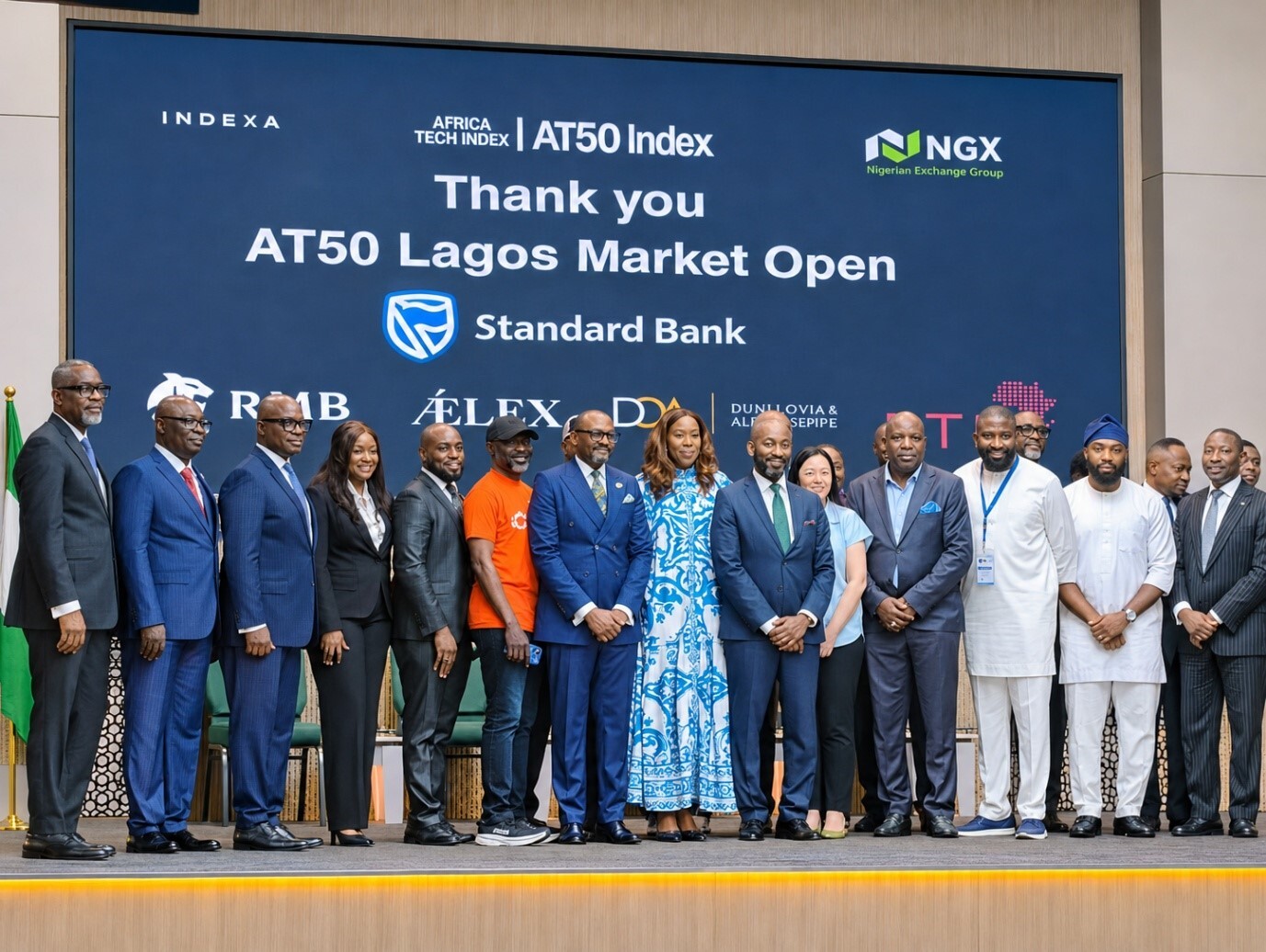
At the Nigerian Exchange, Indexa Exchange Group turned the screen over to a short film about a question that has followed Africa’s technology companies from London to Lagos:
How do private businesses become visible to public markets before they are ready to list?
Its Africa Tech 50 Index offers investors a common starting point.
What matters now is whether that visibility leads to better scrutiny, stronger governance and more credible routes to long-term capital.
The Room Turns Towards the Screen
At Exchange House in Lagos, the presenter asks the room to look at the screens.
A short film (00:18:43 - 00:22:23) takes the audience back through London, Johannesburg and Cairo before returning them to the question that brought founders, financiers, advisers and market institutions together on 18 November:
- What comes after a private technology company has proved it can grow?
The organisation putting that question to the room is Indexa Exchange Group.
- In January, it launched the Africa Tech 50 Index, or AT50, at the London Stock Exchange.
- Lagos is the fourth stop in its exchange programme and the home-market gathering for the benchmark’s largest national cohort: 16 Nigeria-linked companies out of 50.
For the people who use those companies’ services, the story starts somewhere else: at the checkout, in the time it takes to move money or in the work of getting goods to a customer.
- The market-open film asks the room to look behind those everyday transactions at the businesses that make them possible, and at the work of building institutions that can last.
A Private Market Comes Into View
AT50 starts with a distinction that can get lost at an exchange ceremony: being tracked is not the same as being traded.
- Indexa’s benchmark follows up to 50 private African technology companies.
- It is not a fund or a basket of listed shares that an investor can buy, and inclusion does not commit a company to an initial public offering, or IPO.
This distinction is the point.
- A merchant knows whether a payment platform works at the counter.
- An institutional investor needs to know how the platform earns revenue, whether that revenue can hold up under pressure and who can challenge management’s decisions.
The same company can be familiar to one audience and hard for the other to assess. AT50 was built to give the second audience a more consistent place to start.
- “It is a global venue for market standards, and it signals what we are building, Africa-led, globally aligned.”
Gbite Oduneye, Indexa chair, on the London launch, speaking to Forbes Africa.
Four Exchanges Give the Benchmark Shape
London put AT50 in front of an international capital-markets audience on 28 January.
- On 15 July, the Johannesburg Stock Exchange hosted its first African exchange engagement.
- The Egyptian Exchange followed on 22 September in Cairo, when Egypt was home to nine constituents.
Lagos brought the discussion to the market with the largest cohort at the November gathering, with Nigerian Exchange Group hosting and Standard Bank as lead banking partner.
The route matters because the benchmark is meant to serve two audiences.
- Investors looking across borders need a consistent way to compare companies.
- Founders weighing a listing also need to understand what their own exchanges, regulators and prospective shareholders will expect.
The Cairo footage makes that tension practical:
- The speakers discuss reporting and corporate governance alongside the possibility of companies in different African markets learning from one another.
What the Benchmark Makes Easier to See
Indexa reviews the benchmark quarterly using six criteria, from revenue strength to governance maturity.
The framework turns broad claims about growth into more specific questions:
- Does revenue support the case for the company’s valuation?
- Is its expansion strategy credible?
- What would give an outside investor confidence that the business can operate beyond its founders?
Indexa identifies the Capital Markets Readiness Council, Methodology & Inclusion Committee and Governance Secretariat as its oversight bodies.
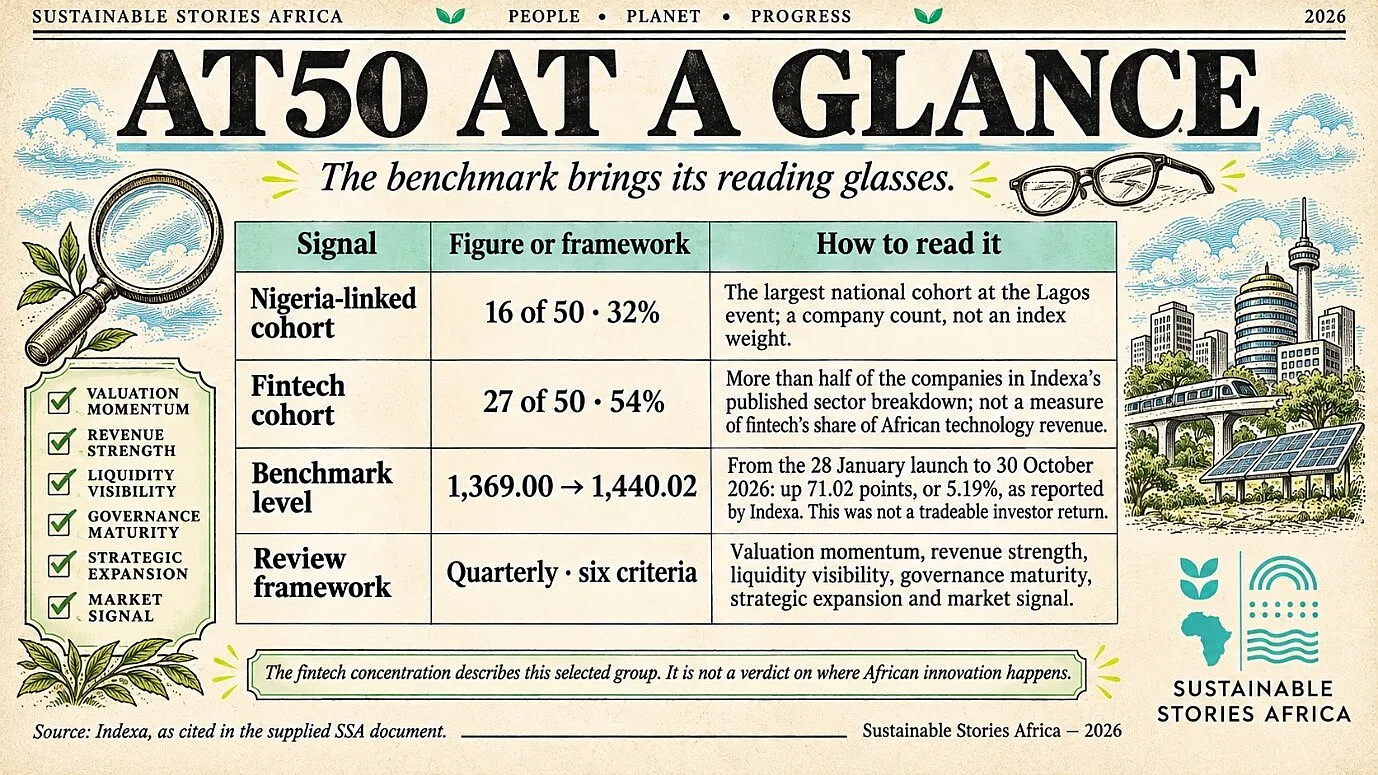
The concentration in fintech is useful context, not a verdict on where African innovation happens.
- It tells readers what is prominent in this selected group.
- It also helps explain why the framework matters: a benchmark is most informative when readers know what it covers and what they should not infer from it.
Visibility Must Lead to Better Questions
At Lagos, the next step was not to announce a queue of IPOs.
- It was to bring company leaders into the same conversation as the people who would evaluate, advise or regulate a future transaction.
These conversations can start before a company needs to raise money.
- Founders can find out what reporting investors will ask for; investors can follow a business over time rather than trying to understand it for the first time during a deal.
This is also where the governance promise can be tested.
- A common framework makes it easier to ask similar questions of different companies, but it cannot answer those questions on their behalf.
- Boards still have to show how they oversee risk.
- Management teams still have to explain what went to plan, what did not and why.
The benchmark opens the conversation; the quality of the evidence companies provide will determine how far it goes.
Path Forward – The Test Begins After the Gong
The film could show where AT50 had been.
It could not show which companies would choose to list, what investors would pay or how scrutiny would change how a business is run.
Indexa’s more durable contribution may come before any listing:
Making it normal for an African technology company and a prospective long-term investor to know more about one another long before either needs a deal.