An industry specialist argues that smart meters can help municipalities identify losses and improve billing as electricity sales come under pressure.
The proposal highlights the link between utility finances and the transition to more distributed energy.
For households, the value will depend on accurate bills, reliable service and meaningful ways to resolve errors.
The meter becomes part of a wider revenue debate
Municipalities should treat metering data as an operational resource as well as a billing tool, Goodness Maziya argues in an opinion highlighted by Renewables Rising on November 13.
- Maziya is a Metering Manager at ACTOM Smart Technologies.
The argument is an industry perspective, not an independent evaluation proving that a particular rollout has recovered revenue.
- Its relevance to African utilities lies in the relationship between financial performance and service delivery.
A technology purchase needs to demonstrate that relationship in practice.
Better visibility is the central proposition
Maziya’s fuller commentary describes ageing meters, tampering, inaccurate readings and billing delays as revenue problems.
- It argues that more timely consumption data can help identify losses and that integration with operational and billing systems increases its value.
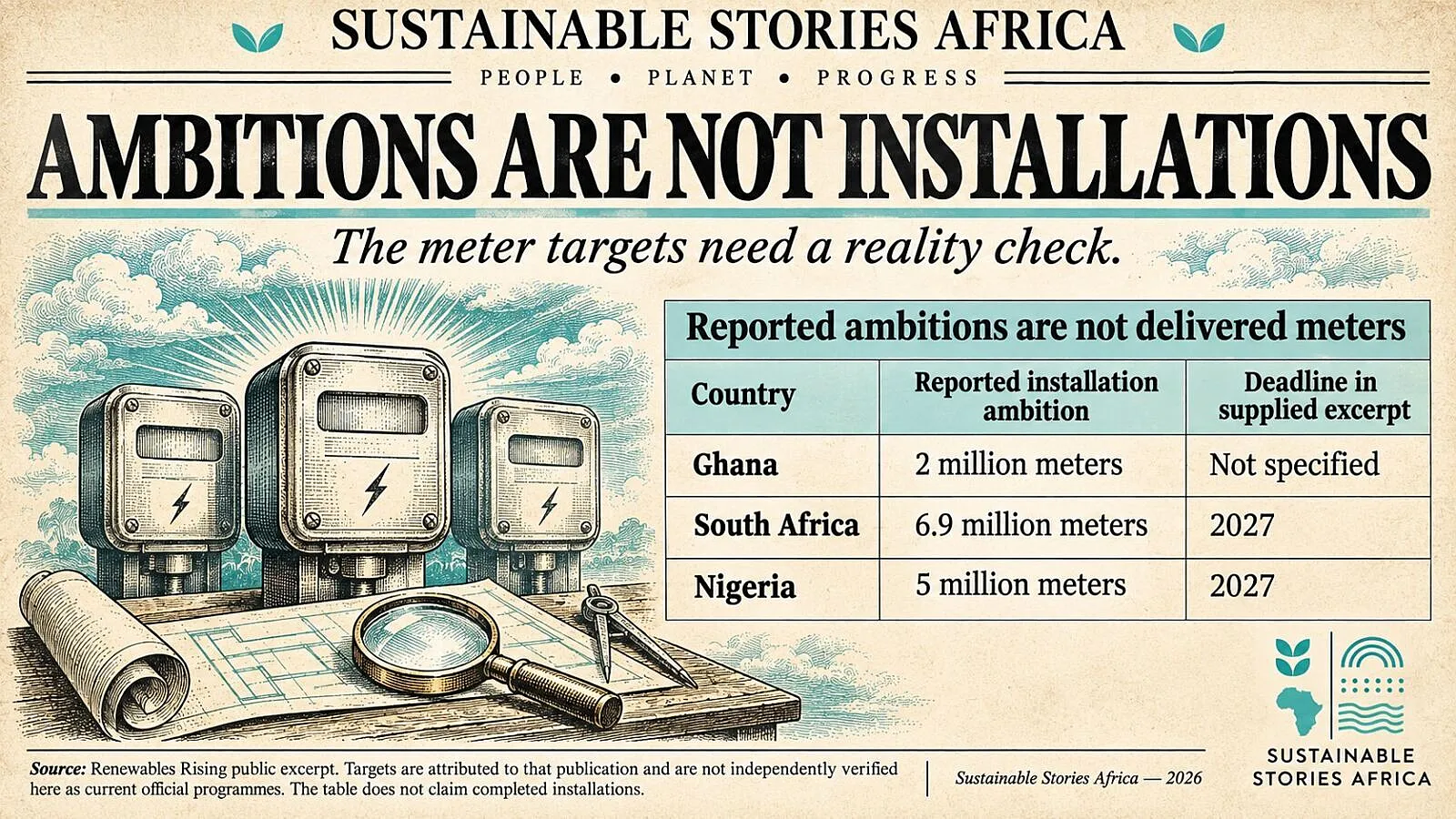
Renewables Rising reports 2 million for Ghana, 6.9 million for South Africa and 5 million for Nigeria, with meter installation ambitions; it links the South African and Nigerian figures to 2027.
Meter installations are a useful activity measure but an incomplete performance measure.
- A meter that has been installed must also be commissioned, connected to the relevant systems and supported by processes that make its information usable.
Customer confidence belongs in the business case
Consider an illustrative household disputing an unexpectedly high bill.
- More frequent readings could help explain consumption, but the household would still need access to the information and a fair correction process.
- Better data would have limited public value if customers cannot understand or challenge an account.
This suggests a broader definition of successful modernisation.
- Evaluating bill accuracy, dispute resolution speed, and the effect on service alongside changes in revenue.
- These measures would help distinguish improved collection from genuine improvement in the customer relationship.
Utilities should also explain what information they collect, who can access it and how long they retain it.
- Clear responsibilities matter when technology providers, billing teams and network operators each manage part of the process.
- These are governance recommendations rather than claims about a particular municipality’s current practices.
Procure the service and the capacity to run it
Assessing rollout plan credibility should include the operating arrangements required after installation.
- Buyers need to understand support obligations, staff training, system compatibility and the route for resolving technical failures.
- The least expensive device may not represent the best complete service, but a higher price also needs justification.
A useful starting point would be a defined pilot with published objectives and an agreed review.
- The evaluation could compare billing accuracy, operational performance and customer experience against a baseline.
- Any expansion should respond to those findings, rather than treating the original procurement volume as the main measure of success.
Municipal decision-makers should also keep the energy transition in view.
- If their objective is a financially sustainable network that serves customers with changing electricity patterns, use, metering is one part of that design.
- Technology should inform a transparent discussion about service and cost, not be expected to resolve every revenue challenge by itself.
The immediate call is for procurement proposals that specify the problem, the expected improvement and the evidence needed to verify it.
- That would let elected representatives, utility managers and customers judge the same project against a shared set of outcomes.
A further distinction concerns the causes of a revenue shortfall.
- Separating electricity that is not measured accurately from bills that are issued but not paid, and from changes in legitimate consumption.
- The problem’s response may differ, even where the same data system helps identify it.
That diagnostic work should precede procurement.
- A municipality would have a stronger investment case if it could explain which losses the project addresses and which remain outside its scope.
- Clear boundaries would also protect the evaluation from unrealistic expectations.
A successful metering project should be judged against a defined problem, with wider financial reforms assessed on their own merits.
Path Forward – Make metering improvements visible to customers
Smart metering is presented as a route to better information and stronger revenue management.
The next step is to test that proposition through accountable implementation.
Linking investment to billing accuracy, customer remedies and measurable service improvements.
Reported national targets should remain clearly distinguished from completed, functioning systems and verified public benefits.