The African Development Bank Group has approved a $102 million financing package for Sterling Bank Nigeria Limited.
The operation combines lending instruments with a trade finance guarantee to address different financing needs.
Its development promise rests on reaching businesses and vulnerable farmers, then demonstrating what the financing changes for them.
Different financing needs receive different tools
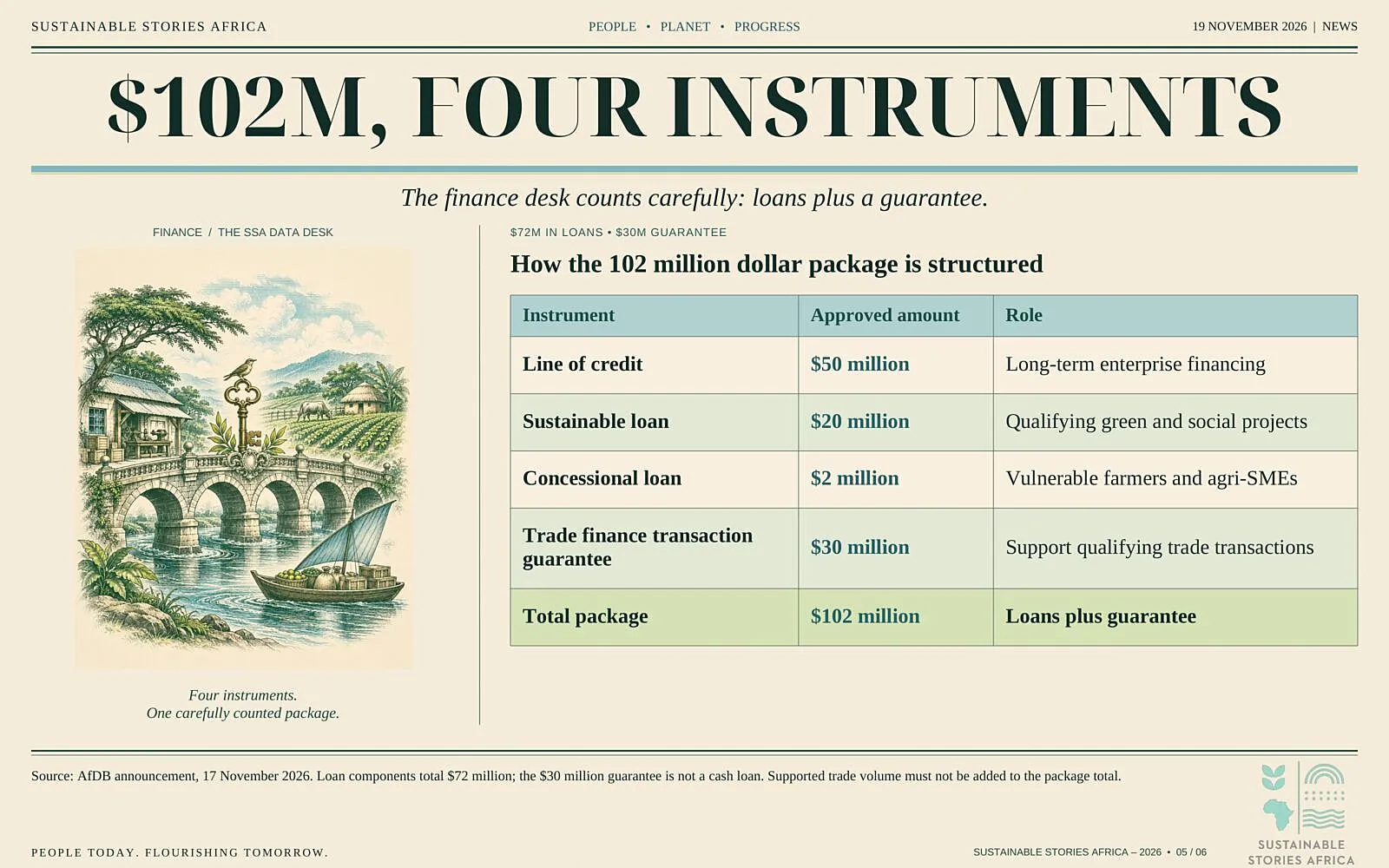
The African Development Bank Group has approved a $102 million package for Sterling Bank Nigeria Limited to expand finance for enterprises, sustainable investments and vulnerable farming communities.
- Announced on November 17, the operation combines three loans with a trade finance transaction guarantee.
- It is a financing approval, not a report of completed lending to end beneficiaries.
The mix matters because an enterprise financing equipment, a trader purchasing goods and a farmer rebuilding production do not necessarily need the same financial product.
A combined package can address those differences, provided the terms and distribution arrangements fit the people it is designed to reach.
Read the financing instruments separately
The four instruments have different functions, as the table shows.
- AfDB says at least 30% of the line of credit is intended for eligible women-owned, women-led and youth-owned enterprises.
- This earmark applies to the line of credit, rather than to the full package.
AfDB identifies targets of at least 200 businesses, up to 6,000 jobs and more than 5,000 vulnerable smallholder farmers and agri-SMEs.
- The trade guarantee is expected to support up to $150 million in transactions.
- These are expected results and supported activity, not additional grant funding.
The approval follows a separate $61 million AfDB package for the Development Bank of Nigeria, announced in May, with more than 95% earmarked for women-owned or women-led small and medium enterprises.
- The earlier operation uses participating financial institutions, illustrating a broader approach of reaching firms through intermediaries.
Reach matters as much as the headline
For a business owner, the meaningful questions begin after the announcement.
- What documents are required?
- What will the financing cost?
- When will a decision arrive?
- Can repayments be matched to the investment’s cash flow?
These practical conditions determine whether a facility can be used productively.
The inclusion promise should be judged at the point where an eligible applicant receives an appropriate offer.
- An earmark can guide allocation, but it does not establish that a first-time borrower understands the process or can satisfy every requirement.
- Transparent communication and application support would help make the intended reach more credible.
The same scrutiny applies to farmers exposed to disrupted livelihoods.
- A financing decision should distinguish a viable recovery plan from a request that cannot reasonably support repayment.
- Seasonal timing and the intended use of funds need careful assessment.
These are implementation considerations, rather than conditions disclosed for every eventual beneficiary.
The distinction between loans and guarantees also protects the public understanding of the announcement.
- A guarantee supports transactions by sharing specified risks; it is not equivalent to placing its face value into a borrower’s account.
The instruments therefore need separate reporting before their combined contribution can be assessed.
Publish the route from approval to outcomes
The next useful disclosure would explain how eligible businesses can access the relevant products once available.
- Clear eligibility criteria, pricing information and decision processes would allow prospective borrowers to assess the opportunity without relying on the headline figure alone.
- The announcement itself does not establish a universal application entitlement.
Performance reporting should distinguish commitments, disbursements, outstanding lending and guarantee-supported transactions.
- It should also show which groups were reached and what evidence supports employment claims.
- A target for jobs is a reason to track results, not a substitute for observing them.
For sustainable investments, reporting can identify the activity financed and the environmental or social result being assessed.
- The appropriate evidence will vary by project.
- A loan category should not be presented as proof that every underlying activity has already delivered an improvement.
The earlier Development Bank of Nigeria approval provides useful context, but it should remain separate.
- Adding announcements from different institutions or periods would not reveal how much any particular business has received.
- Consistent disclosure across programmes would make overlap and additional reach easier to understand.
The practical test is whether the package expands productive access on workable terms.
- If it does, its value will show in businesses able to invest, livelihoods able to recover and transactions able to proceed.
- Evidence of these changes will matter more than repeated statements of the approved total.
Path Forward – Track access from approval to livelihoods
Sterling Bank’s next implementation steps should clarify access, appropriate products and reporting for the groups the package targets.
Progress should be measured through actual financing, verified reach and defensible outcomes.
Keeping loans, guarantees and expected results distinct will help businesses and the public judge whether the approval delivers its intended development value.