A GlobeScan survey finds widespread dissatisfaction with how economic gains and burdens are shared in several European markets.
The November 18 analysis places the findings alongside cost-of-living demonstrations, while cautioning that the research does not establish protest causes.
For African decision-makers, it raises a useful question: how should economic progress be assessed from the household’s perspective?
Fairness becomes a test of progress
Majorities in five European markets believe the benefits and burdens of recent economic developments have been shared unfairly, according to GlobeScan findings published on November 18.
- The result directs attention to a question that headline growth alone cannot answer: who feels better off, and who believes they are carrying the costs?
The finding has relevance for African businesses and governments as an international warning about trust
- It does not establish what African respondents think.
A useful comparison starts by keeping those boundaries clear and asking which local evidence would be needed before drawing a similar conclusion.
Read the changes as well as the levels
The table shows substantial differences in direction.
- Germany worsened sharply
- Spain and Italy improved from higher starting points.
A large dissatisfied majority does not automatically mean sentiment is deteriorating.
- Comparing the level with the change gives a more informative reading than either number alone.
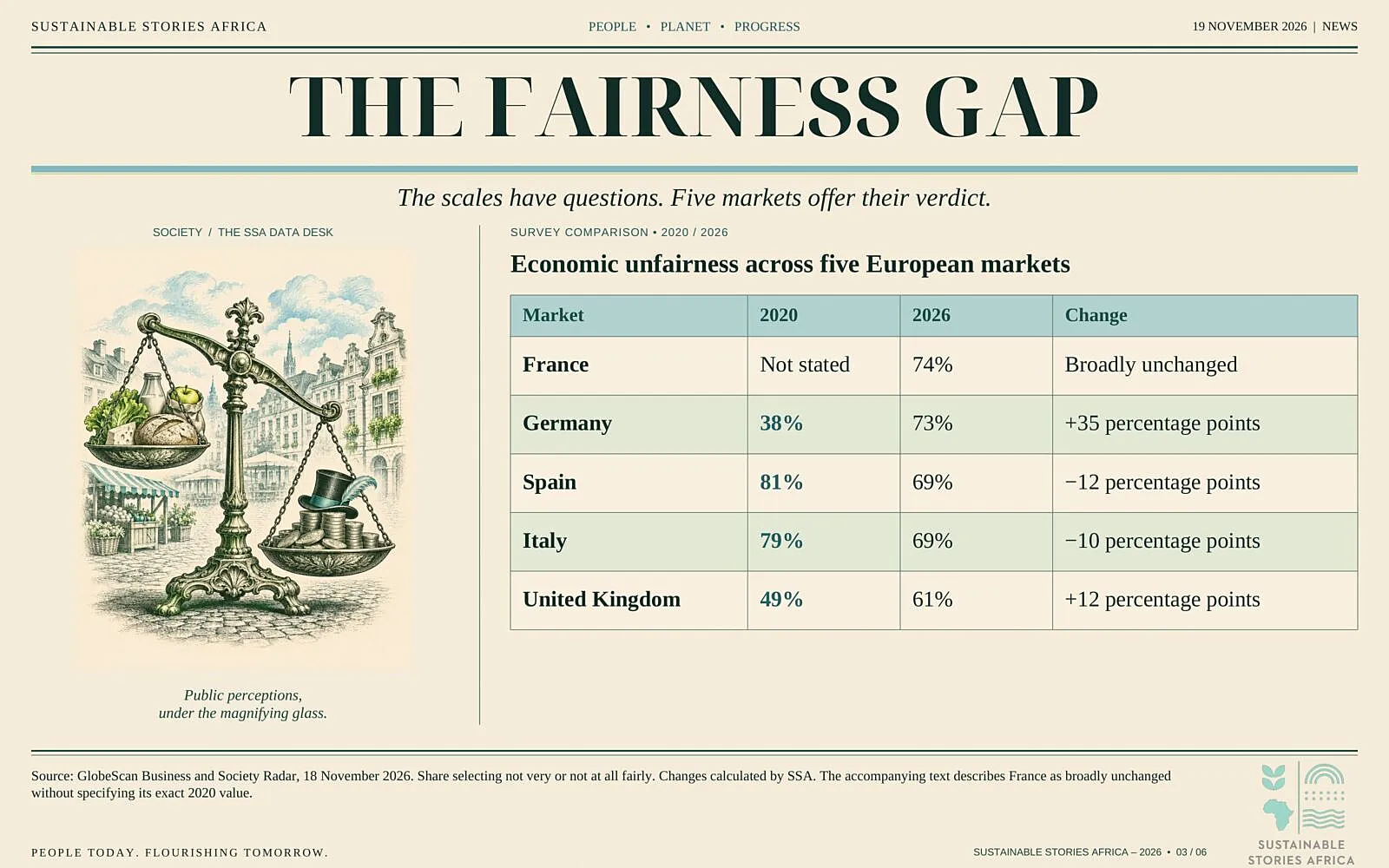
| Market | 2020 | 2026 | Change |
| France | Not stated | 74% | Broadly unchanged |
| Germany | 38% | 73% | +35 percentage points |
| Spain | 81% | 69% | −12 percentage points |
| Italy | 79% | 69% | −10 percentage points |
| United Kingdom | 49% | 61% | +12 percentage points |
Source: GlobeScan Business and Society Radar, 18 November 2026. Share selecting not very or not at all fairly. Changes calculated by SSA. The accompanying text describes France as broadly unchanged without specifying its exact 2020 value.
The findings come from online surveys across 34 countries and territories, generally with 1,000 respondents per market.
- Respondents assessed the distribution of recent economic benefits and burdens.
- The research measures perceptions, not a statistical income inequality index.
The published analysis places these attitudes alongside European cost-of-living protests.
- It explicitly cautions that the survey cannot identify what causes people to demonstrate.
- Correlation in timing is not proof that any particular policy or price increase brought respondents onto the streets.
Make household experience visible in decisions
- For an employee, an official account of economic improvement may carry little weight if essential expenses remain difficult to meet.
- For a small business, a growing market can coexist with pressure on rent, transport or working capital.
These are illustrative tensions, rather than experiences established by the European survey.
Fairness requires its own evidence.
- An average improvement can conceal sharply different outcomes across income groups or locations.
- Public institutions therefore need to explain whose circumstances a reported gain describes, what costs remain, and whether support reaches those facing the greatest difficulty.
Businesses face a comparable question.
- When changing prices or compensation, managers can explain the factors involved without claiming that a difficult decision is painless.
- Employees and customers may still disagree.
- Transparency nevertheless creates a basis for evaluating the decision rather than asking people to accept an unexplained assertion of necessity.
The potential gain is more credible dialogue.
- A government that acknowledges distributional consequences can discuss priorities more honestly
- A business that monitors customer hardship can assess whether a product remains useful and affordable.
Neither approach guarantees agreement, but both make trust a matter of demonstrable practice.
Ask who gains before declaring success
African policymakers should use locally grounded household and labour evidence when evaluating reforms.
- A practical assessment would compare intended beneficiaries, transition costs and the timing of relief. It would also state where the data are incomplete.
- European percentages cannot substitute for that work.
Employers can examine wage decisions, purchasing practices and the way financial pressure is communicated.
- Consumer-facing businesses can review complaint patterns and whether proposed assistance actually resolves problems.
- These are possible responses to the fairness question; they are not actions GlobeScan says its respondents have requested.
Measurement needs continuity.
- Repeating a clear question over time helps distinguish a persistent level of concern from a sudden deterioration.
- Recording the population surveyed, the method and the comparison period prevents decision-makers from presenting unlike results as a reliable trend.
The wider implication is that sustainability reporting should explain the distribution of benefits alongside aggregate achievements.
- A project’s economic contribution can be substantial while particular communities still face costs.
- Acknowledging both allows those affected to test whether promised improvements are reaching them.
For leaders preparing the next public statement on progress, the survey offers a disciplined starting point: explain what improved, identify who benefited and show how remaining burdens will be addressed.
- This would turn fairness from a reassuring word into a question that evidence can answer.
Publishing the limits of an assessment can strengthen that account.
- Readers should be able to distinguish a measured improvement from a policy ambition, and a national average from evidence about the particular community being discussed.
Path Forward – Measure progress through lived economic experience
The immediate task is to separate perceptions, material conditions and protest activity, then assess each with appropriate evidence.
African institutions can apply that discipline locally.
Reporting who gains, who pays and how decisions are explained would give citizens and businesses a clearer account of whether economic change is improving everyday life.