The International Energy Agency argues that diversified mineral supply costs can be viewed as insurance against disruption.
Its September 30 analysis compares investment needs with the much larger value of exposed downstream industries.
African producers could find new opportunities, provided projects offer competitive supply and credible local benefits.
Mineral supply security gains an insurance argument
The International Energy Agency has proposed framing the additional cost of diversified critical mineral supply as a mineral security premium.
In a September 30 commentary, analysts Shobhan Dhir and Tae-Yoon Kim argue that paying for more resilient supply could help protect industries exposed to export restrictions.
The concept is an analytical proposal, not a newly imposed charge.
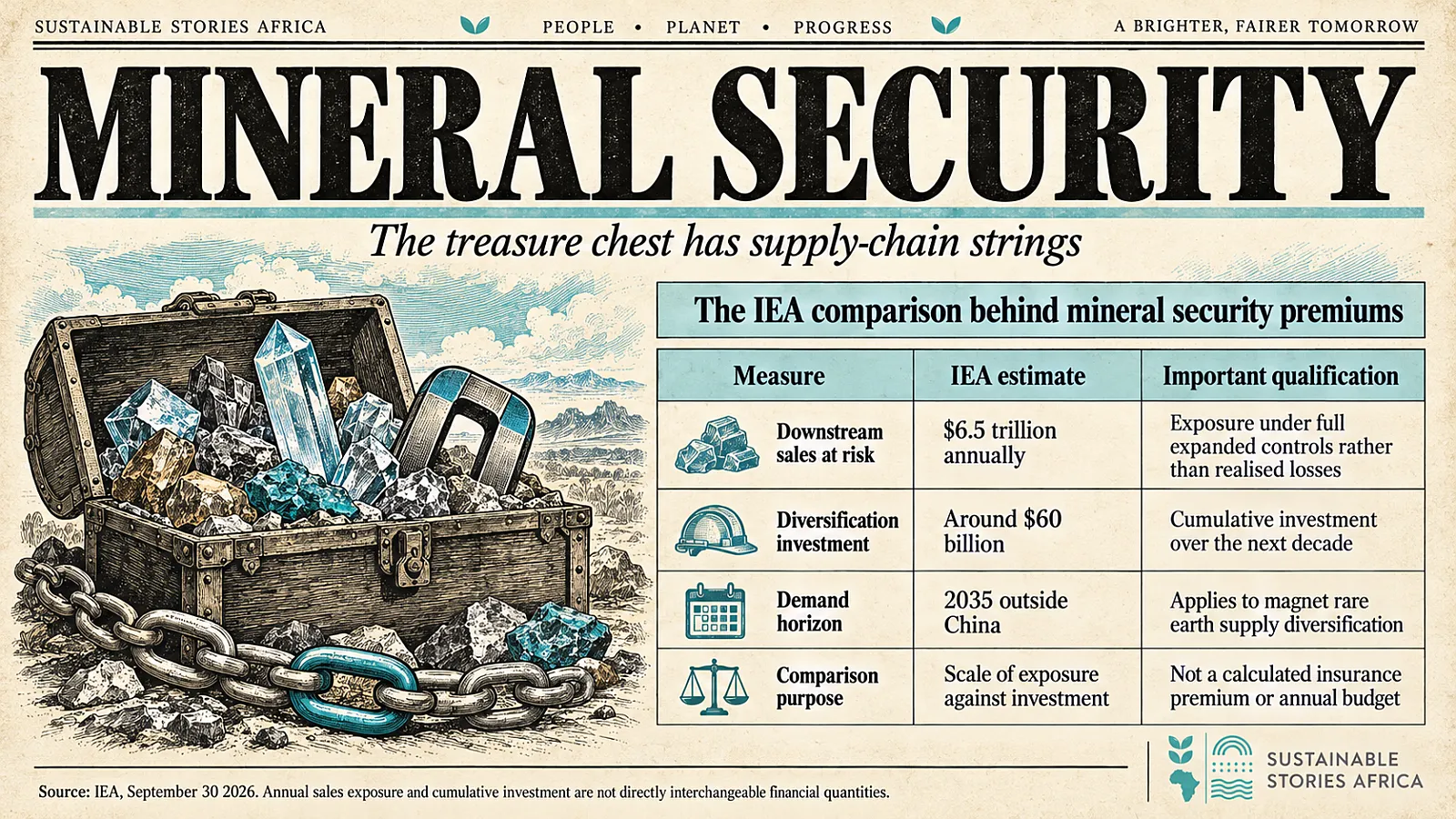
The IEA estimates that implementing expanded rare earth export controls could put $6.5 trillion in annual downstream sales outside China at risk.
- It compares that exposure with around $60 billion of investment over a decade to diversify magnet rare earth supply for projected demand outside China in 2035.
- These figures describe different measures and time periods.
The African implication is strategic.
- Producers seeking investment should understand the value buyers place on dependable supply, while ensuring that new arrangements also meet development objectives in the countries hosting production.
A small input can underpin large industries
The IEA’s comparison concerns the vulnerability of high-value industries to essential mineral inputs.
- Its commentary says alternative production and processing can face materially higher operating costs than established supply bases.
- The challenge is deciding whether the extra cost is justified by reduced exposure to disruption.
That assessment needs more than a headline price comparison.
- A purchasing business should identify which interruption would affect its operations, how long an alternative would take to qualify and what stock or substitution options it has.
- These practical questions determine whether a security premium buys useful resilience.
African policymakers should distinguish a global supply opportunity from a guaranteed investment result.
- A mineral deposit alone does not establish the commercial readiness of a project.
- Developers still need to demonstrate an operating plan that a buyer can evaluate and a host country can hold accountable.
African projects could offer dependable, responsible supply
A project seeking a supply-security role should explain why it can deliver consistently.
- Buyers would need evidence about output, logistics and the ability to meet product requirements.
- Host communities need a different but equally important employment account, environmental management and responses to local concerns.
In principle, longer-term purchasing commitments could help a developer make an investment case.
- They should be designed around verifiable delivery and realistic commercial assumptions.
- An agreement that promises volume without resolving practical constraints would offer little protection to the buyer and could leave the project vulnerable.
There is also a distribution question.
- If buyers are willing to pay for more secure supply, policymakers should examine how that value is shared.
- A host country should assess the revenue, skills and business opportunities associated with the project, rather than assume that higher mineral prices automatically translate into broad development gains.
Regional cooperation could be considered where neighbouring markets offer complementary capabilities.
- That option would need its own evidence about costs, infrastructure and responsibilities.
- It should not be presented as a universal answer, but assessed against the specific requirements of the mineral and the participating economies.
Environmental safeguards remain necessary.
- A project’s contribution to supply security should not make water impacts, worker safety or community grievances less visible.
- A durable supply relationship requires confidence that these issues can be managed and that concerns are addressed before they undermine operations.
Governments should test support against specific risks
African governments evaluating incentives should ask which supply vulnerability the proposed project would reduce and what commitments buyers will make.
- Support should have a clear purpose and be assessed against delivery.
- Public expenditure deserves scrutiny even when a project is described as strategically important.
Developers should provide records that allow both commercial and public interest assessments.
- Buyers should explain their qualification requirements early enough for projects to plan against them.
- Communities should have accessible routes to understand proposed operations and raise concerns.
The opportunity is to negotiate credible production relationships. A security premium would be useful if it supports dependable additional supply.
- Its legitimacy should ultimately depend on credible evidence of that contribution and on a transparent account of who pays, who benefits and what obligations follow.
Path Forward – Convert security demand into accountable investment
Governments and developers should connect proposed support to verifiable supply and local development outcomes.
Buyers should provide clear requirements and credible purchasing commitments.
The IEA’s proposal reframes diversification as risk management.
African projects should use that discussion to seek durable partnerships while keeping costs, environmental responsibilities and the distribution of benefits open to scrutiny.
Culled from: A price worth paying? A mineral security premium as insurance against supply disruptions – Analysis - IEA