
ISO’s proposed organisational net zero standard failed to secure the approval needed to advance in its current form.
About 5,000 consultation comments require consideration as the committee decides its next steps.
For African businesses, the delay makes careful transition planning more important while the final requirements remain unsettled.
Net zero draft fails its approval vote
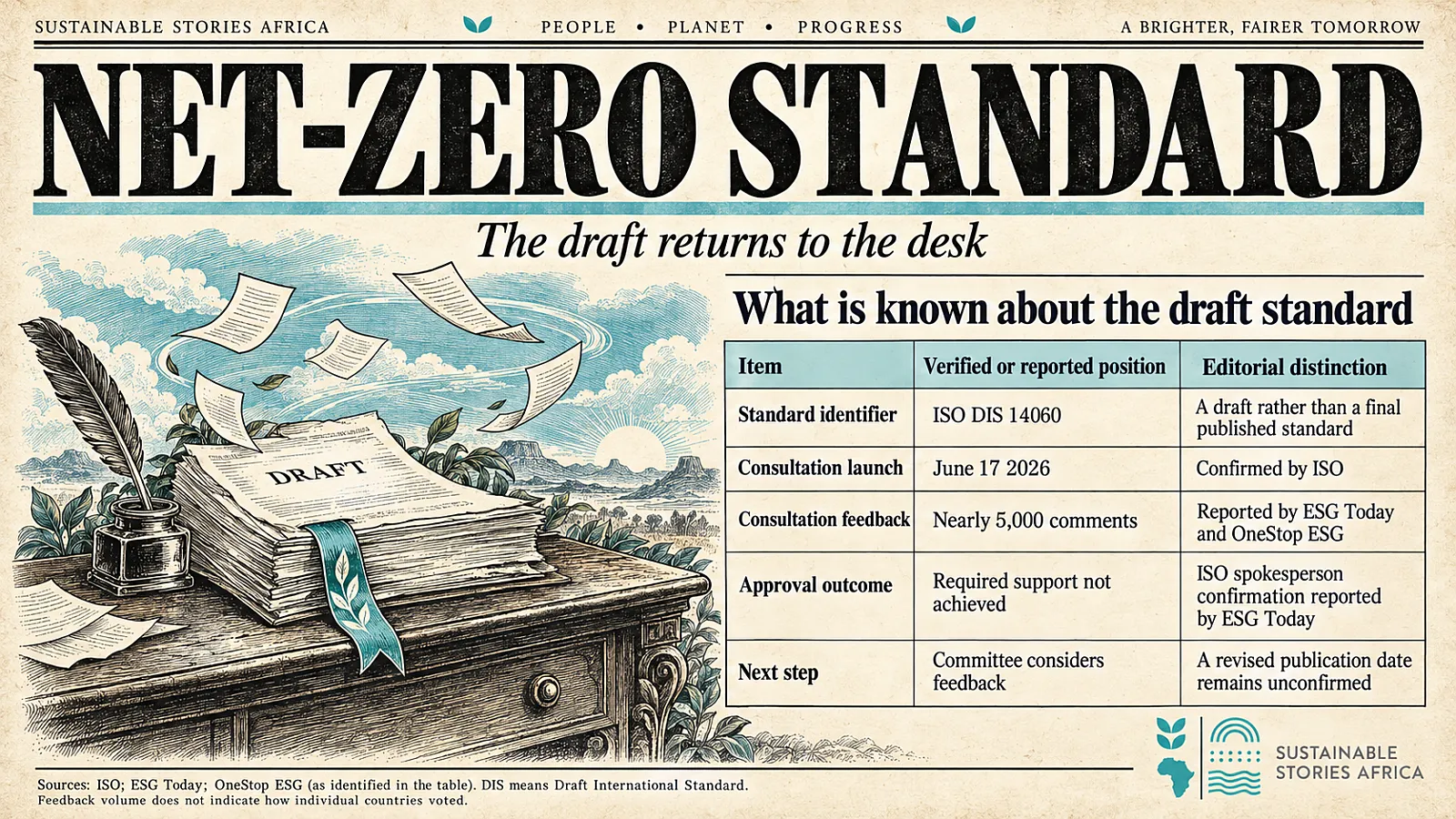
The International Organisation for Standardisation’s proposed net zero standard, ISO/DIS 14060, has failed the member approval vote needed to advance in its current form.
September 29 reporting by ESG Today and OneStop ESG describes nearly 5,000 comments submitted during consultation, with the responsible committee now required to consider the feedback and determine the project’s next steps.
An ISO spokesperson told ESG Today that the draft “did not receive the level of approval required to advance in its current form”.
- No final replacement text or confirmed revised timetable accompanied that report.
The setback concerns a draft standard; companies should not describe themselves as meeting a newly published ISO 14060 standard on that basis.
The underlying business challenge continues.
- An African manufacturer planning cleaner production still needs to understand its emissions, financing needs and available energy options.
- An unsettled international text changes the certainty of a future benchmark, but it does not remove the need to make those decisions.
The proposed framework remains under international development
ISO launched consultation on June 17 after almost two years of international negotiations.
- Its stated objective was a globally consistent and independently verifiable framework for organisations developing credible net zero transition plans.
- The process involved national standards bodies across more than 170 countries.
Reported disagreement about carbon credits should be attributed carefully.
- OneStop ESG and ESG Today describe opposition linked to fossil fuel-producing countries, drawing on other reporting and sources familiar with negotiations.
- ISO does not disclose individual votes or the reasons for them.
Those explanations should therefore be treated as reported accounts, rather than a published country-by-country finding.
The revision process should be judged on whether it produces requirements that are both credible and usable.
- A company must be able to explain how an emissions target connects to operating decisions.
- Stakeholders also need to distinguish actions inside the business from external instruments used in a climate claim.
Credible planning must accommodate differing operating realities
For African companies, a practical transition plan should recognise the conditions under which emissions reductions must occur.
- Management should identify which changes it controls directly, which depend on suppliers and which require infrastructure or finance outside the company.
- That breakdown would make progress easier to assess without turning constraints into an excuse for indefinite delay.
Consider a business evaluating an equipment replacement.
- A useful plan would show the expected operational benefit, the capital requirement, the decision date and the person responsible.
- If the investment is conditional on financing, that condition should be explicit.
- Readers can then assess a real project rather than an undated promise.
There is also a fairness question.
- Smaller suppliers should be able to understand the evidence buyers request from them.
- Complex requirements without practical assistance could shift compliance costs down a value chain while leaving the underlying transition underfunded.
Clear guidance and proportionate support would make a credible final framework more accessible.
Businesses should strengthen plans while revisions continue
Boards should use the intervening period to test the quality of existing climate commitments.
- They should ask whether baselines are documented, whether milestones have budgets and whether public statements separate emissions reductions from other components of a claim.
- These are management checks, not assertions about the final ISO text.
African standards bodies, businesses and civil society should remain engaged as the committee determines further steps.
- Their contribution would be most useful when grounded in specific implementation problems and proposed solutions.
- A request for clearer guidance should explain which decision or verification task the current wording makes difficult.
Companies should also review promotional language.
- Where a framework remains in development, public communications should say so.
- The commercial value of a future standard will depend on confidence that claims correspond to verifiable work, including when the evidence exposes unfinished action.
Procurement teams should avoid locking suppliers into an interpretation of draft requirements without explaining how later revisions would be handled.
- Contracts and information requests need a practical way to accommodate changes.
That would protect useful preparation while limiting the cost of work that might need to be repeated after the committee’s decisions.
Path Forward – Build credible plans while revisions continue
Companies should document emissions baselines, fund practical milestones and describe climate claims precisely.
African stakeholders should contribute concrete implementation evidence as further consultation opportunities emerge.
The committee’s next steps remain decisive.
A useful outcome would give organisations clearer requirements while preserving investors' and communities’ ability to test whether promised reductions are happening.
Culled from: ISO Sends Net-Zero Standard Back After 5,000 Comments | OneStop ESG