
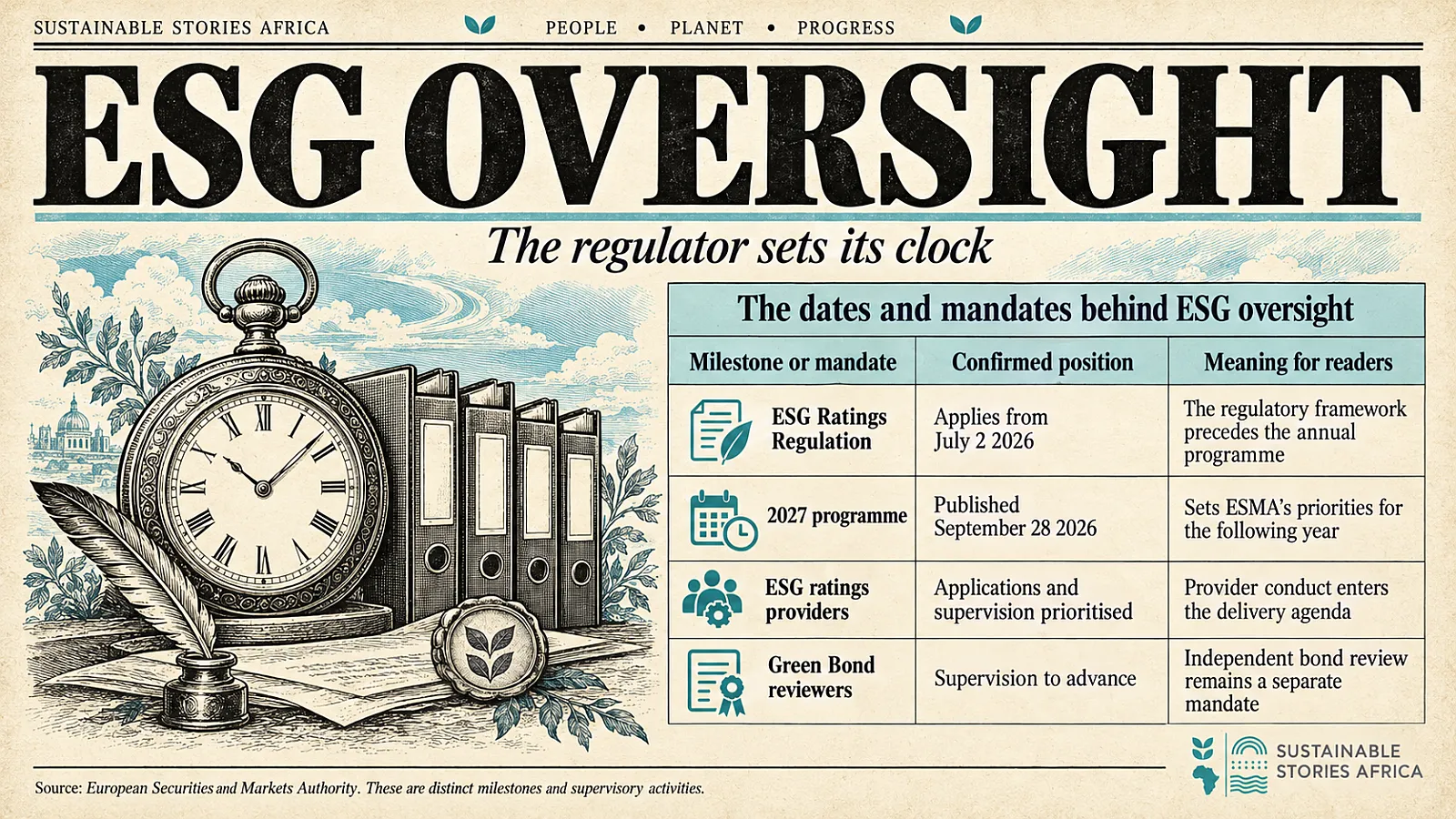
Europe’s securities regulator has set out its 2027 work programme, including applications and supervision for ESG ratings providers.
The programme moves key sustainable finance initiatives into delivery, alongside oversight of European Green Bond reviewers.
For African companies seeking international capital, the practical challenge is making the evidence behind sustainability claims easier to examine.
Europe prepares to scrutinise sustainability rating providers
The European Securities and Markets Authority has made ESG ratings supervision a priority in its 2027 work programme, published on September 28.
The EU regulator plans to process applications and begin supervising providers, while advancing its oversight of external reviewers of European Green Bonds.
- The announcement sets out the authority’s delivery agenda rather than introducing a new ratings law.
The timing needs care.
- The EU ESG Ratings Regulation already applies from July 2, 2026; its application date and ESMA’s annual supervisory priorities are separate milestones.
Providers should follow the applicable registration and transition requirements rather than interpret the 2027 programme as permission to postpone preparation.
For an African business approaching an international investor, the relevant question is how its environmental, social and governance information reaches the people assessing it.
A rating may change a conversation about risk, but the underlying evidence still needs to explain what the company measures, where uncertainty remains and what management has done.
What the supervisory programme actually sets out
ESMA’s priorities also include market integration, regulatory simplification and the use of data and technology.
- Four flagship simplification initiatives cover transaction reporting, funds reporting, the retail investor journey and risk-based supervision.
The authority frames these as ways to reduce unnecessary administrative burdens and improve the usefulness of regulatory information.
That combination creates a useful test for sustainable finance:
- Can information become easier to use while the organisations producing assessments become more accountable?
- Less paperwork will have limited value if investors still cannot understand the basis of a sustainability judgement.
African issuers should treat the programme as a reason to review how their evidence travels through the investment chain.
- A report, a ratings questionnaire and a bond presentation may use different formats.
- They should nevertheless reconcile to the same operational records, reporting boundaries and explanations of performance.
Better evidence can improve African investment conversations
More transparent assessment processes could help an investor distinguish missing information from weak performance.
- That distinction matters for businesses whose activities require local explanation.
- A water indicator, for example, should identify the sites covered and the conditions being measured before anyone concludes the total.
African issuers could make their information more useful by publishing definitions alongside material indicators.
- If a number changes because the reporting boundary changed, the explanation should be visible.
- If a target covers only part of the business, the remaining operations should not disappear behind an ambitious headline.
Supervision cannot guarantee identical ratings or eliminate judgement.
- Investors should still compare what different assessments seek to measure and how they handle uncertainty.
- A stronger regulatory framework is most useful when users continue asking those questions, rather than treating an authorised provider’s output as a substitute for due diligence.
Companies should prepare records before investor questions
Boards should ask management to trace a small selection of important disclosures back to their source records.
- The exercise could cover energy consumption, workplace incidents or supplier screening, depending on the company’s material issues.
- Any reconciliation problems should be resolved before the same figures are distributed to several external users.
Ratings providers serving African clients should explain which regulatory obligations apply to their activities and which services fall outside them.
Issuers, meanwhile, should request clear information about methodology, coverage and correction procedures.
- These steps would support a more informed relationship without assuming that every African company is directly subject to ESMA’s rules.
The business objective should be a defensible account of performance.
- A favourable score is useful only if management can explain the operations behind it, recognise weaknesses and demonstrate a credible response when investors ask for more detail.
Investors can support that discipline by asking issuers how they investigate inconsistent assessments.
- A useful response would identify the disputed indicator, the evidence supplied and any correction made.
- That exchange is more informative than selecting whichever rating gives the strongest impression.
- It also leaves a record that future users can examine when the same question arises.
Clear records would also help issuers respond consistently when several investors request information about the same activity.
Path Forward – Make sustainability evidence useful across markets
African issuers should reconcile material ESG indicators, explain reporting boundaries and retain supporting records.
Providers should prepare for the obligations relevant to their EU activities.
ESMA’s delivery programme offers an opportunity to improve trust, but a practical measure of progress will be whether investors can understand and challenge the information they receive.
Culled from: ESMA Sets 2027 Priorities for ESG Ratings Oversight | OneStop ESG