Airtel Africa and Starlink have launched commercial satellite-to-mobile connectivity in the Democratic Republic of the Congo, the first deployment of its kind in Africa.
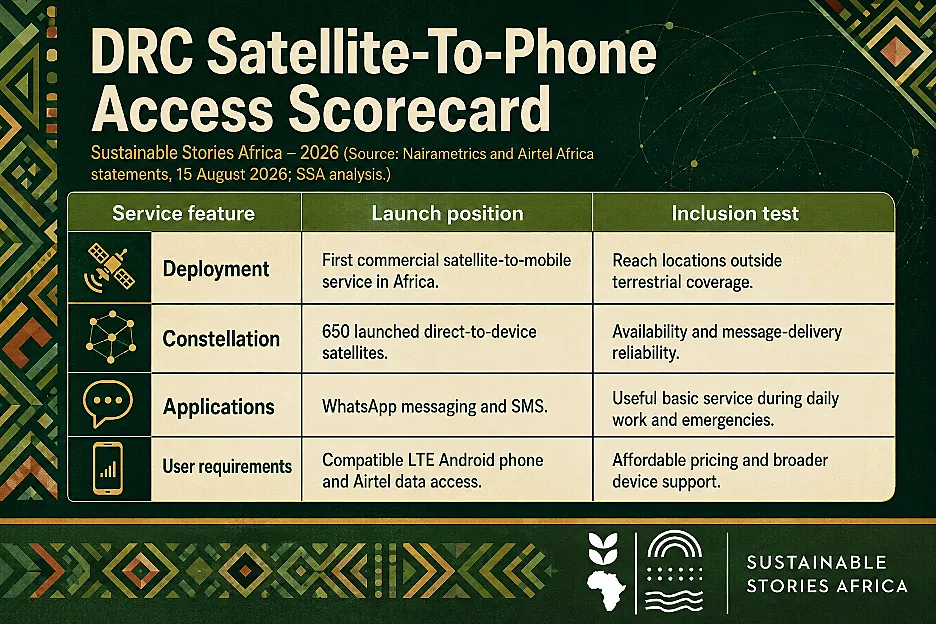
Compatible Android phones can use WhatsApp messaging and SMS beyond terrestrial coverage without specialised satellite equipment.
The service could support remote communities and emergency operations; however, affordability, device compatibility, regulation and service transparency will determine its impact on inclusion.
A phone now reaches beyond towers
Airtel Africa and Starlink have launched Africa’s first commercial satellite-to-mobile service in the Democratic Republic of the Congo, enabling customers with compatible smartphones to obtain basic connectivity in places where terrestrial mobile coverage is unavailable.
The service requires a clear view of the sky but no separate satellite handset or specialised receiving equipment.
At launch, Starlink’s direct-to-device constellation comprises 650 satellites and supports light data uses including WhatsApp messaging and SMS, according to Airtel Africa.
For a country whose size, difficult terrain and dispersed settlements make universal tower coverage expensive, even limited messaging can improve the safety and usefulness of travel, fieldwork and remote service delivery.
Commercial launch follows regional testing
The deployment follows Airtel Africa and SpaceX’s strategic partnership announced in December 2025 and tests of mobile data and messaging in Kenya in March 2026.
Airtel Africa chief executive Sunil Taldar called the launch a significant partnership milestone and said combining terrestrial and satellite infrastructure could extend connectivity beyond conventional network limits.
Airtel DRC managing director Theirry Diasnoma said many people live, work and travel outside terrestrial coverage.
- The new service is positioned as an additional layer rather than a replacement for towers and fibre.
- Users need a compatible LTE Android phone, and either an active Airtel DRC data bundle or data roaming enabled; Apple devices are expected to be supported later.
Potential users include transport and logistics operators, humanitarian organisations, health workers, farmers, mining operations and communities beyond existing networks.
Satellite-to-phone connectivity could also provide a backup channel during natural disasters, emergencies or temporary terrestrial outages.
Basic messaging can unlock wider value
This development will bring increased advantages, unlocking greater value across sectors.
- For a health worker, a text can request supplies or a referral of a patient.
- For a driver, it can confirm location after a breakdown.
- For farmers and humanitarian teams, basic messages can support market coordination, weather alerts and safety checks.
Those gains are modest compared with broadband, but substantial where the alternative is no signal.
The DRC launch can also generate operational evidence for expansion across Airtel Africa’s markets, subject to national approvals.
SpaceX had secured operating licences in nine of Airtel’s 14 African markets when the partnership was announced, with five more in progress.
Regulators will now be watching interference, emergency access, consumer protection and the relationship between satellite and terrestrial investment.
Inclusion depends on price and trust
This first launch does not automatically close the digital divide.
- Airtel should publish coverage limitations, supported devices, pricing, fair-use rules, expected delivery times and complaint processes in clear language.
- Users must understand when their phone is connected by satellite and what data protections apply across the network and satellite layers.
Regulators should require service-quality reporting and ensure emergency access is reliable.
- They should also prevent satellite coverage from becoming an excuse to underinvest in terrestrial networks where towers and fibre remain economically and socially necessary.
- The strongest model will use space-based service to fill genuine gaps and strengthen resilience.
Path Forward – Turn a milestone into universal access
Airtel and Starlink should track active users, successful message delivery, emergency performance, affordability and coverage in underserved locations.
Device support must expand without leaving lower-income customers behind.
African regulators can use the DRC evidence to build proportionate direct-to-device rules that cover spectrum, safety, privacy and competition.
The promise is not connectivity from space alone; it is dependable communication wherever people live, work or face danger.
Culled from: Airtel, Starlink launch satellite-to-phone service in DRC, first in Africa - Nairametrics