
African Dealmakers Need Sharper Due Diligence As Risks And Information Loads Expand
Excerpt
An Intralinks podcast featuring Bayes Business School researchers describes a more complex mergers and acquisitions due diligence process.
Its March 2025 findings point to longer reviews, larger teams and heavier document loads, not a fresh October 2026 survey.
For African dealmakers, the lesson is to connect specialist scrutiny with investment decisions, rather than mistake more information for better judgement.
More diligence does not guarantee better judgement
Mergers and acquisitions reviews have become longer and more crowded, according to research discussed by Bayes Business School specialists in an SS&C Intralinks podcast.
- Their assessment offers African investors a practical warning: assembling a large data room is not the same as understanding the business being bought.
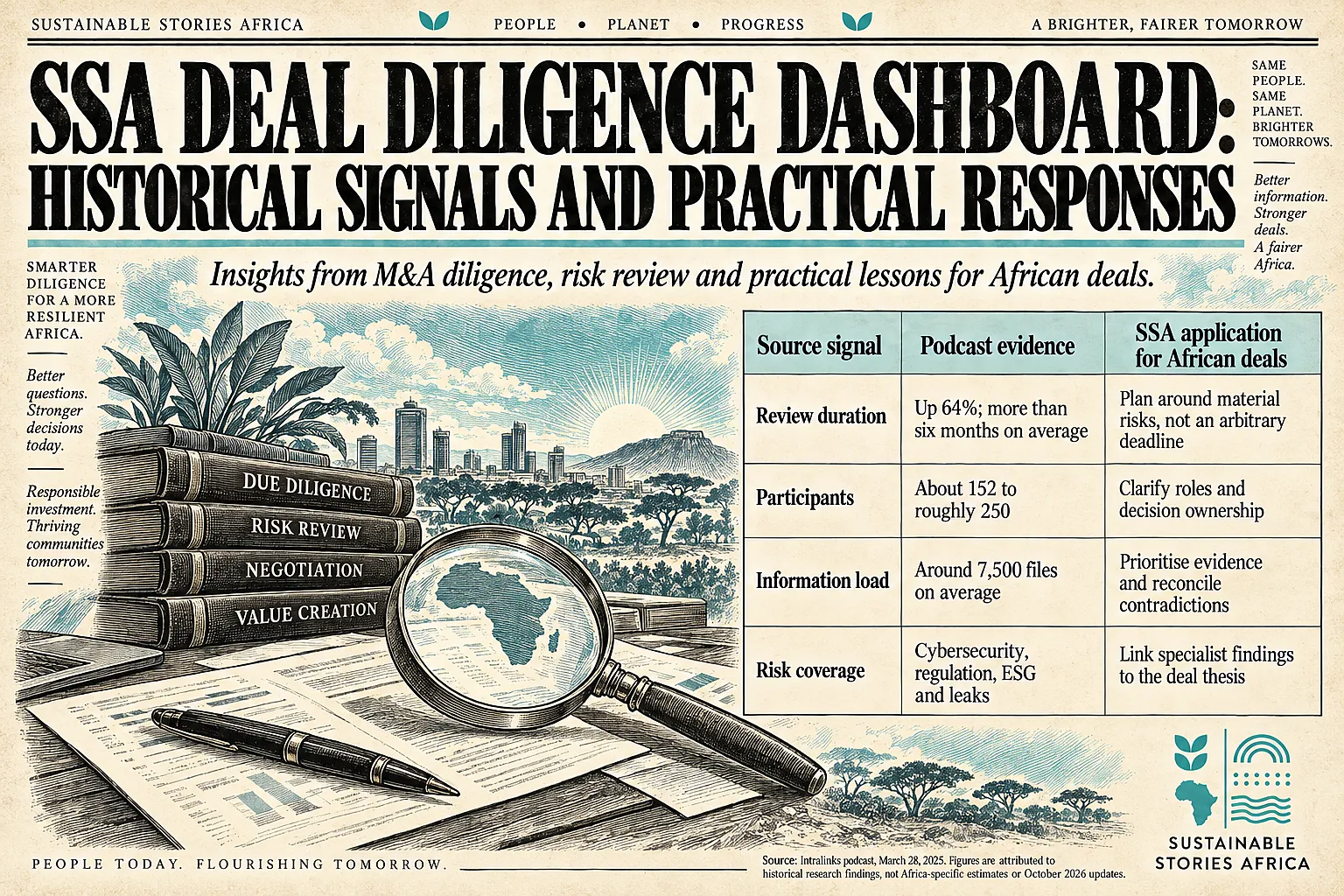
In the episode, researcher Valeriya Vitkova said pre-announcement diligence time increased by 64% over the preceding decade, reaching more than six months on average.
- The source was published on March 28, 2025.
- These are historical findings discussed in that episode, not newly measured conditions across African transactions in October 2026.
Hosted by Catherine Ford, the discussion brings together Vitkova and Scott Moeller of the M&A Research Centre at Bayes Business School.
- It examines how technology, wider regulatory concerns and specialist judgement change the work required before a transaction is announced.
Teams and document volumes expanded together
Vitkova described a rise in virtual data room participation from about 152 people to roughly 250, with around 7,500 files shared on average.
- She connected the longer process with the expansion in both information and participants.
- These figures describe the source research discussed in the podcast and do not treat them as universal deal benchmarks.
The risk agenda has also widened.
- The researchers discuss antitrust scrutiny, foreign investment review, cybersecurity, deal leaks and environmental, social and governance considerations.
- Cybersecurity can influence valuation and negotiation, while environmental and human rights exposures require attention alongside financial and legal checks.
Moeller contrasts this environment with physical data rooms, where location and limited viewing slots constrained file access.
- Virtual platforms make records searchable and allow teams to track access and update documents more easily.
- Technological improvement, however, does not settle whether the right questions are being asked.
His account of visiting a manufacturing facility without sufficient operational expertise illustrates the distinction.
- Financial reviewers could see an impressive plant but lacked the specialist knowledge needed to assess its performance.
- The lesson is about team composition, not a claim that automated document analysis is ineffective.
Connect findings to the investment case
For African buyers and sellers, a useful application is to organise diligence around the assumptions that make a transaction valuable.
- If the investment case depends on reliable production, the review should test the operational evidence.
- If it depends on expansion, the team should examine the permissions, capabilities and relationships required to deliver it.
ESG belongs in that process when it affects the business being acquired, rather than as a disconnected checklist.
- Questions about water access, workforce practices, community relationships or data protection lead to decisions about price, investment needs, contractual protection or whether to proceed.
- These are SSA’s practical applications of the discussion, not outcomes measured in the podcast.
Better integration can make a review more useful even when it does not make it shorter.
- A clearly assigned issue, supported by evidence and linked to a decision, has greater investment value than another folder of unprioritised documents.
The objective should be decision quality, not document accumulation.
Give every material concern an owner
Deal teams should agree early which assumptions require testing, which specialists are needed and who will resolve contradictory evidence.
- A concise issues register can connect each material concern with its source, accountable reviewer and proposed transaction response.
The podcast anticipates a growing role for artificial intelligence, including analysis of unstructured text and video, but retains human expertise at the centre of interpretation.
- Buyers should therefore distinguish a tool’s ability to find information from a reviewer’s responsibility to validate its significance.
For sellers, preparation means presenting coherent records and explaining gaps before they become negotiation disputes.
For boards, approval should depend on how unresolved issues affect the investment thesis, not simply on confirmation that advisers have completed their individual workstreams.
- Local regulatory obligations still require current, jurisdiction-specific advice.
A disciplined process should preserve a record of disagreements and conclusions.
- Decision-makers need to know where specialists differ, which assumptions remain unresolved and what would change the recommendation to proceed.
Path Forward – Turn Better Questions Into Stronger Deals
African dealmakers can use the discussion to strengthen planning, specialist participation and accountability.
Its historical metrics should inform questions, not become mandatory targets for local transactions.
The next step is to connect material findings with valuation, conditions and integration plans.
Technology can support that work, but responsibility for the investment decision must remain visible, informed and human.