
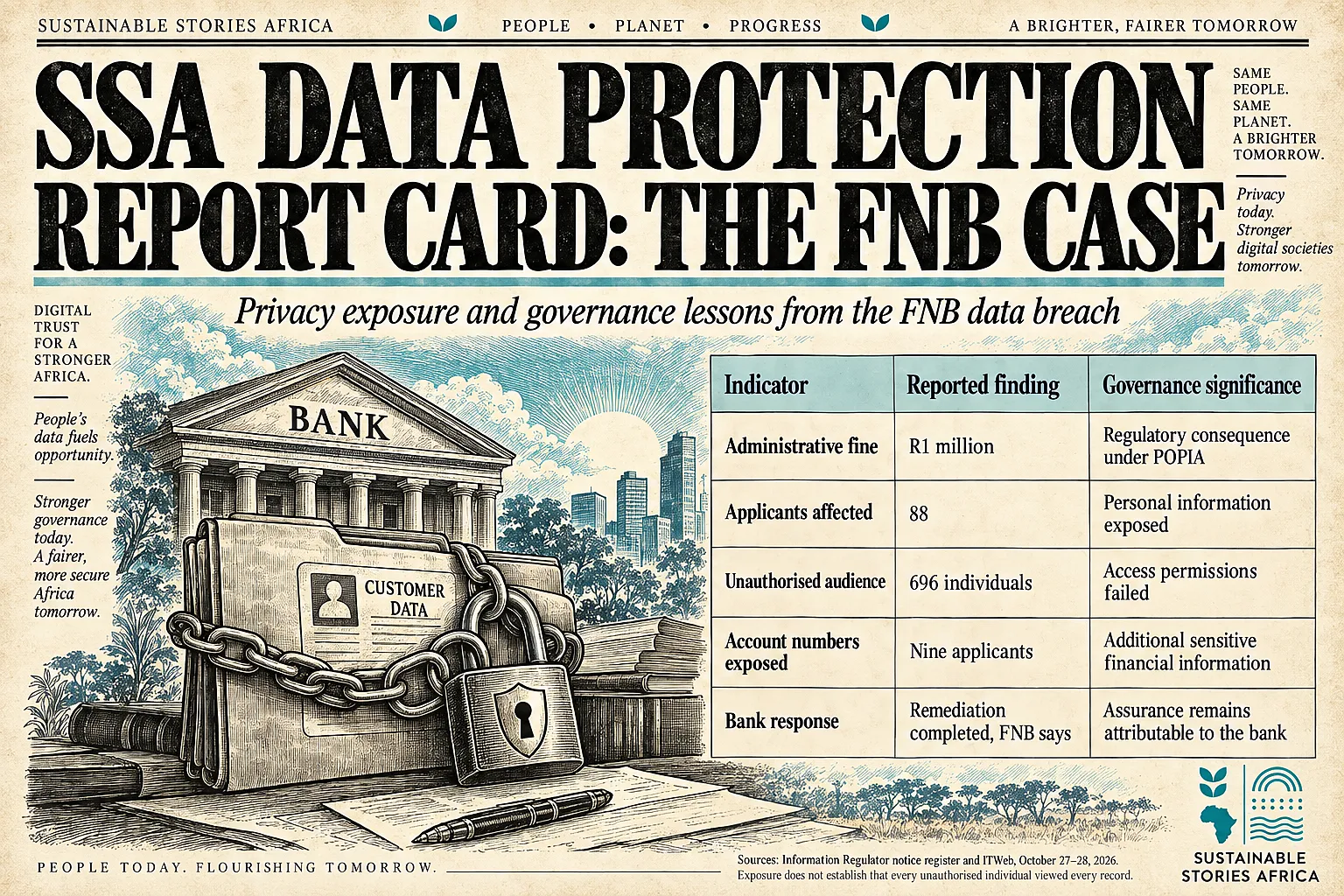
South Africa’s Information Regulator has fined FNB R1 million following failures involving customer information on its digital home loan platform.
The case concerns access controls, incident handling and wider information governance, not simply an external cyberattack.
FNB says it has completed remediation and that no customers suffered financial harm as a result.
A banking error becomes a governance test
First National Bank (FNB) was fined R1 million by the Information Regulator in South Africa after a digital access-control failure exposed information which belongs to 88 home loan applicants to 696 unauthorised individuals.
- The enforcement action puts the handling of sensitive customer records, and the response to repeated warnings, under scrutiny.
The regulator’s public register lists both enforcement and infringement notices against FNB dated October 23.
- Contemporary reports differ on the announcement date, so the reliable chronology is that the notices were listed on October 23 and publicly reported during the following week.
FNB says the shortcomings have been addressed.
- “Since identifying the issue, comprehensive remediation has been completed, with no customers experiencing financial harm as a result,” the bank said in a statement reported by ITWeb on October 28.
- This is the bank’s assessment, not an independently verified finding of this article.
The problem extended beyond permissions
Some account holders were incorrectly classified as employees, giving them access to home loan applications through the banking app.
- The exposed records included identifying and contact information, while nine applicants also had account numbers exposed.
- The regulator found shortcomings in how FNB identified, classified and responded to repeated security incidents.
That sequence is important. Removing access for an individual who reports a problem is different from investigating whether the same configuration allows others to see restricted records.
- According to reporting on the enforcement notice, the bank treated earlier reports as isolated incidents rather than addressing the broader vulnerability.
The regulatory findings also concerned security safeguards under section 19 of the Protection of Personal Information Act (POPIA), and governance over information retention.
- The regulator linked the administrative penalty to an offence under section 105 involving account information.
- The fine should therefore not be presented as a simple charge for every record exposed.
Innovation Village report describes concerns about collecting personal information from public sources and retaining certain records indefinitely.
- These issues reinforce the wider governance context, and the legal application should be read against the notices rather than reduced to a claim that all media-based due diligence is prohibited.
Trust depends on demonstrable control
For African financial institutions, the central lesson is operational: customer trust depends on who can access data, how exceptions are detected and whether reported weaknesses lead to system-wide action.
- A sophisticated app does not remove the need to validate the permissions behind it.
An effective review would trace a customer record from collection through processing, storage and deletion.
- It would test the business justification for access rights and examine whether incident teams can identify patterns across separate complaints.
- These are practical implications of the failings described in the reporting, not additional findings against FNB.
The potential gains extend beyond avoiding a fine.
- Clear responsibilities can help institutions respond consistently, explain what happened to affected customers and demonstrate that corrective work has been tested.
- Conversely, an unsupported assurance that a problem is fixed leaves boards and customers unable to judge the quality of the remedy.
Verify remediation rather than assume it
Bank boards should ask management for evidence that access roles have been reviewed, repeated complaints can be connected, and sensitive information is retained for justified periods.
- Internal audit can examine whether the controls work outside the particular scenario that first revealed the weakness.
FNB says it has strengthened systems, governance, resources and employee training over the past three years.
- This response should go with the regulator’s findings to give readers a balanced account; it does not erase those findings or establish the outcome of every compliance requirement.
The reported infringement process gives the bank 30 days to pay or elect trial.
- Reporting also describes a separate 90-day compliance reporting requirement.
- The periods should not be conflated, and neither should it be converted into a precise calendar deadline without the applicable service date.
A useful assurance process should also clarify which checks were completed, who reviewed the results and what remains outstanding.
That keeps a public commitment separate from evidence that the control environment has improved.
Path Forward – Make Customer Data Protection Operational Daily
The immediate priority is verified remediation: access controls, consistent incident escalation and justified retention practices.
Assess FNB’s response against the regulator’s requirements, not treat it as a substitute for them.
For Africa’s financial sector, the broader objective is accountable digital growth.
Boards should require evidence that customer information is protected throughout its life cycle, while keeping regulatory findings, company assurances and proven customer outcomes distinct.
Culled from: FNB issued with R1m fine for POPIA violation | ITWeb, FNB fine: regulator hits bank with R1-million Popia penalty, FNB fined R1 million for POPIA violations and data protection failures - Innovation Village | Technology, Product Reviews, Business