
Researchers argue that nature finance should be judged by ecological recovery and community wellbeing rather than fundraising alone.
A paper published in Global Environmental Change questions the disproportionate attention given to natural capital markets.
For Africa, the debate centres on choosing finance that serves locally defined outcomes, while protecting the rights of people who steward ecosystems.
Put the purpose before the instrument
Governments, investors and conservation organisations should redesign nature finance around ecological and social outcomes rather than treat raising money as an end in itself, researchers argue in a paper published on October 27.
Their intervention challenges the assumption that better natural capital markets alone can deliver the breadth of recovery needed.
The paper, Reimagining nature finance, appears in Global Environmental Change.
- A University of Oxford summary says the authors see natural capital markets as a small, specialised source of conservation and restoration funding occupying a disproportionate share of policy debate.
For African decision-makers, the relevant question is not whether they should reject every market instrument.
- The challenge is whether a proposed financial arrangement supports the ecosystem and communities concerned, or forces the project to fit a revenue model before its purpose has been properly defined.
Five limitations challenge market-first thinking
The authors identify five recurring limitations:
- Barriers to scaling
- An emphasis on compensation rather than restoration
- Financial returns taking precedence over socio-ecological outcomes
- Measurement difficulties
- Concerns about justice and equity
They also warn that incentives can marginalise local communities, Indigenous knowledge and participatory governance.
“Nature’s decline is driven by economic systems that still reward its degradation,” co-author Nathalie Seddon, professor of biodiversity at the University of Oxford’s Smith School of Enterprise and the Environment, said in the university summary.
- She argues that ecosystem recovery and the rights and wellbeing of their stewards should be the starting point.
- Lead author Theo Stanley, a research fellow at the University of Southampton, says society has placed too much faith in markets’ capacity to deliver diverse and just restoration projects.
The authors contend that some limitations cannot be resolved through better standards, measurement and market design alone.
Their position is nevertheless qualified.
- The summary acknowledges useful innovation and the practical contribution markets can make.
- Co-author Justin Adams says such arrangements can be a lifeline for projects, and perfecting them will not by itself change the wider incentives driving destruction.
This is a critique of overreliance, not a claim that all nature-related transactions are worthless.
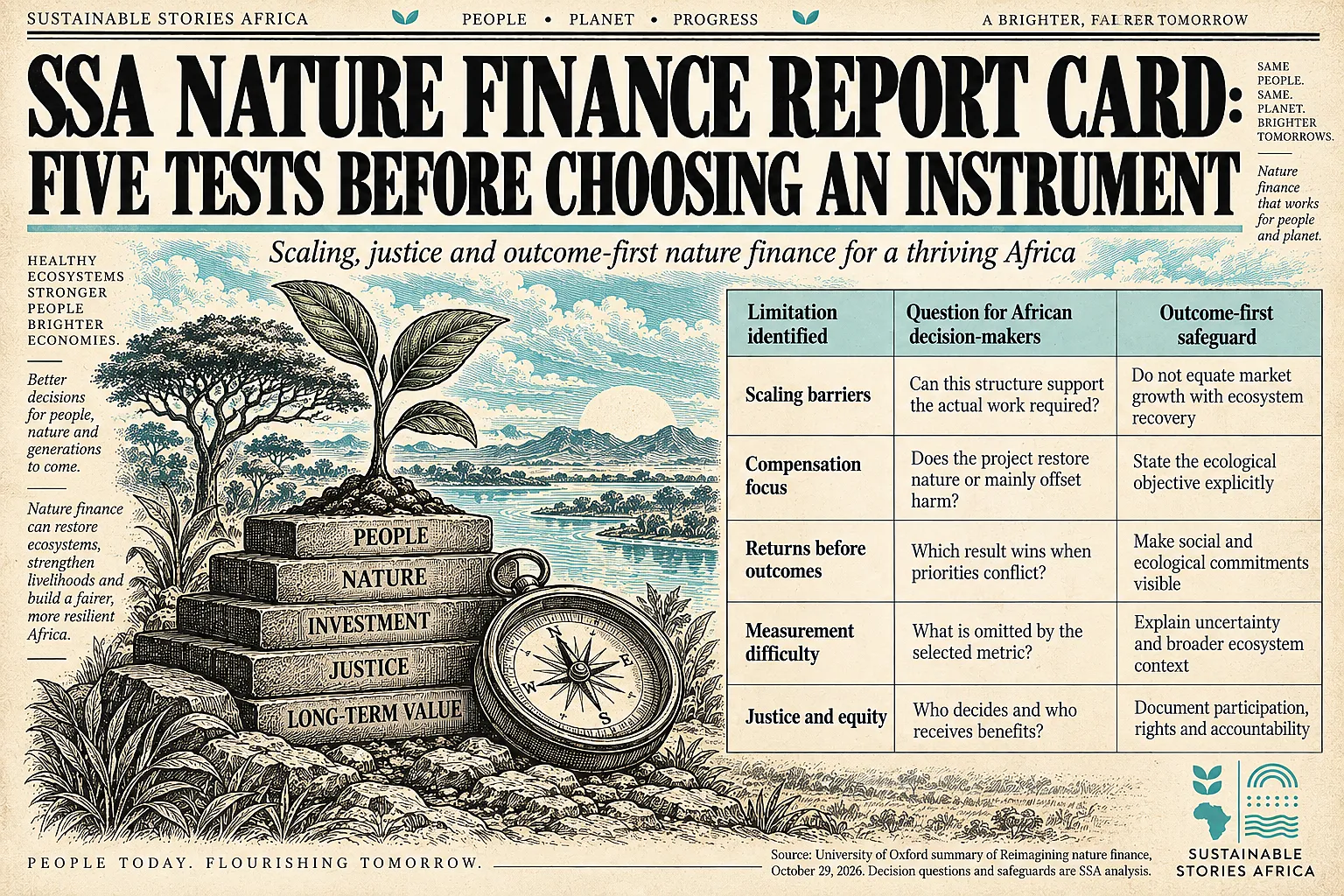
Match finance to locally defined recovery
For African project developers and public authorities, the practical implication is to define the intended outcome before selecting the instrument.
- What needs to recover?
- Who depends on the landscape?
- Who should take part in decisions?
- How will benefits and obligations be shared?
These questions make the ecological and social purpose explicit.
A proposed arrangement can then be judged against that purpose.
- If the financing terms reward a narrow measurable output while neglecting other locally important outcomes, the mismatch should be visible before commitments are made.
- This is SSA’s application of the authors’ critique, not an assessment of any named African project.
The potential gain is a broader set of choices.
- Rather than assuming every conservation activity must generate a marketable unit, decision-makers can examine which funding and governance arrangements fit the work.
- The paper’s institutional summary calls for a wider range of approaches, but does not establish a single preferred model for every context.
Accountability remains essential regardless of the instrument.
- An outcome-first approach should still explain how funds are used, how progress is assessed and how affected people can challenge decisions.
Review incentives as well as integrity
African governments, financiers and conservation organisations should require proposals to state ecological objectives, social safeguards and decision-making arrangements alongside financial returns.
- Reviewing the relationship between those elements can reveal whether incentives support recovery or merely make a transaction possible.
The authors’ argument also invites scrutiny of the wider policy environment.
- Financing a restoration activity does not automatically change the incentives affecting the same landscape.
- Public authorities and businesses should therefore examine how their other decisions interact with the project’s goals, rather than treating a financial instrument as a complete strategy.
For investors, the next step is disciplined selection rather than blanket enthusiasm or rejection.
- Ask what the instrument can credibly achieve, what it cannot deliver and which complementary arrangements are required.
- Transparent limits can strengthen a proposal more than an expansive claim that the evidence cannot support.
Path Forward – Fund Nature Recovery Beyond Market Metrics
The priority is to make finance serve ecological recovery, rights and community wellbeing, rather than using raised capital as the sole measure of success.
African institutions can apply that principle by defining outcomes first, examining incentives and matching funding with accountable governance.
Markets may contribute, but the researchers’ central warning is against expecting one class of instruments to carry the whole task.