A western United States study finds that heatwaves accelerate snowmelt at almost all affected monitoring stations, while river responses are less consistent.
The research separates local snow loss from basin-scale streamflow, showing why the two cannot be treated as interchangeable.
For African water planners, the transferable lesson is to test how hazards become service risks using local evidence.
Faster melt does not guarantee a river surge
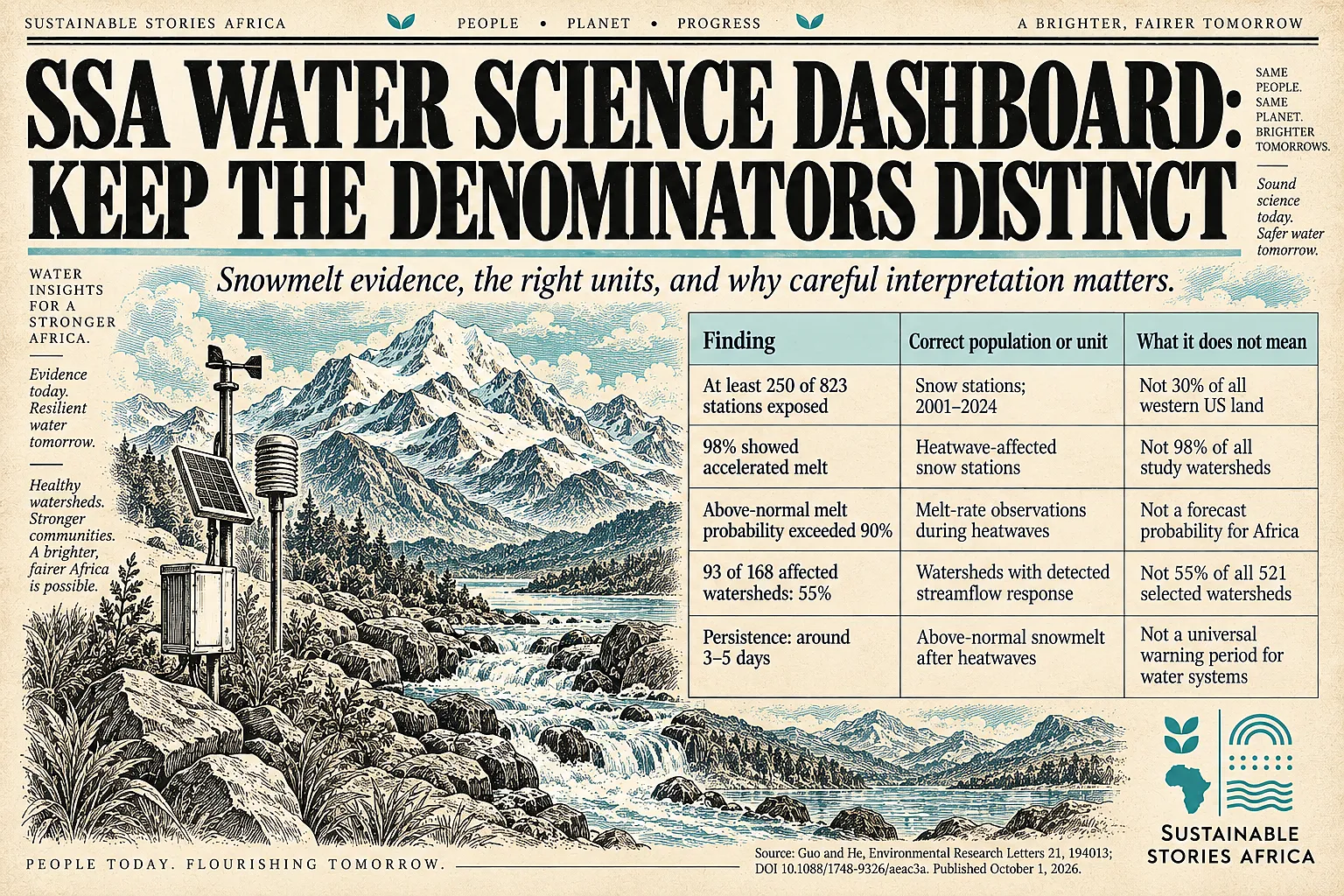
Heatwaves accelerated snowmelt at 98% of affected snow-monitoring stations in a western United States study.
However, corresponding streamflow fluctuations in only 55% of affected headwater watersheds.
- The finding highlights a critical planning distinction: a strong response at one monitoring point does not automatically produce the same response across a river basin.
Haonan Guo and Siwei He of Montana State University analysed observations from 2001 to 2024.
Their paper, published in Environmental Research Letters on October 1, examines how short heat events affect snowpack and subsequent river discharge, rather than assuming event-scale behaviour from long-term warming trends.
The research is not an Africa-wide water forecast.
- Its value for African decision-makers is methodological: connect a measured hazard to the relevant water system, check the mechanism and avoid transferring percentages between different physical environments.
The observations reveal two different scales
The researchers used snow water equivalent records from 823 Snow Telemetry stations, temperature information, river gauges and satellite snow-cover data.
- At least 250 snow stations, about 30% of those studied, experienced heatwaves at least once during the 24-year observation period.
- Almost all of those affected stations showed faster-than-normal melt.
Over the periods, the probability of snowmelt exceeding the normal rate rose from around 50% to more than 90%.
- That probability is different from the 98% station-level finding: one describes the distribution of melt rates during heatwaves, while the other describes the share of affected stations showing acceleration.
The effects also persisted after the heat events.
- Snowmelt remained above normal for around three to five days, with longer persistence in spring.
- This indicates that the relevant monitoring window may extend beyond the last unusually hot day.
For streamflow, the researchers selected 521 headwater watersheds.
- Of those, 168 experienced heatwave impacts at least once; 93 of the affected watersheds showed the streamflow fluctuations the study assessed, equivalent to 55%.
The authors emphasise the importance of spatial overlap between heatwave-affected areas and snow cover.
- Faster local melt alone did not ensure a detectable positive basin-scale response.
Better decisions require the right system boundary
For African water institutions, the broader lesson is to define what a piece of climate evidence can actually support.
- A temperature anomaly, a reservoir observation and a household supply interruption describe different parts of a system.
- A credible assessment must explain the connections between them rather than treat them as interchangeable indicators.
That matters when communicating research from another region.
- The US percentages should not be presented as expected African impacts.
- Their interpretation depends on the study’s snow-dominated environments, event definition, monitoring networks and selected watersheds.
A useful local application would identify the service or asset at risk, determine which physical processes matter and test the link using relevant observations.
- It could also examine whether the monitoring period captures delayed effects.
- These are analytical lessons, not claims that African basins respond like those examined by Guo and He.
The potential benefit is more credible investment and operating decisions.
- Planners can target measurement gaps and explain uncertainty, while readers can better distinguish between an environmental signal and an established consequence for water availability.
Monitor the pathway, not one headline indicator
Water agencies, infrastructure operators and financiers should ask impact assessments to state their geography, observation period and unit of analysis.
- If a project uses evidence from elsewhere, its authors should explain why the mechanism is relevant and which numerical findings cannot be transferred.
The study also supports caution about timing.
- Its three-to-five-day persistence finding is specific to the observed snowmelt process, but it illustrates why an assessment should test whether effects continue after a hazard ends.
- Monitoring plans should follow the local process, not assume that all consequences occur simultaneously.
For communicators, the immediate task is precision: distinguish stations from watersheds, acceleration from discharge and observed associations from universal predictions.
- That discipline can make climate reporting more useful without diminishing the significance of the underlying research.
That distinction matters for the project appraisal as much as the headline.
- A clearly bounded finding can inform a defensible decision; an overstretched comparison can create confidence the local evidence does not justify.
Path Forward – Measure Local Hazards Before Transferring Conclusions
The research shows that heatwave-driven snow loss and river discharge do not move in a simple one-to-one relationship across the studied basins.
African planners should apply analytical discipline rather than import the percentages: identify the mechanism, use local observations and communicate uncertainty.
Stronger evidence about how hazards reach water services can support more defensible adaptation decisions.