15 financial institutions are urging the International Sustainability Standards Board to develop a dedicated Nature Standard as consultation opens on nature-related disclosures.
The investors want comparable information on how businesses depend on, affect and face financial risks from nature.
For African companies and financiers, the debate raises a practical question: how should water, land and ecosystem pressures enter corporate reporting and investment decisions?
Investors press for a stronger baseline
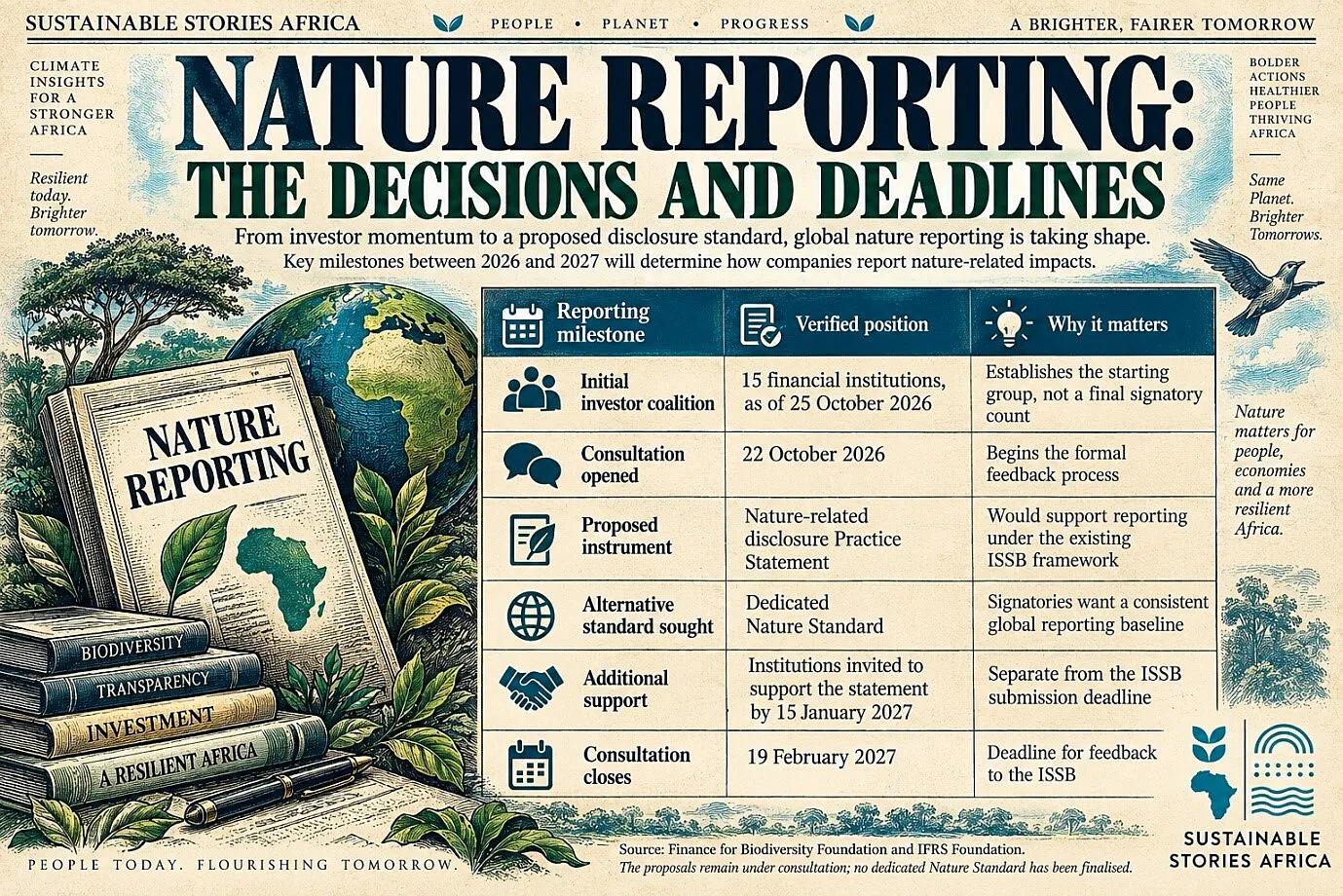
An initial group of 15 financial institutions has called for a dedicated global Nature Standard, arguing that investors need more consistent information on companies’ nature-related dependencies, impacts, risks and opportunities.
Their intervention follows the International Sustainability Standards Board’s launch of a consultation on 22 October, with responses due by 19 February 2027.
The Finance for Biodiversity Foundation and its members presented their statement to ISSB board member Sue Lloyd at COP17.
- Signatories include Storebrand Asset Management, Federated Hermes Limited, Rabobank, Nordea Asset Management and Domini Impact Investments.
- The foundation announced the initiative on 25 October.
At issue is not whether nature can affect business performance, but how companies should explain that exposure, and whether the proposed reporting instrument will provide a sufficiently consistent global baseline.
What the consultation would change
The ISSB has proposed a Practice Statement to help companies provide material information about nature-related risks and opportunities.
- It is also asking whether the content should instead be issued in another form, including a dedicated Standard
That distinction matters.
- Companies would not need to apply the Practice Statement to claim compliance with ISSB Standards.
- However, IFRS S1 already requires companies applying it to disclose material sustainability-related risks and opportunities affecting their prospects, including those relating to nature.
The consultation therefore seeks greater specificity rather than creating nature-related financial reporting from nothing.
For the signatories, a dedicated Standard offers a clearer route towards comparable disclosure across markets.
They warn that voluntary approaches and the absence of a common baseline could leave investors navigating fragmented requirements and uneven information.
Bringing nature into investment decisions
For African markets, the connection is tangible.
- Water availability, land use and ecosystem conditions can influence the operating assumptions behind agricultural, industrial and infrastructure investments.
- A useful disclosure should connect those dependencies to business prospects rather than treat nature as a separate corporate responsibility narrative.
That is the financial-information relationship the ISSB proposals seek to clarify.
Sonya Likhtman, stewardship director at Federated Hermes Limited, said investors require “clear and coherent information” about companies’ nature-related impacts, dependencies, risks and opportunities.
She also cautioned that considering climate change without water, land use and pollution would leave investors with an incomplete picture.
The potential gain is better-informed capital allocation and stewardship.
- Comparable information can help investors distinguish companies that understand their exposures from those whose financial projections leave important dependencies unexplained.
It does not, by itself, establish that a company’s activities are environmentally sustainable.
Turning consultation into practical reporting
The foundation is urging governments and regulators to support a dedicated Standard and accelerate implementation of Target 15 of the Global Biodiversity Framework.
- It identifies voluntary reporting, data gaps and the absence of a global nature standard as continuing barriers.
For African regulators, companies and financial institutions, the consultation offers an opportunity to explain what decision-useful reporting requires locally:
- Relevant location information, workable assessment methods and clear links between environmental conditions and financial exposure.
The proposals include location-specific analysis and information gathered through engagement with affected stakeholders.
The immediate task is therefore substantive engagement, not premature claims of compliance with a standard that does not yet exist.
- Companies can assess existing reporting against IFRS S1
- While investors can identify the information gaps that most constrain their decisions.
Path Forward – Making Nature Count Financially
The next milestone is the consultation deadline on 19 February 2027.
The ISSB will consider feedback before deciding the final content and form of its nature-related disclosure work.
African stakeholders have an opening to shape that outcome around local operating realities.
The objective is reporting that connects nature-related dependencies and impacts to material financial risks and opportunities, not another disconnected sustainability checklist.