LinkedIn’s Global Green Skills Report 2026 warns that demand for green talent is growing faster than workforce supply, threatening climate delivery and economic opportunity.
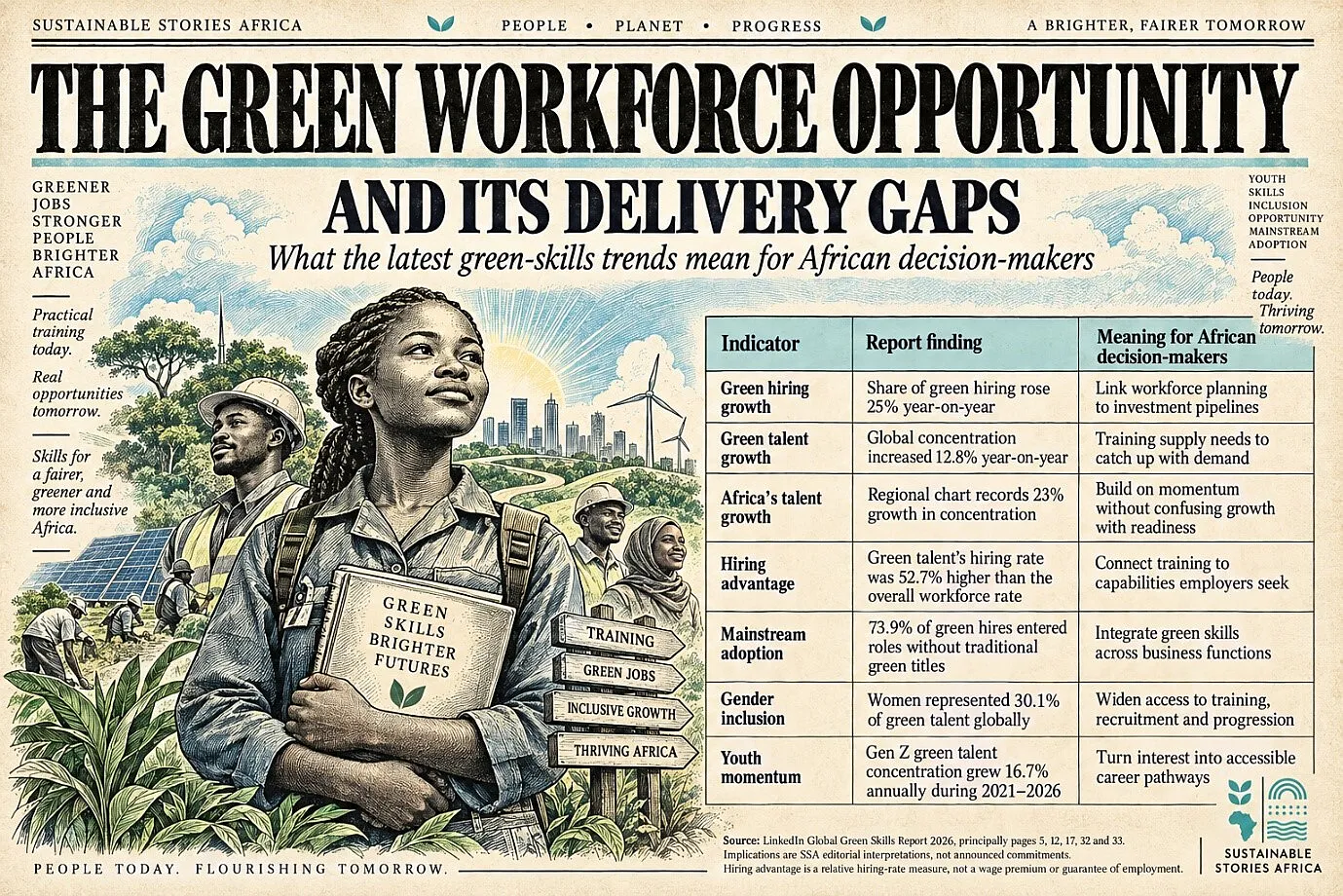
The share of green hiring rose 25% year-on-year, compared with approximately 13% growth in green talent concentration.
For African economies, the findings underline the importance of connecting energy investment, education and recruitment so workers can access opportunities across existing occupations, not only specialist sustainability roles.
Skills shortages threaten the transition’s delivery
Employer demand for green talent is outpacing workforce supply across every industry examined by LinkedIn, raising concerns that skills shortages could constrain climate action, infrastructure delivery and economic growth.
The company’s Global Green Skills Report 2026 finds that the share of green hiring increased 25% year-on-year, while green talent concentration, the proportion of members classified as green talent, grew approximately 13%.
- The widening mismatch puts workforce development alongside finance and technology as a condition for delivering the transition.
For African policymakers and businesses, the report points to a practical challenge: investment plans need people capable of building, operating and maintaining the systems being financed.
- LinkedIn’s regional chart records 23% growth in Africa’s green talent concentration between 2025 and 2026, although different starting levels mean growth rates should not be treated as rankings of workforce readiness.
“Green skills are no longer a niche.
- They're how businesses build efficiency, manage risk, and stay competitive,” said Sue Duke, LinkedIn’s head of global public policy, in the report.
“Ambition alone won't upgrade a grid, retrofit a home, or make a data center more efficient people will.”
Demand extends beyond sustainability job titles
The shortage is not confined to environmental specialists.
- Nearly three in four green hires, 73.9% entered roles without traditional green job titles, showing how these capabilities are spreading into finance, procurement, technology, manufacturing and operations.
Manufacturing illustrates the pressure.
- Between 2021 and 2026, its share of green hiring grew 15.2% annually, compared with 10.2% growth in green talent concentration.
- Transportation, logistics, supply chain and storage recorded corresponding growth rates of 14.5% and 11.0%.
These gaps matter because weaknesses in production and distribution can affect the wider value chains they serve.
Existing careers offer routes into opportunity
The report’s findings suggest that workers do not necessarily need to abandon their professions to participate.
- Relevant training can add carbon accounting to finance, responsible sourcing to procurement, or low-carbon technology knowledge to skilled trades.
- Employers can similarly develop existing staff rather than compete exclusively for a limited specialist workforce.
Efficiency provides a particularly practical entry point.
- Skills in LinkedIn’s waste prevention category account for more than one-quarter of green skills globally.
- Operational efficiency, maintenance and process optimisation connect environmental objectives with the commercial need to use energy, materials and equipment more effectively.
Digital infrastructure is strengthening that connection.
- The median share of data-centre talent with at least one green skill increased from 3.9% in 2021 to 13.8% in 2026.
- LinkedIn argues that AI, digital, operational and green capabilities should increasingly be developed together, rather than treated as separate workforce priorities.
Training must translate into accessible employment
Access remains uneven.
- Women account for only 30.1% of green talent globally. Meanwhile, Gen Z is building green capabilities faster than other generations, but 54% of Gen Z respondents in LinkedIn’s survey said finding a green job was difficult.
- Interest alone is not overcoming barriers involving experience, opportunities and skills.
- LinkedIn recommends embedding green capabilities in existing qualifications and apprenticeships, expanding paid and work-based training, and recruiting around demonstrable skills.
- It also calls for climate, energy, labour, education and industry agencies to develop shared workforce plans and measure whether training produces employment and career progression.
For African markets, the implication is to link training decisions to identifiable employer needs and investment pipelines.
- The report also cautions that renewable-energy deployment does not automatically generate local jobs; workforce, industrial and supply-chain strategies must help economies capture that value.
The evidence nevertheless requires qualification.
- LinkedIn’s findings reflect its membership, not a census of African labour markets. Its revised definition classifies green talent as members with at least two green skills or a green job title, applied retrospectively to 2021.
The hiring advantage signals an association, not proof that acquiring a skill alone causes employment.
Path Forward – Turning Green Skills Into Shared Prosperity
African governments, employers and training providers should link climate investment with workforce planning, embed relevant capabilities across existing occupations, and assess success through employment and progression, not training enrolment alone.
Paid learning opportunities, skills-first recruitment and clearer pathways for women and young people can widen participation.
The objective is to ensure that investment in cleaner, more resilient systems also builds the local capabilities needed to deliver and sustain them.